
Biotech crops and pesticide reduction have become critical topics in global agriculture as farmers seek sustainable ways to protect crops while reducing chemical use.
The Rome-based Food and Agriculture Organization (FAO) of the United Nations estimates that up to 35% of the losses in the annual crop production worldwide are due to pests – insects, weeds, plant diseases, rodents and birds. Of the estimated one million insects in the world, between 150 to 200 species frequently cause serious damage to crops.
When losses due to pests are combined with postharvest losses, worldwide food losses would amount to 45%. “This is almost one half of the world’s potential food supply,” the FAO pointed out.
This is the reason why most farmers around the world use pesticide to control these pests. For a long time, no one seemed to question the safety of pesticides. Not until 1962, when marine biologist and writer Rachel Carson wrote the now classic Silent Spring. In her book, she described how pesticides cause long-term hazards to birds, fish, other wildlife, and humans, but provides only short-term gains to controlling the pests.
Despite her findings, pesticide use continues to soar. “Farmers now apply abut one pound of pesticides per year for every person on the planet, 75% of it in industrial countries,” Peter Weber, a researcher with the Washington-based Worldwatch Institute reported some years back.
In the Philippines, most farmers are using chemicals to control pests that attack rice. “Pesticides are like bombs being dropped in the food web creating enormous destruction,” said entomologist Dr. K.L. Heong, who once worked with the International Rice Research Institute.
Pesticides are killing more than just the pests. “Some pesticides harm the living organisms other than the targeted pest,” observed the Davao-based Technical Assistance Center for the Development of Rural and Urban Poor. “Some travel to the food chain to bioaccumulate in higher organisms.”
Health experts claim pesticides can enter the human body through the lungs, digestive system, or skin. Depending on the pesticide, health effects can be immediate (acute) or they can occur after years of lower-level exposure.
Long-term effects of pesticides include skin disorders, damage to internal organs (liver, kidneys, lungs), increased sensitivity to pesticides and effects on the progeny.
Now, if Filipino farmers want to stop using pesticides to control those attacking their agricultural crops, all they need to do is plant biotech crops.
A report from the International Service for the Acquisition of Agri-Biotech Applications (ISAAA) said farmers who planted biotech crops have reduced pesticide spraying.
There was a “decreased environment impact from herbicide and insecticide use by 19%,” the report said. From 1996 to 2015, there was a reduction of pesticide applications by 8.1%. In 2015 alone, a reduction by 6.1% was noted, it added.
The reduction was made possible through the use of biopesticides. For years, many organic farmers have used a bacterial pesticide called Bt to control a variety of pests that attack agricultural crops.
Bt stands for Bacillus thuringiensis, a common soil bacterium so called because it was first isolated in the Thuringia region of Germany. It produces a protein that paralyzes the larvae of some harmful insects.
Scientists, through genetic engineering, have taken the Bt gene responsible for the production of the insecticidal protein from the bacterium and incorporated it into the genome of plants. As such, the plants have a built-in mechanism of protection against targeted pests.
Aside from corn, Bt is also introduced in cotton, poplar, potato, rice, soybean, tomato, and more recently eggplant. “The protein produced by the plants does not get washed away, nor is it destroyed by sunlight,” said a briefing paper published by the Global Knowledge Center on Crop Biotechnology. “The plants are protected from the insects round the clock regardless of the situation.”
Since Bt crops are able to defend themselves against pests, the use of chemical insecticides is significantly reduced. A study conducted by the United States Department of Agriculture showed that 8.2 million pounds of pesticide active ingredients were eliminated by the farmers who planted Bt crops in 1998.
Currently, there are more than 200 types of Bt proteins identified with varying degrees of toxicity to some insects.
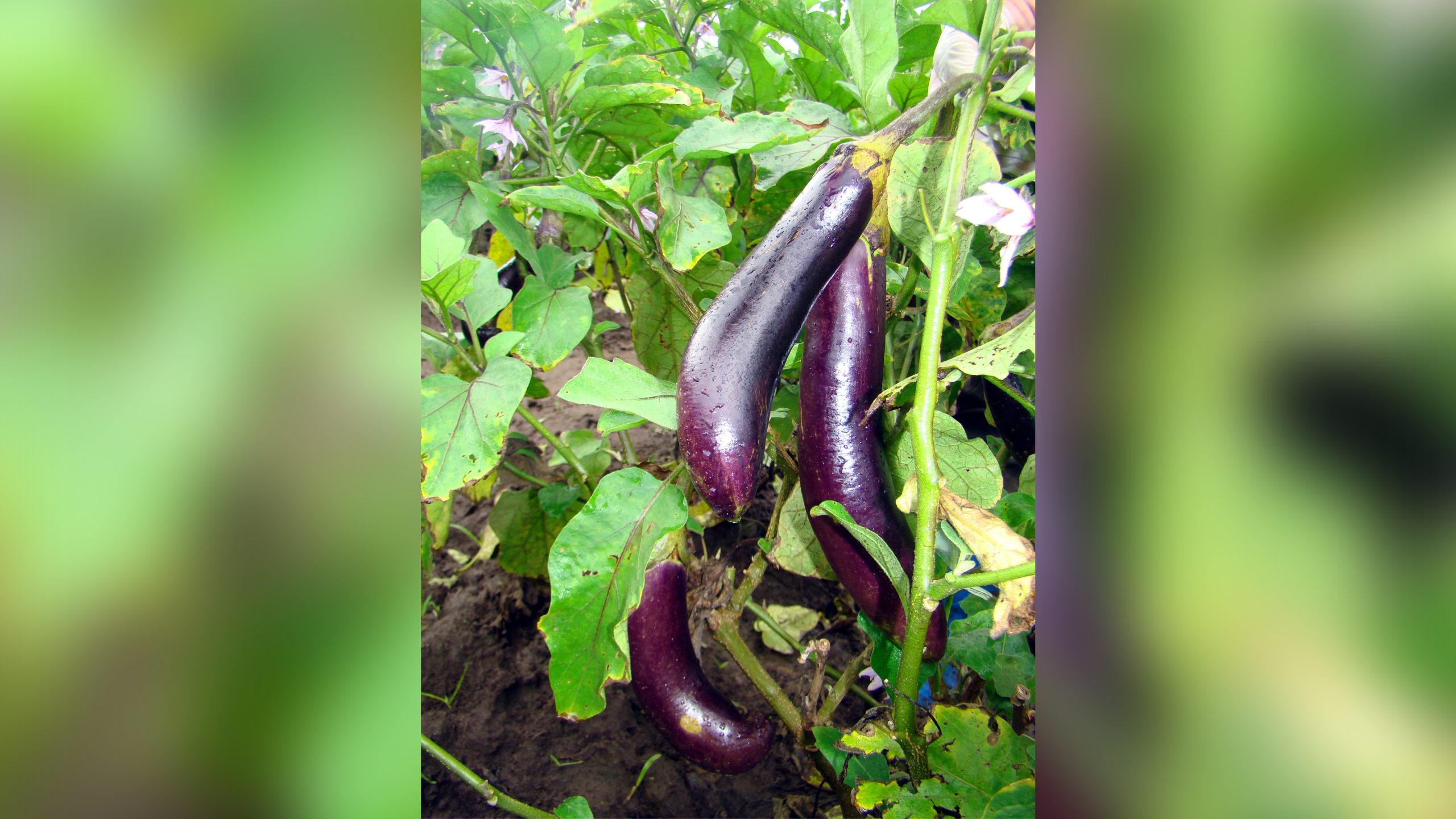
A recent report said that the Philippines stands to be a global forerunner in healthful, pesticide-free growing of traditionally intensively-sprayed eggplant. The country is among the world’s top 10 eggplant production with a production of around 200,000 metric tons annually.
In the past, Filipino farmers spray every other day or 60-80 times in an entire four-month eggplant cropping season. They do this to eliminate the highly infesting moth “fruit and shoot borer” (FSB).
Damage caused by the FSB, whose larva consumes the inner part of the eggplant, results to nearly 80% of yield loss, especially during the high incidence of infestation.
But thanks to Bt eggplant, they can now do away with pesticide spraying by as much as 100%. “Producing the no toxin-laden eggplant is now possible,” the report said.
“Researchers on Bt eggplant from the University of the Philippines at Los Baños have experimentally demonstrated that it is effective, and the use of this technology can dramatically reduce the current use of toxic chemical insecticides,” pointed out Dr. Eufemio T. Rasco, Jr., an academician at the National Academy of Science and Technology.
A field trial was also conducted in two barangays in Pangasinan, the country’s biggest eggplant producer.
“All throughout three trials, the superior efficacy of Bt eggplant in stopping by virtually 100% infestation of FSB was observed in the three eggplant varieties tested – Dumaguete Long Purple, Mara, and Mamburao,” the report said. “All three varieties – unsprayed by insecticides – were planted both for Bt eggplant and non-Bt eggplant.”
Dr. Desiree M. Hautea, who led the study, concluded: “Commercial production of Bt eggplant has great potential to reduce yield losses to FSB while dramatically reducing the reliance of growers on synthetic insecticides, reducing risks to the environment, to worker’s health, and to the consumer.”
Their report was filed with the peer-reviewed journal PLOS (Public Library of Science).
Meanwhile, ISAAA said that while biotech crops are essential, they “are not a panacea.” It explained: “Adherence to good farming practices, such as rotations and resistance management, are a must for biotech crops as they are for conventional crops.”

 Facebook
 Twitter