
Methane release in farming is a major contributor to climate change, but farmers can adopt practical strategies to significantly reduce emissions.
(Second of Two Parts)
“If we control methane, which is viable, then we are likely to soften global warming more than one would have thought, so that’s a very positive outcome.” – Dr. Drew Shindell, a climatologist at NASA’s Goddard Institute for Space Studies, Columbia University in New York
***
“Over the last 30 years, methane has gone from being a gas of no importance, to — in some researchers’ eyes, at least — possibly the most important greenhouse gas both for understanding climate change and as a cost-effective target for future emission reductions,” said Dr. Gavin Schmidt, a research scientist at the NASA Goddard Institute for Space Studies and Center for Climate Systems Research, Columbia University in New York.
Unknowingly, methane also contributes to the depletion of the ozone layer, which acts as a shield against the deleterious radiation of the ultra violet rays of the sun. The ozone layer is the upper atmospheric layer of air above the earth.
Although non-toxic, colorless and odorless gas, methane is highly combustible. At room temperature, methane is a gas less dense than air. It melts at –183°C and boils at –164°C. It is not very soluble in water. Methane is combustible, and mixtures of about 5%-15% in air are explosive.
Some scientists claim that a holocaust is likely to happen should methane violently reactive with oxidizers, halogens and some halogen-containing compounds. Earth’s atmosphere is made up of 21% free oxygen, and some 2% of halogen and halogen compounds.
One environmentalist post this alarming information in his blog: “If global warming continues unchecked, and the regions of the earth where there is a 5-15% concentrations of methane gas in the atmosphere reaches the temperature of 53 degrees Celsius, which is the flash point of methane gas, it could result in a spontaneous ignition of atmospheric gases and wreak unimaginable destruction to our planet.”
One of the reasons why methane concentration in the atmosphere keeps increasing is due to food production. There’s no end in hindsight. A report from www.theconversation.com stated: “Food production will continue to grow strongly to meet the demands of a growing global population…”
Way out
Is there a way out? “If we cut methane emissions now, this will have a rapid impact on methane concentrations in the atmosphere and therefore on global warming,” the report observed.
Rice cultivation is a good start. Flooded rice paddies emit as much as 500 million tons of methane, around 20% of total manmade emissions of this gas, according to the Laguna-based International Rice Research Institute (IRRI).
Scientists explain that long-term flooding of the fields cuts the soil off from atmospheric oxygen and causes anaerobic fermentation of organic matter in the soil. During the wet season, rice cannot hold the carbon in anaerobic conditions. The microbes in the soil convert the carbon into methane which is then released through the respiration of the rice plant or through diffusion of water.
On the other hand, decomposition of organic material in flooded rice fields produces methane, which then escapes to the atmosphere during the growing season. “Traditionally, farmers flood their rice fields continuously and incorporate 4-5 tons of rice straw per hectare at land preparation,” says a report released by the Philippine Council for Agriculture, Aquatic and Natural Resources Research and Development (PCARRD). “Every year, these practices release 5,883 tons of methane to the atmosphere.”
In Isabela State University, a study funded by PCARRD showed that by using simple science-based strategies, farmers can contribute significantly to the reduction of methane emissions. For instance, mid-season drainage of irrigation water reduced methane emission by 48 percent. This emission is valued at P34.16 million, based on the 2009 World Bank price of US$12 per ton of carbon dioxide and exchange rate of P48 per US$1.
Meanwhile, composting of rice straw resulted in 64 percent less methane emission released in the air. By combining mid-season drainage and application of rice straw compost, methane emission is further reduced by 81 percent.
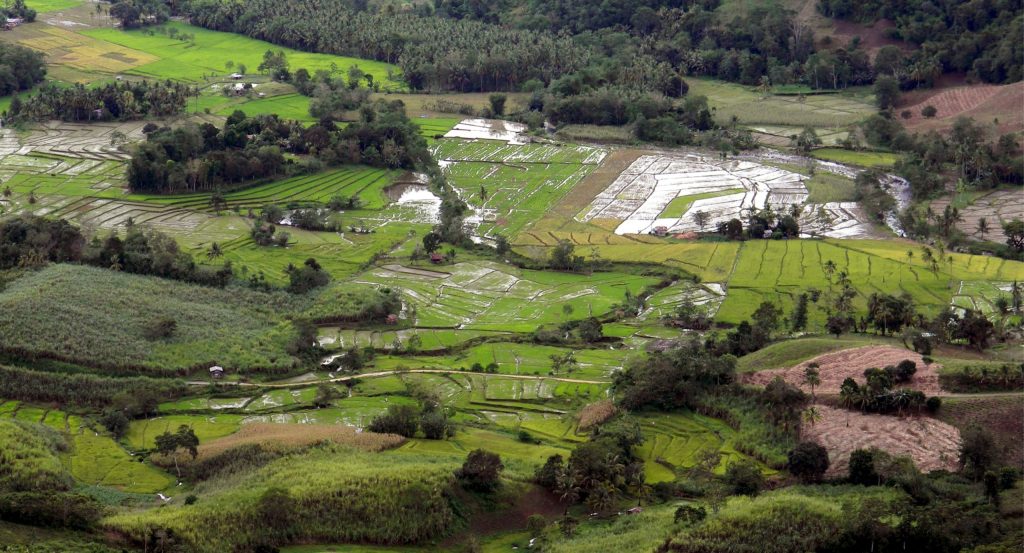
“By shifting to climate-change friendly farming practices, as what was done in the 7,789.34 hectares of lowland irrigated rice in Isabela, farmers can get incremental benefits amounting to as high as P138.95 million per year,” the PCARRD report points out.
Alternate wetting and drying
Rice farmers can also help reduce methane emissions into the atmosphere by adopting controlled irrigation or alternate wetting and drying (AWD) technology.
Developed by the Laguna-based International Rice Research Institute (IRRI), AWD is a technology which allows rice fields to dry for a certain period before applying irrigation water.
Also called controlled irrigation or intermittent irrigation, AWD technology can actually save farmers almost one-third of irrigation water without sacrificing yields. It also saves farm inputs like oil, fuel, and labor being utilized on the operation of water pumps.
In an 8-season field experiment conducted at IRRI, it was found that AWD “has real potential to reduce the global warming impact of paddy fields to one-third of the conventional continuously-flooded field water management.”
In a paper presented during the international workshop on “Water Management and Technology for Crop Production under Climate Change” in Suwon, Korea, the authors claimed AWD “can reduce methane emissions by over 40%.”
Rice fields using this technology are alternately flooded and dried. The number of days of non-flooded soil can vary from one day to more than 10 days, according to IRRI. It uses an “observation well” that is made of bamboo, plastic pipes, or any hollow indigenous material. Perforations are made in the lower half of the tube.
The AWD technology can be started a few days after transplanting (or with a 10-centimeter tall crop in direct seeding). When many weeds are present, AWD can be postponed for 2-3 weeks until weeds have been suppressed by the ponded water. Local fertilizer recommendations for flooded rice can be used. Nitrogen fertilizer may be applied preferably on the dry soil just before irrigation.
“A practical way to implement AWD technology is by monitoring the depth of the water table in the field using a simple perforated field water tube,” IRRI explains. “When the water level is 15 centimeters below the surface of the soil, it is time to flood the soil to a depth of around 5 centimeters at the time of flowering, from one week before to one week after the maximum flowering.”
The water in the rice field is kept at 5 centimeters depth to avoid any water stress that would result in severe loss in rice grain yield. The threshold of water level at 15 centimeters is called “safe AWD,” as this will not cause any yield decline because the roots of the rice plants are still able to take up water from the saturated soil and move it to the root zone.
“The field water tube used in this technology will help to measure the water level in the field so that incipient water stress in the rice plants can be anticipated,” the IRRI points out. As such, the AWD technology does not only save water but can greatly reduce emissions of methane.
Rice-duck scheme
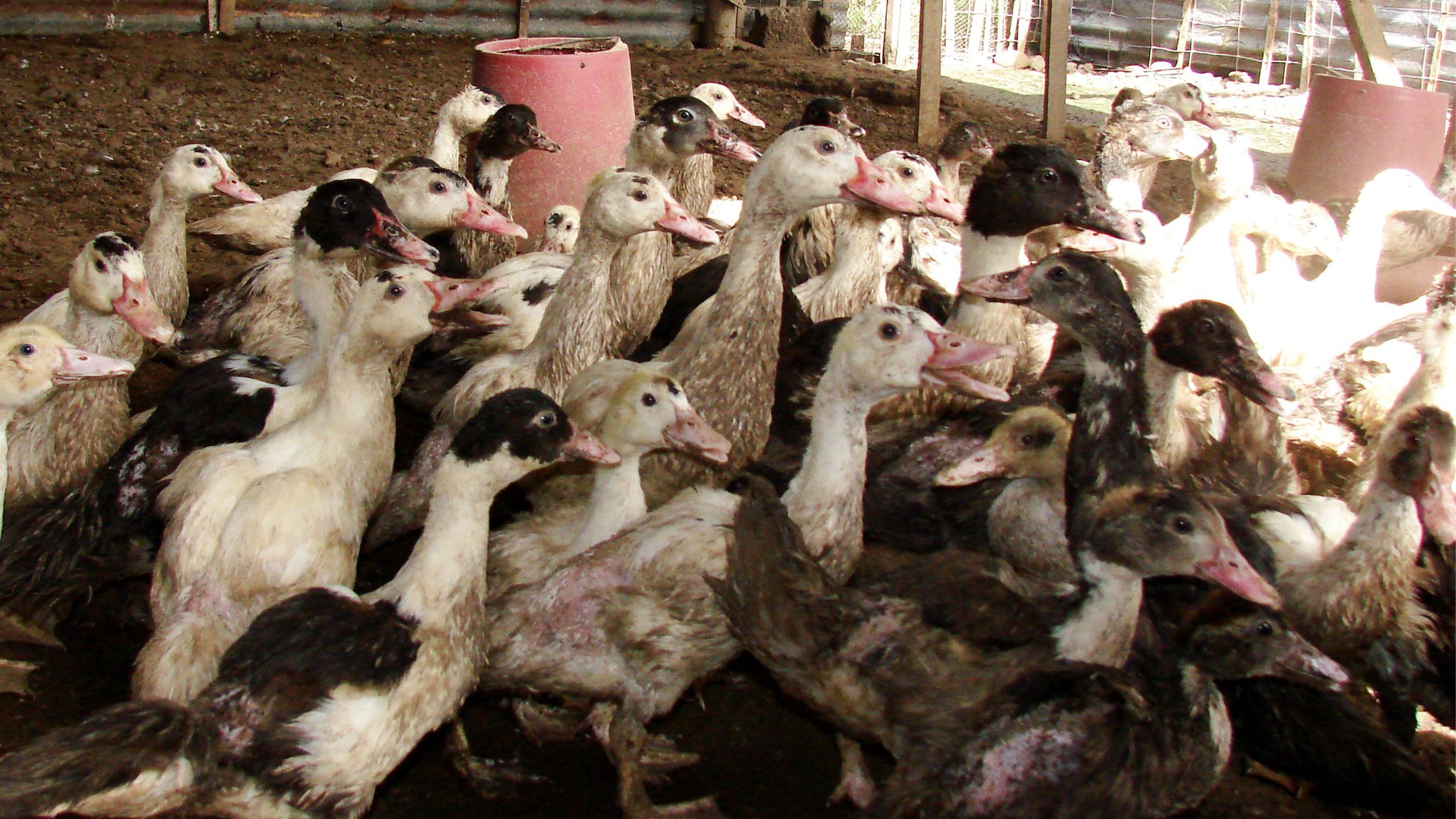
In Zamboanga del Sur, farmers release ducks after rice harvesting. Nonoy E. Lacson, in a report, wrote: “Under the system, ducklings are released to rice fields to graze and feed. The paddling movement of the ducks in the rice fields increases the rice tillers, in effect raising annual yield by as much as 10 to 15 percent. Besides their paddling, ducks also eat the insects and unwanted weeds in the rice field.”
According to the agriculture department, the integrated rice-duck farming system is one of the best strategies in increasing rice productivity as it reduces labor and inputs characterized by its devoid use of artificial fertilizers and chemicals. Thus, the shift from the conventional way of planting using inorganic materials to this technology provides an additional source of income and food to farmers.
The said technology is environmentally sound as it restores the relationship of people with nature. This is a sustainable system as it helps in eliminating the contamination of soil, water and air brought by chemical substances which are harmful to both nature and humans.
“The integrated rice-duck technology reduces the use of chemicals,” the agriculture department points out. “Since ducks are grown alongside rice paddies, they eat harmful pests at the same time their dung fertilizes the soil. Their paddling movement cultivates the soil and destroys the weeds. Its benefits to the farmers are immediately felt and tangible.”

 Facebook
 Twitter