
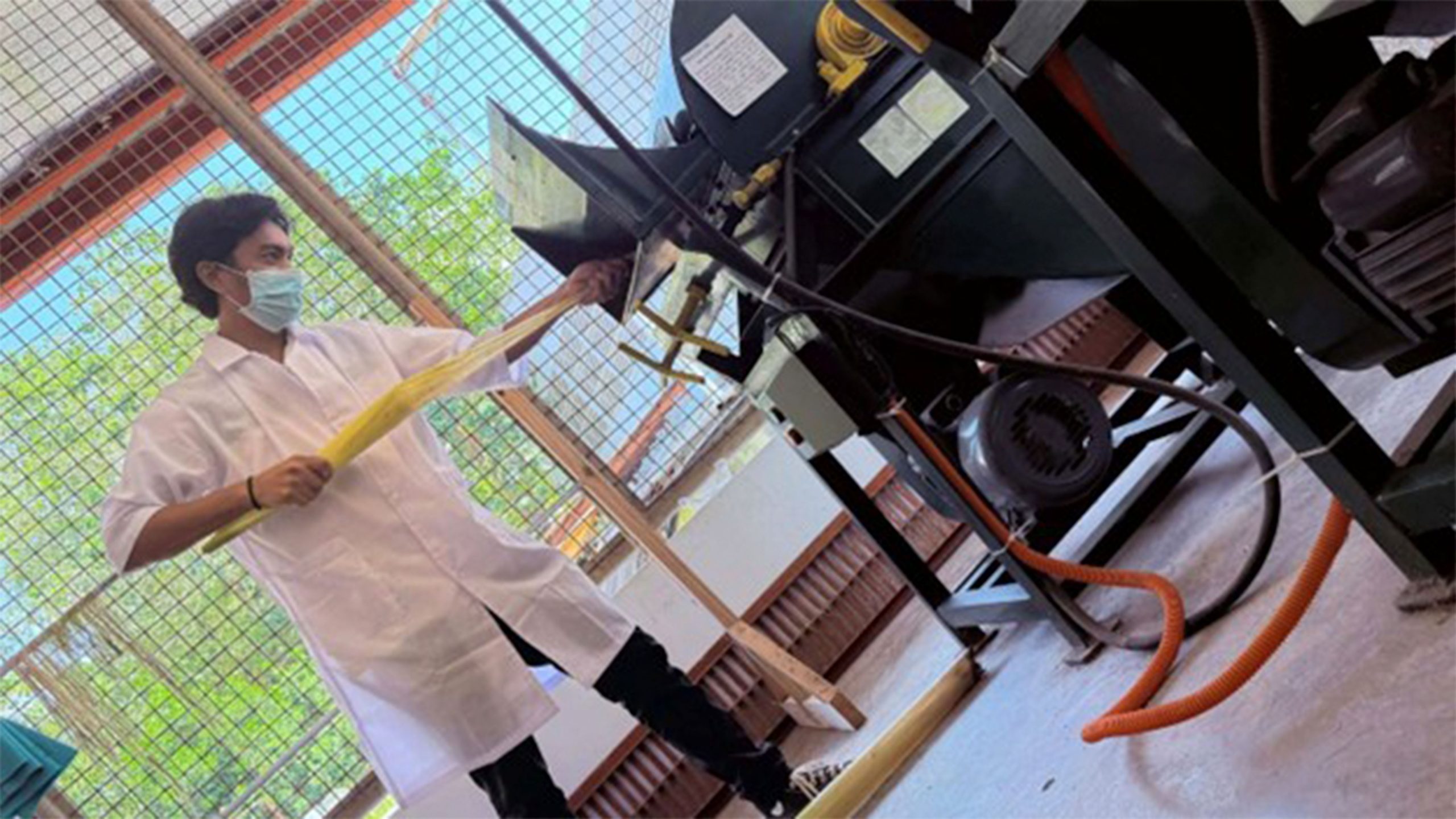
Natural Textile Fiber Innovation Hub Laguna marks a significant step in advancing sustainable textiles in the Philippines, as the Department of Science and Technology officially launched the facility to support farmers, weavers, and local industries through innovation and value-added production.
The Department of Science and Technology–Philippine Textile Research Institute (DOST-PTRI) officially launches on April 16, 2026, the Natural Textile Fiber Innovation Hub (NTFIH) Laguna at the Laguna University in Sta Cruz, Laguna, marking a major step in advancing sustainable textiles and local livelihoods.
The facility is the third Natural Textile Fiber Innovation Hub in the country, aimed at transforming agricultural by-products such as abaca, banana, and pineapple fibers into high-value textile products while integrating local communities into the value chain. It can process a maximum of 40 kilograms of natural fibers for yarn production in the area.
DOST-PTRI Director Julius Leaño underscored the hub’s role in moving the country up the value chain: “That is exactly the point of why we are here. We are trying to extend the supply and value chain such that we do not just export raw materials, we export higher-value products. So, ang mga materyales po natin, hindi lumalabas na ang presyo ay halos kalahating dolyar na kada kilo, but instead we convert them into materials that are of higher value, of higher impact, to both commerce, trade, and of course, sustainability in human consumption.”
He also highlighted Laguna’s strategic advantage in terms of sustainability and logistics.
“When we made a new run of the analysis of the fibers, ang number one selling point ng fiber from Laguna ay hindi po quality ng hibla; it is the carbon footprint. Dahil napakalapit po n’ya sa Metro Manila. And if you compute the carbon footprint of the fiber that will come from Mindanao, compared to the fiber that will come from the nearby provinces in CALABARZON, mataas ang advantage niya sa carbon footprint,” he said.
DOST Secretary Renato U. Solidum Jr. further emphasized the importance of innovation that delivers real impact, “But beyond strategies and frameworks, what matters most is impact. And so, we ensure that the technologies we develop create quality jobs. The establishment of NTFIH Laguna is going to serve a catalytic purpose in integrating small players within the regional textile value chain. It will provide a business model for investors who can replicate and expand its current capacities and is positioned as an innovation hub where knowledge in textile materials and engineering can continue to grow.”
Further, DOST Undersecretary for Regional Operations Engr. Sancho A. Maborrang echoed these sentiments, saying, “Hindi lamang po kami nag-i-establish ng mga innovation hubs and facilities, but we are also looking into sino [ho] ba ang magbe-benepisyo ng ating mga ginagawa… Ito po ay magtatangkang mag-create ng livelihood, and eventually mag-create ng employment, mag-create po ng mga world-class textiles and probably uniforms in the near future, such as dresses and wardrobes that will be used by Filipinos.”
Meanwhile, Solidum earlier encouraged communities to see value in waste materials, “Kapag may nakita tayong waste, huwag agad isipin na patapon na. Isipin natin: pera ’yan… puwedeng-puwede pang pagkakitaan o gawing bagong produkto.”
In an interview, Jhomier Casaul, a field worker from Villa Socorro Farm in Pagsanjan, Laguna, said that the establishment of the NTFIH Laguna facility will surely help them streamline their work and boost the yarn production in the area.
Meanwhile, Governor Sol Aragones, through Provincial Administrator Carina F. Macalos assured continued provincial support for the initiative and its long-term development.
“Sana ang ambition po ng ating pamunuan ay magtuluy-tuloy, hindi lang maging umpisa ito, pero ma-strategize pa natin, ma-streamline natin yung mga programs, at maituluy-tuloy po natin itong pag-take off ng ating programa para matulungan natin ang ating mga magsasaka, matulungan natin ang living industry na umunlad,” she said.
The provincial government also committed to pushing collaborations with academic institutions such as the University of the Philippines Los Baños and Laguna University to use locally sourced textile fibers to produce university sablay (academic sash). Sta. Cruz, Laguna Mayor Joseph Kris Benjamin B. Agarao, along with Fourth District of Laguna Representative Benjamin C. Agarao, Jr., also expressed their strong support for the initiative.
Moreover, during the facility tour, it was revealed that water hyacinths from Laguna de Bay are currently undergoing testing for yarn production, with promising results emerging so far.
The NTFIH Laguna is expected to support micro, small, and medium enterprises (MSMEs), generate jobs among local farmers and weavers, and strengthen the country’s sustainable textile industry by linking research, innovation, and community-based production.
It is also one of the initiatives of the Department of Science and Technology (DOST) aimed at providing science-based, innovative, and inclusive solutions across four strategic pillars: human well-being, wealth creation, wealth protection, and sustainability. These pillars embody the mantra OneDOST4U: Solutions and Opportunities for All.

 Facebook
 Twitter