
Words and Photo by Henrylito D. Tacio`
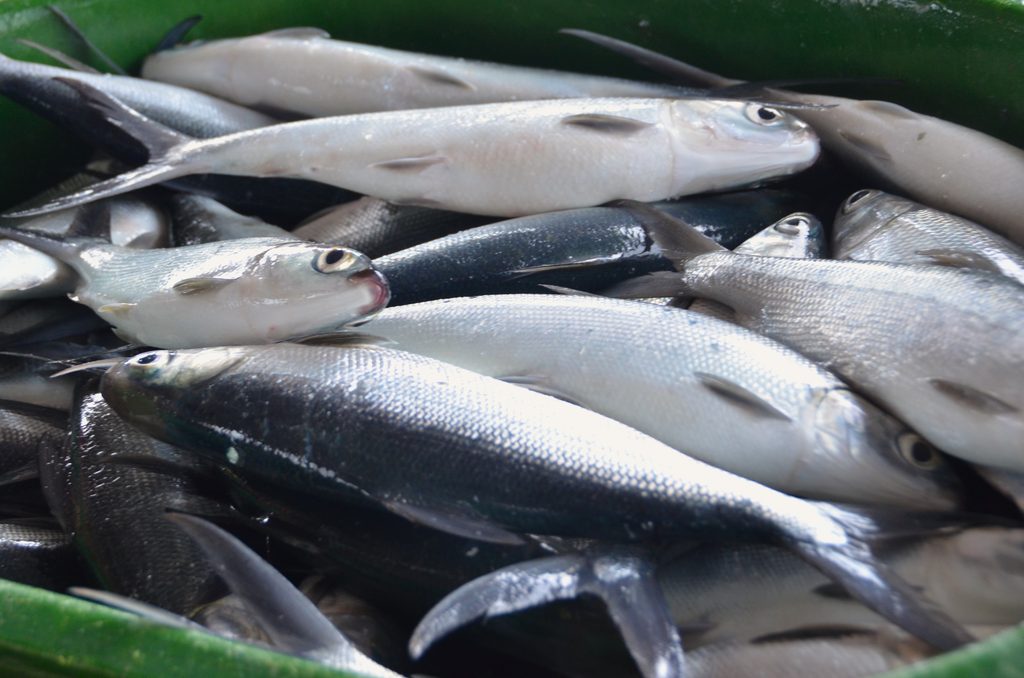
If there’s one fish that most Filipinos love, it’s none other than milkfish, or more popularly known as bangus (scientific name: Chanos chanos). The undisputed national fish is the most preferred fish because of its mild, sweet flesh, and its melt-in-the-mouth belly fat.
“We love bangus because it is white and nice to eat whether roasted, fried or stewed,” summed up Dr. Rafael D. Guerrero III, an academician with the National Academy of Science and Technology (NAST). “Besides, it can be made boneless.”
The popularity of bangus can be gleaned in such recipes as bangus en toncho (fried bangus served with a sauce of any of the following: tahure, tokwa, or tausi), bulanglang na bangus (with eggplants, ampalaya, sitao, malunggay, onion, tomatoes, rice washing and bagoong), rellenong bangus (a party dish in the past but is now available even in school cafeterias and malls), and bangus lumpia.
So much so that most of the bangus produced in the country are basically for domestic consumption only. Bangus products are either sold fresh and/or frozen – and they are served anytime of the day: breakfast, lunch, or dinner.
Although bangus is very popular among Filipinos, production is still low. One reason is that there’s a lack of bangus fry (seed) to supply the needs of fish cage operators as the country is dependent on imported fry from neighboring countries.
Normally, bangus fry appears in different places and various seasonal peaks. Areas like Southern Leyte, Western Samar, Bohol, Negros Oriental and Occidental, Antique, and Iloilo have two peak seasons: March to July and October to November. Provinces like Cotabato and Zamboanga del Sur have fry available year-round.
“The shortage of milkfish seeds is more pronounced between November and February when the weather becomes too cold for breeders to lay eggs,” said the Iloilo-based Southeast Asian Fisheries Development Center (SEAFDEC).
Data from Philippine Statistics Authority showed 446,382.19 metric tons of bangus fry were produced in 2021. About 205,354 metric tons came from local resources while the remaining 245,354 metric tons were sourced from Indonesia.
Aside from being expensive, “imported milkfish fry are also known to perform poorly compared to those that are locally-produced,” said SEAFDEC.
Now, the good news. A milkfish project of the University of the Philippines Visayas (UPV) targets to address the insufficient supply of milkfish fry caused by high importation rate and low survival of hatchery-produced fry.
The project, “Improvement of Milkfish Larval Rearing and Nursery Culture through Gut Metagenome, Transcriptome Analysis, and Gut Microbial Community Manipulations” primarily aims to explain the microbiotic factors and their roles in the physiology of milkfish larvae and juveniles using metagenomic and transcriptome techniques.
Metagenomics is a study of the genetic material of a species to understand the connection of microorganisms to the environment and their health.
“By examining the gut metagenomic composition of milkfish fry and juveniles, along with evaluating the influence of the gut microbiome on overall larval physiology through transcriptome analysis, the project aims to uncover the mechanisms behind the physiological fitness of milkfish larvae,” explained Rizza B. Ramoran of the Science and Technology Media Services.
Transcriptome, on the other hand, is a collection of all the gene readouts present in a cell.
The project’s objective is “to employ this knowledge in designing improved rearing protocols to significantly boost milkfish hatchery productivity.” The Laguna-based Philippine Council for Agriculture, Aquatic and Natural Resources Research and Development (PCAARRD) is funding the study.
According to the backgrounder of the study, it was found that the country’s requirement for milkfish fry is close to 4 billion annually, but hatcheries can produce only 800 million fry per year at most because of insufficient broodstock to produce the fry. As such, a substantial 75% of the required milkfish fry is currently imported from Indonesia.
“The UPV has been observing industry challenges in milkfish production, particularly deformities and low survival rates of hatchery-produced milkfish fry in nursery ponds, in contrast to the better survival and yield of wild-caught milkfish fry,” wrote Rizza B. Ramoran of the Science and Technology Media Services.
“This difference,” she added, “is attributed to the potential lack of maintenance in genetic quality and genetic degradation of hatchery-reared milkfish fry.”
Recognizing the importance of gut microbiota in fish, the project seeks to study this further to potentially aid in selecting probiotics, prebiotics, and chemical compounds to enhance gut health and overall physical functionality of fish.
“Seen as significant alternatives, these can possibly reduce the reliance on antibiotics and can be a useful tool in developing rearing protocols for efficient hatchery production of milkfish larvae. This will be facilitated through a metagenomics approach,” Ramoran wrote.
The information gathered by the project will be useful to the management of hatcheries and nurseries to boost the quality and supply of milkfish fry. Such improvements are expected to benefit farmers, leading to increased yields in milkfish production.
This is good news, indeed. There is money in raising bangus as it is very saleable. Bangus products are either sold fresh and/or frozen – and they are served anytime of the day: breakfast, lunch or dinner.
The acceptance of bangus even extends to other countries. The Philippines has been exporting bangus to the United States, Middle East, England, Canada, and Japan. It exports bangus in different forms such as smoked, dried, marinated, frozen and canned products.
“We export bangus to countries where there are a lot of Filipinos and overseas foreign workers,” said Dr. Guerrero, who used to be the executive director of the Philippine Council for Aquatic and Marine Research and Development (PCAMRD).
For a very long time, the Philippine aquaculture industry was virtually synonymous with bangus culture as it was introduced into the country 400 to 600 years ago. “The backbone of Philippine aquaculture” is how bangus farming has been regarded by most fishery experts.
The Philippines is one of the top bangus producers in the world, along with Indonesia and Taiwan. Bangus can be raised anywhere in the country. It is farmed in brackishwater, freshwater and marine water.

 Facebook
 Twitter