
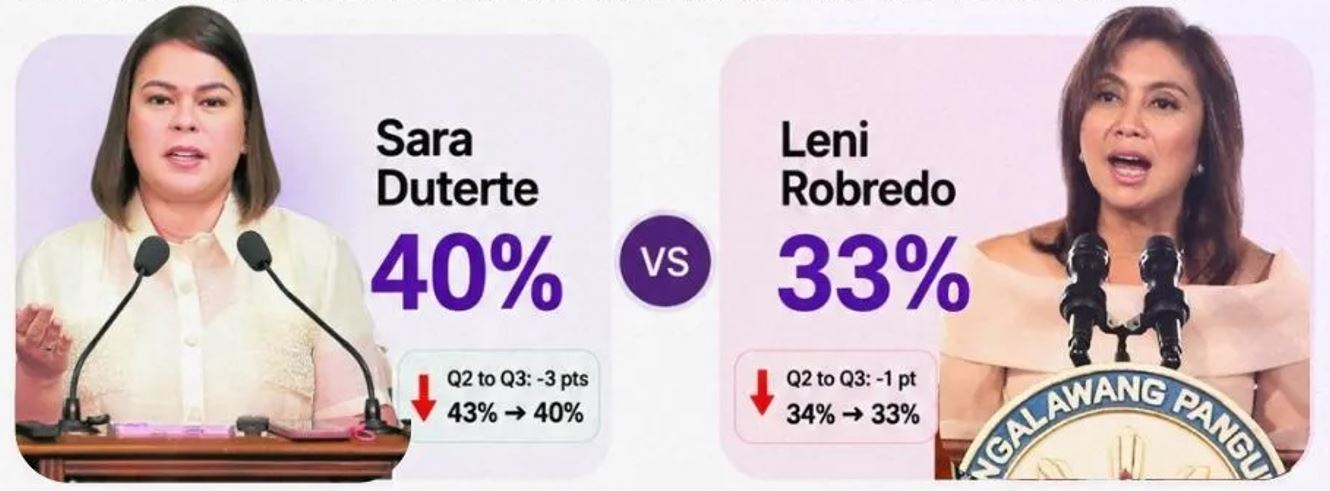
MANILA, Philippines — OCTA 2028 survey results show Vice President Sara Duterte maintaining a lead over Naga City Mayor and former vice president Leni Robredo in a hypothetical presidential matchup, although the gap between the two potential contenders has narrowed to seven percentage points in the latest third-quarter 2026 poll.
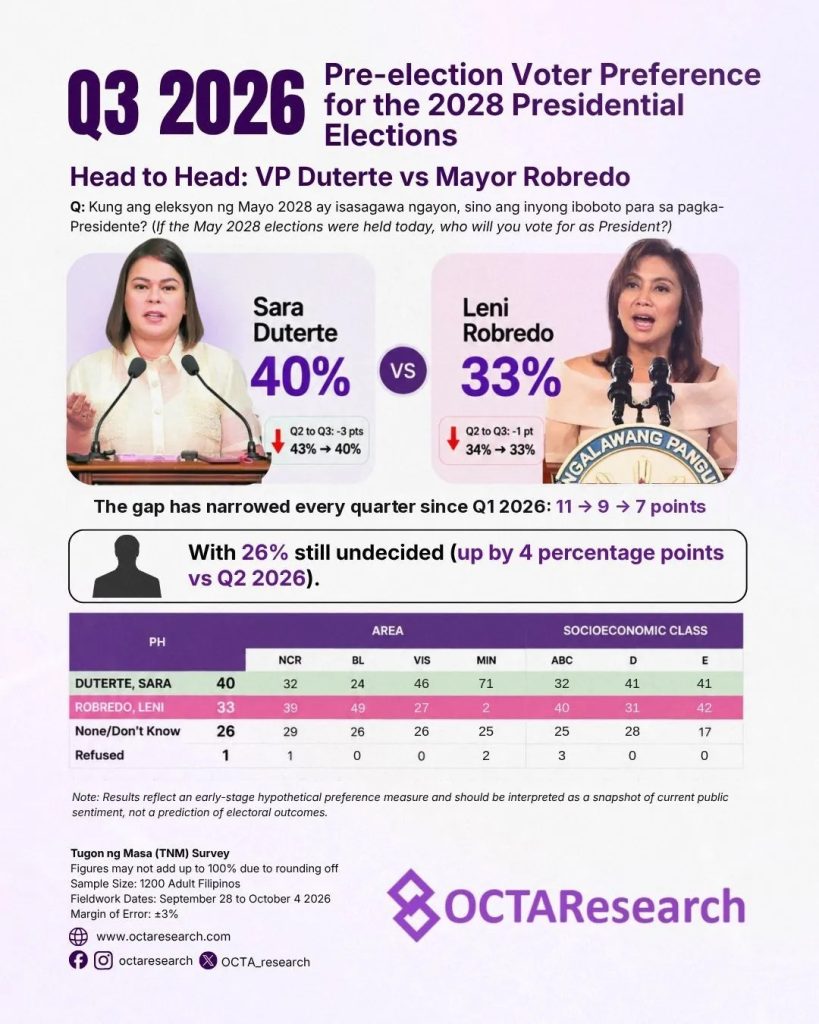
Results of OCTA’s third-quarter 2026 Tugon ng Masa (TNM) survey showed Duterte receiving 40% of voter preference, compared with Robredo’s 33%.
The latest figures mark the narrowest gap between the two potential presidential contenders recorded by OCTA in its three survey rounds this year.
Meanwhile, 26% of respondents remained undecided, preferred neither candidate, or did not know whom to support. Another 1% declined to answer.
Sara Duterte’s Lead Narrows in Three Consecutive Surveys
The latest results continue a pattern of a narrowing lead for Duterte since the first quarter of 2026.
In OCTA’s first-quarter survey, Duterte received 46% while Robredo registered 35%, giving the vice president an 11-point advantage.
The gap decreased to nine percentage points in the second quarter, when Duterte recorded 43% against Robredo’s 34%.
In the third-quarter survey, Duterte’s preference declined further to 40%, while Robredo’s figure slipped slightly to 33%.
Although both personalities recorded lower numbers in the latest round, the share of respondents who were undecided or not committed to either candidate increased.
The uncommitted group rose from 19% in the first quarter to 22% in the second quarter and 26% in the latest survey.
OCTA noted that the three-wave results may indicate some softening in Duterte’s numbers and growth in the uncommitted voter bloc. However, additional surveys would be needed to determine whether the trend will continue.
Robredo Leads in Metro Manila and Balance Luzon
The survey also revealed significant differences in voter preferences across the country’s major geographic areas.
Robredo received 39% in the National Capital Region, ahead of Duterte’s 32%. Another 29% selected neither candidate or said they did not know whom to support.
Her strongest showing came from Balance Luzon, where she registered 49% compared with Duterte’s 24%.
Duterte, meanwhile, maintained an advantage in the Visayas, receiving 46% against Robredo’s 27%.
Her strongest regional performance was recorded in Mindanao, where she obtained 71% of voter preference, while Robredo received 2%.
The regional results highlight the continuing geographic differences in support for the two political figures.
Survey Shows Different Preferences Across Income Groups
OCTA’s findings also showed contrasting preferences among socioeconomic groups.
Among Class ABC respondents, Robredo received 40%, while Duterte registered 32%.
Duterte led among Class D respondents, with 41% compared with Robredo’s 31%. Around 28% of respondents in this group remained undecided or uncommitted.
The results were considerably closer among Class E respondents. Robredo received 42%, up 11 percentage points from the previous quarter, while Duterte registered 41%.
OCTA described the two figures as a statistical tie, indicating that neither candidate had a clear advantage in this socioeconomic group.
OCTA Survey Covers 1,200 Filipino Adults
The third-quarter 2026 Tugon ng Masa survey was conducted through face-to-face interviews from September 28 to October 4, 2026.
OCTA interviewed 1,200 probability-based respondents aged 18 and above, covering male and female participants.
The survey carried a margin of error of plus or minus three percentage points at a 95% confidence level.
While Duterte’s seven-point advantage remains outside the reported margin of error, OCTA cautioned that the changes in the candidates’ individual ratings between the second and third quarters were mostly within or near the margin of error.
The results represent voter preferences during the survey period and should not be interpreted as a prediction of the 2028 presidential election.
With more than one in four respondents still undecided, future political developments, potential alliances, campaign activities, and public opinion could influence the preferences of Filipino voters before the next national elections.
The next survey rounds will provide a clearer picture of whether the narrowing gap between Duterte and Robredo represents a sustained shift in voter preferences.

 Facebook
 Twitter