
Marine turtles extinction has become a serious environmental crisis as hunting, egg poaching, and illegal trade continue to threaten their survival in the Philippines and beyond.
“No water, no life. No blue, no green. No sea turtles, no complete marine scene.” – Sylvia Earle, an American oceanographer, explorer, author, and marine conservationist renowned for her pioneering deep-sea research and advocacy for ocean protection
***
Once upon a time, there was a sailboat enthusiast who found himself alone, adrift in the middle of nowhere after a sudden sea storm struck. When his boat capsized, this shipwreck survivor was granted a new lease on life by a kind marine turtle. A two-day piggyback journey brought this fortunate individual back to shore, and he lived happily ever after.
However, the same cannot be said for the marine turtles, locally known as pawikan. In the Philippines, marine turtles are currently facing the threat of extinction. They are hunted in the ocean or killed on the beach while they are nesting. The eggs and meat are taken for consumption, while their skins and shells are processed into various by-products. Consequently, the local population of marine turtles has dwindled to perilously low levels.
“Unless we seriously take on the task of protecting our much-endangered marine turtles, these ancient creatures will no longer be swimming in our waters,” deplores the Haribon, one of the country’s well-known environmental groups.

According to the Department of Environment and Natural Resources (DENR), marine turtles are large, air-breathing reptiles that persist today in relatively the same form as their ancestors did 200 million years ago. Curiously enough, they have outlived the dinosaurs.
Marine turtles are well adapted to life at sea. They are powerful swimmers and can remain underwater for long periods of time. They do not have external ears and cannot hear well, but their senses of sight, taste and touch are well developed. Having no teeth, the marine turtle uses its sharp, horny beak and sturdy jaws to tear and bite its food.
There are only eight species of marine turtles in the world and five of them can be found in the Philippines, mostly in seven Turtle Islands (Taganak, Baguan, Lihiman, Boaan, Sibaung, Langaan, and Great Bakkungan) in Tawi-Tawi.
The five species found in the Philippines are Green Sea turtle (scientific name: Chelonia mydas), Hawksbill turtle (Eretmochelys imbricata), Olive Ridley turtle (Lepidocheyls olivacea), Loggerhead turtle (Caretta caretta), and Leatherback turtle (Dermochelys coriacea).
Not found in the Philippines are Kemps’ Ridley turtle (Lepidochelys kempi), Flatback turtle (Chelonia depressa), and Black Sea turtle (Chelonia agassizi).
The Green Sea turtle is the only marine turtle that lives on plants. They are the most widely distributed species in the country with Turtle Islands as a major nesting ground. The Hawksbill turtle, one of the most beautiful sea turtles, are valued for their shells – the source of the so-called “tortoise shell” for handicrafts and jewelry. This species is the second most widely distributed in the Philippines.
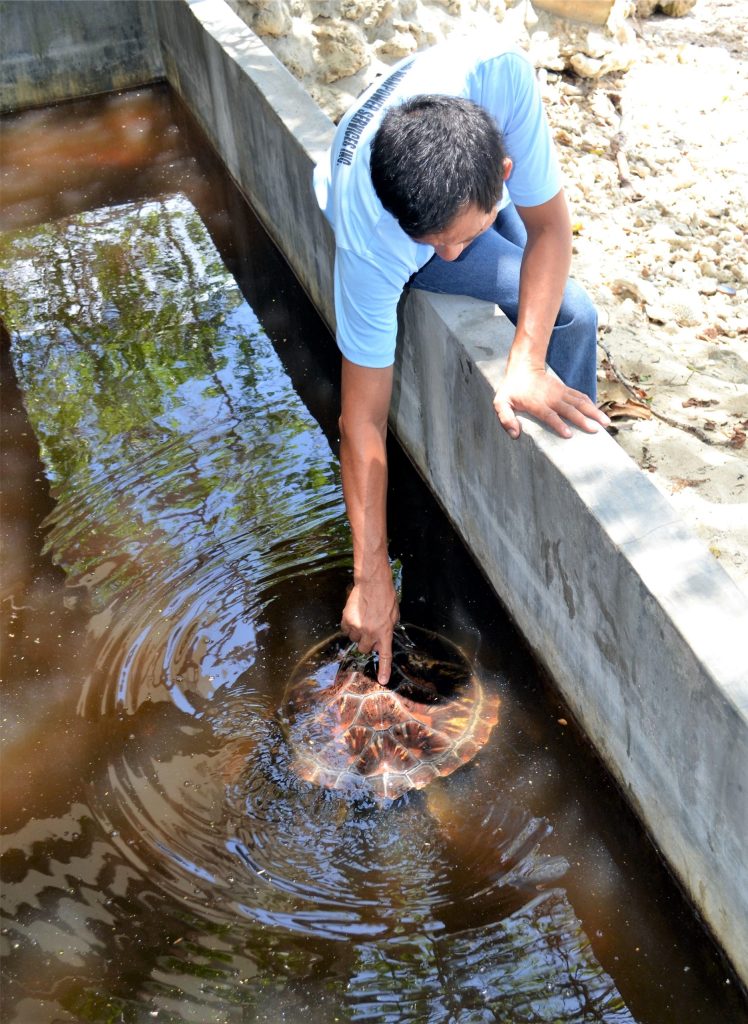
Olive Ridley turtle, one of the smallest marine turtles, is distributed throughout the Philippines with most reports from the coasts of Zambales. Rarely sighted, with documented sightings in Albay, Palawan and Basilan provinces, are the Loggerhead turtles, which hunt near coral reefs and rocks for food.
The Leatherback turtle is the largest sea turtle living today, as it grows to 190 centimeters long and weighs 600 kilograms. In recent years, most sightings of this species have been reported in the Central Philippines.
All five species of marine turtles are listed by the World Conservation Union as endangered, which means “their populations are in danger of extinction” and are “unlikely to survive if the causes of their decimation continue.”
“Today, man’s growing need for survival has endangered the very existence of these sea-dwelling creatures,” points out the Cavite-based International Institute of Rural Reconstruction. “All over the world, these reptiles are threatened with extinction by indifferent and relentless commercial exploitation.”
Pollution has been identified as a significant factor contributing to the decline of marine turtles in Philippine waters. In addition, the swift expansion of beach resorts for the tourism sector has played a role in the degradation of nesting habitats for these turtles.
Furthermore, the utilization of trawl nets in regions populated by marine turtles exacerbates the situation. These nets indiscriminately capture all marine life in their vicinity, resulting in the unintended capture of turtles, which are not the intended targets. Unfortunately, these creatures often succumb to drowning.
However, a primary cause of the reduction in marine turtle populations is overhunting. Throughout history, the flesh of marine turtles has been a source of sustenance for humans. In the seventeenth century, sailors relied on turtles as provisions for their voyages, as their unique ability to survive for extended periods without food and water provided a reliable source of fresh meat without the complications of storage.
Marine turtles are also hunted for their commercial value. In the past, the country was one of the major exporters of turtle by-products, such as turtle wall décor, jewelry pieces, shell-backed guitars, and bags and shoes.
“We can dramatically reduce this demand if we ourselves desist from patronizing these products,” said Haribon. “Put a stop to the massacre by becoming aware of the plight of marine turtles.”
Aside from overhunting, another factor that endangers the survival of marine turtles is the wanton gathering of marine turtle eggs. Mistakenly touted as having aphrodisiac prowess, the eggs taste just like boiled chicken eggs.
“Marine turtles serve as a barometer of our planet’s health,” says the DENR’s Pawikan Conservation Project. “It is possible that in a world in which marine turtles cannot survive may soon become a world in which humans struggle to survive.”
It added that in “saving one of the earth’s most mysterious and time-honored creatures, we might just be saving ourselves, too.”


 Facebook
 Twitter