
Pangasinan salt research center officials announced plans to reduce massive salt imports and achieve 100% national salt sufficiency rate.
The Department of Science and Technology (DOST) said the first-ever dedicated salt research and development center in the country envisions a 100 percent national sufficiency rate, addressing the country’s massive import reliance on salt.
With the goal to boost the salt industry of the country, the DOST in partnership with Pangasinan State University (PSU) Binmaley campus officially inaugurated the Accelerating Salt Research and Innovation (ASIN) on February 17, 2026—almost three years after the completion of the project in November 2023.
The ASIN center is a research and innovation hub that supports the Philippine salt industry through modern and practical salt production technologies, salt farm mapping, product development and strong partnerships with government, industry and local communities.
Its goal is to help develop innovative and sustainable salt production technologies and to improve salt quality and safety to meet local and international standards.
“For years, our country has faced a difficult truth: we rely overwhelmingly on imported salt. Ninety-three percent of our total supply comes from abroad. While only seven percent is produced locally. This gap continues to widen as national demand rises due to legislative and agricultural needs,” explained DOST Secretary Renato U. Solidum Jr.
A study from the Philippine Journal of Fisheries of the Department of Agriculture said that the Philippines is heavily reliant on imports of salt from countries like Australia and China.
It said that the local salt production is estimated at 114, 623.29 metric tons yearly, which is only 16.78 of the country’s annual demand.
“This is why the establishment of the ASIN R&D Center is our response to decades of underinvestment in salt science and a decisive step toward achieving true salt self-sufficiency. But since this is a national problem, the R&D Centers are supposed to share the knowledge that they have generated,” Solidum added.
He further explained that the decline in the salt industry stems from multiple challenges like limited salt farms, aging farmers, outdated technologies, quality issues, climate disruptions, and the absence of a dedicated facility where new generations of salt producers can be trained.

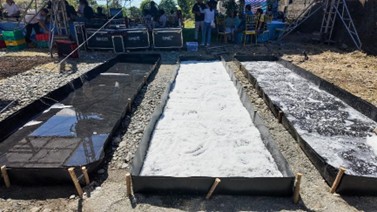
Furthermore, to improve the traditional salt making process, the facility is equipped with advanced laboratory testing equipment, training and workshop areas, and a salt production technology demonstration site.
“We [all] know that Pangasinan is the home of salt makers. Our stakeholders, salt producers, farmers, and I were very happy with the results of our program. They have seen the new technologies that can provide higher production of salt and cleaner salt that we will produce, that meets the standards that the industry is looking for,” project leader Engr. Rex B. Basuel of the PSU Binmaley said.
He added that the local government units of Pangasinan are aiming to promote the technologies developed at the ASIN Center to salt producers so the Philippines will be completely salt-sufficient because of the DOST-NICER program.
The facility will be composed of four divisions, offering services like research and development, testing and analysis, extension and capacity-building, and technology transfer and industry support.
On the other hand, while Pangasinan is known as the second largest producer of salt in the Philippines, Solidum said the ASIN Center will not just help the province of Pangasinan but will also be beneficial in other parts of the country involved in the salt industry.
Monitored by the DOST-Philippine Council for Industry, Energy and Emerging Technology, the center will operate with Mariano Marcos State University, Don Mariano Marcos Memorial State University, and President Ramon Magsaysay State University.
The establishment of the ASIN Center is one of the four projects under the Niche Centers in the Regions for Research and Development (NICER) program of the Department of Science and Technology (DOST) aimed at providing science-based, innovative, and inclusive solutions across four strategic pillars: human well-being, wealth creation, wealth protection, and sustainability. These pillars embody the mantra OneDOST4U: Solutions and Opportunities for All.


 Facebook
 Twitter