
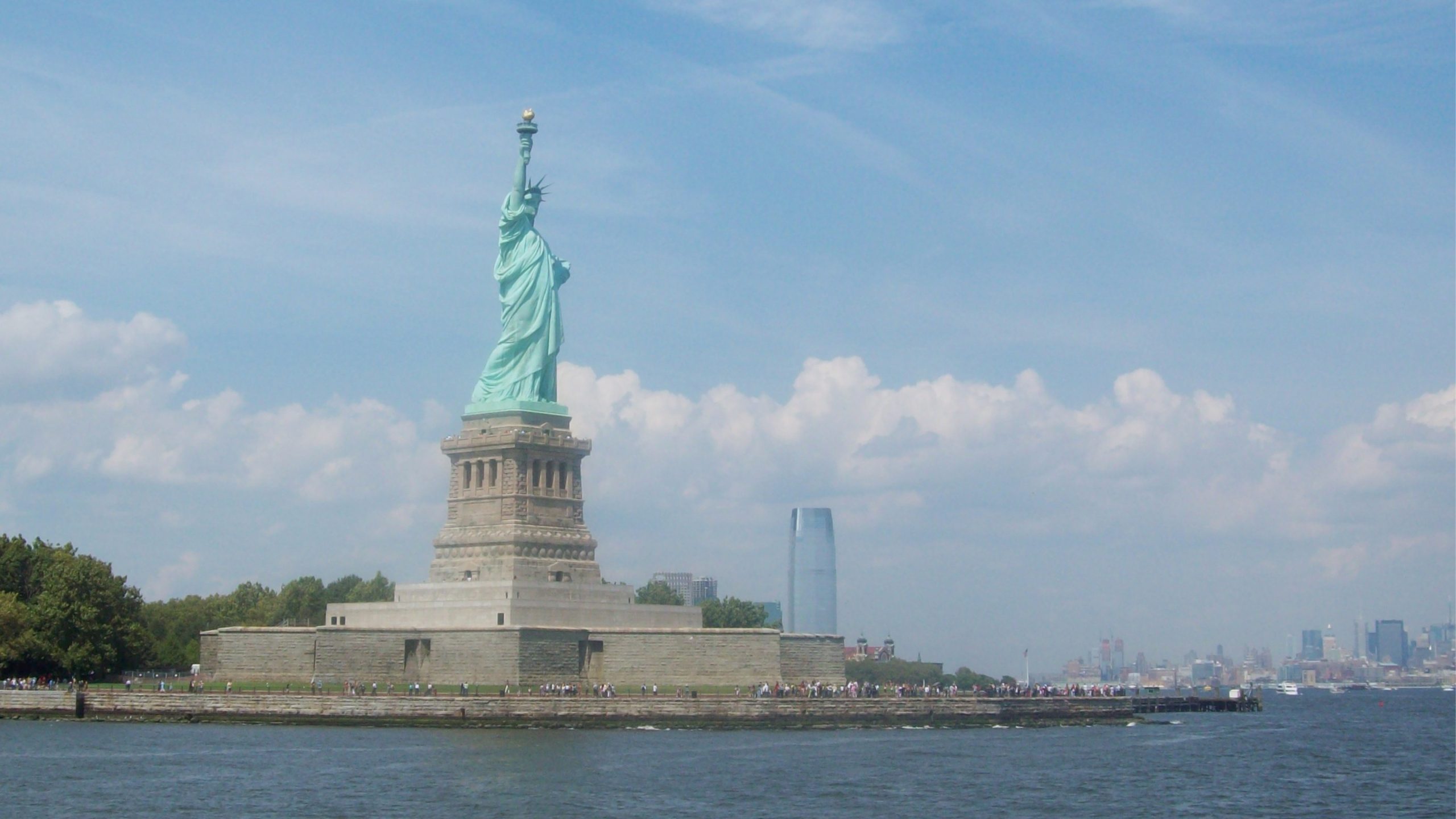
“When you see the Statue of Liberty, you will be in America.”—Steve Jobs
New York, commonly referred to as New York City or NYC, stands as the most populous city in the United States. It is situated at the southernmost point of New York State, positioned on one of the largest natural harbors in the world. The city is divided into five boroughs, each corresponding to a specific county.
The Big Apple, as it is often called, serves as the geographical and demographic hub of both the Northeast megalopolis and the New York metropolitan area, which is the largest metropolitan region in the United States in terms of population and urban expanse.
New York is recognized as a global epicenter for finance and commerce, culture, technology, entertainment and media, education and scientific research, the arts and fashion, and, notably, it hosts the headquarters of the United Nations, making it a significant site for international diplomacy.
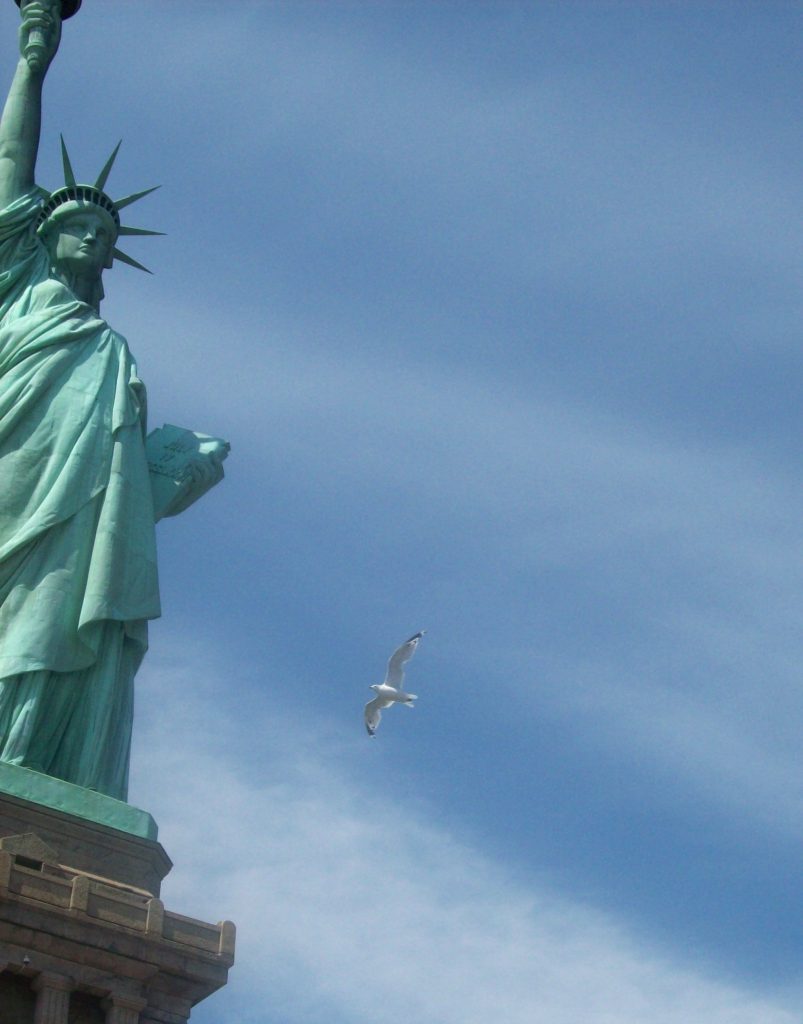
When people talk about New York, they also talk about the Statue of Liberty, which is the famous landmark of the city that never sleeps.
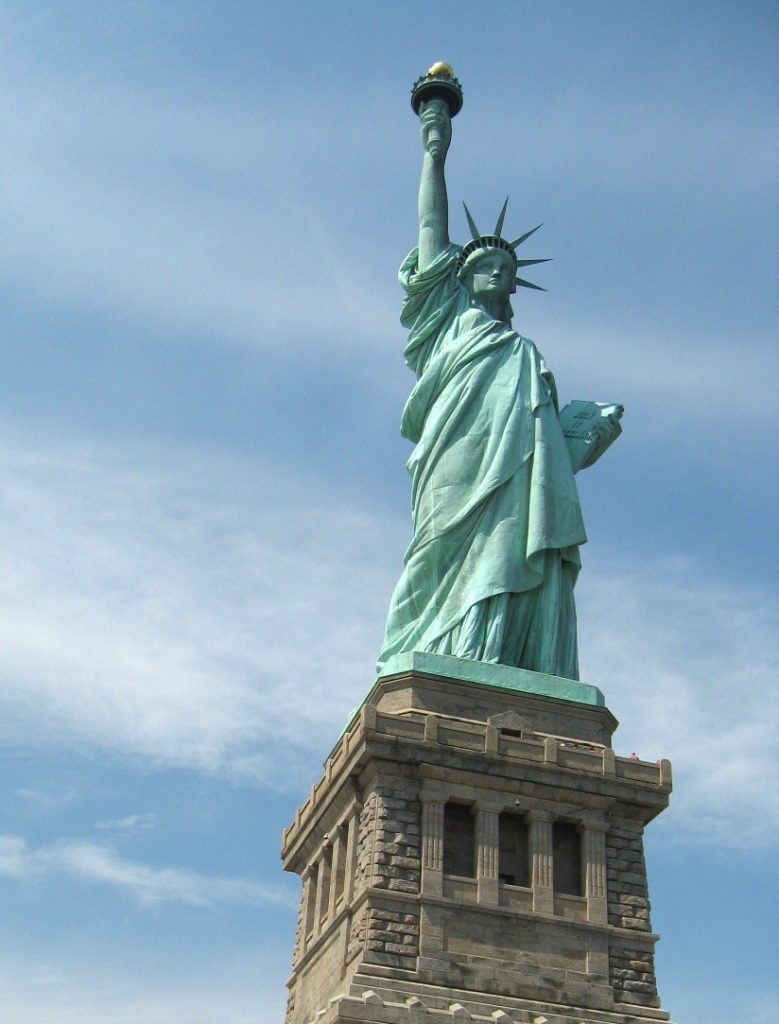
The Statue of Liberty stands at a height of 305 feet (93 meters) on Liberty Island, situated in Upper New York Bay, near New York City. This statue symbolizes liberty, depicted as a woman. She raises a torch in her right hand while holding a tablet in her left.
The statue depicts a woman draped in classical attire, likely drawing inspiration from the Roman goddess of liberty, Libertas. Positioned in a contrapposto stance, she raises a torch with her right hand while holding a tabula ansata in her left, which bears the inscription JULY IV MDCCLXXVI, representing July 4, 1776, in Roman numerals—the date marking the U.S. Declaration of Independence.
Her left foot rests upon a broken chain and shackle, symbolizing the national abolition of slavery that followed the American Civil War. Following its dedication, the statue emerged as an emblem of freedom and the United States, later recognized as a welcoming symbol for immigrants arriving by sea.
“And you have to remember that I came to America as an immigrant,” said Daniel Libeskind, a Polish–American architect, artist, professor and set designer. “You know, on a ship, through the Statue of Liberty. And I saw that skyline, not just as a representation of steel and concrete and glass, but as really as the American Dream.”
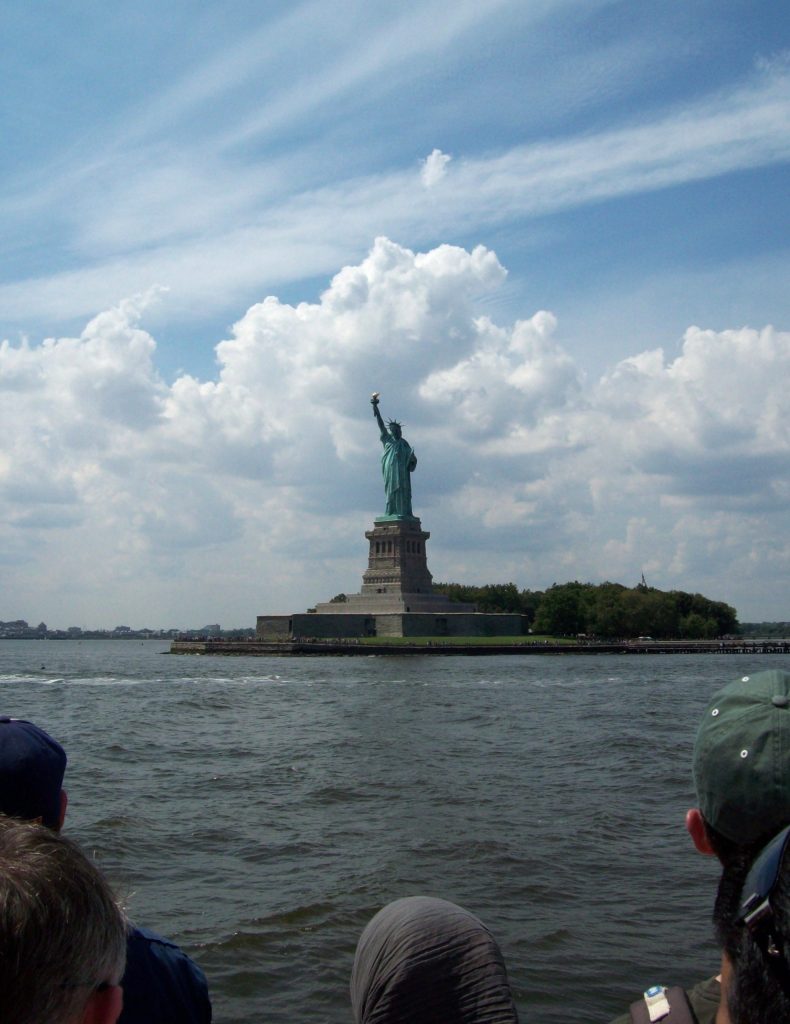
The copper-clad monument, presented to the United States by the citizens of France, was created by the French sculptor Frédéric Auguste Bartholdi, with its metallic structure constructed by Gustave Eiffel.
History records showed the Statue of Liberty was built in France between 1875 and 1884. It was disassembled and shipped to New York City in 1885. The dedication of the statue took place on October 28, 1886.
Britannica Encyclopedia gives this bit of information: “(The Statue of Liberty) was declared a national monument in 1924, and in 1933 the administration of the statue was placed under the National Park Service. Fort Wood was deactivated in 1937, and the rest of the island was incorporated into the monument.
“In 1956 Bedloe’s Island was renamed Liberty Island, and in 1965 nearby Ellis Island, once the country’s major immigration station, was added to the monument’s jurisdiction, bringing its total area to about 24 hectares. Exhibits on the history of the Statue of Liberty, including the statue’s original 1886 torch, were contained in the statue’s base until 2018, when they were moved to the adjacent Statue of Liberty Museum.”
In 1984, the Statue of Liberty was designated a World Heritage Site by the United Nations Educational, Scientific, and Cultural Organization (UNESCO). The UNESCO “Statement of Significance” describes the statue as a “masterpiece of the human spirit” that “endures as a highly potent symbol—inspiring contemplation, debate and protest—of ideals such as liberty, peace, human rights, abolition of slavery, democracy and opportunity.”
The Statue of Liberty has been featured in several Hollywood motion pictures. The torch, for instance, serves as a pivotal element in the climax of Alfred Hitchcock’s film, Saboteur (1942).
This statue was also featured in the 1968 film, Planet of the Apes, where it was depicted partially buried in sand.
In the science-fiction movie Independence Day, it was toppled. In Cloverfield, its head was severe. In Jack Finney’s 1970 time-travel novel, Time and Again, the statue’s right arm, showcased in Madison Square Park during the early 1880s, is of significant importance.
In 1979, Robert Holdstock, the consulting editor of The Encyclopedia of Science Fiction, expressed his thoughts on this subject: “Where would science fiction be without the Statue of Liberty? For decades it has towered or crumbled above the wastelands of deserted Earth—giants have uprooted it, aliens have found it curious … the symbol of Liberty, of optimism, has become a symbol of science fiction’s pessimistic view of the future.


 Facebook
 Twitter