
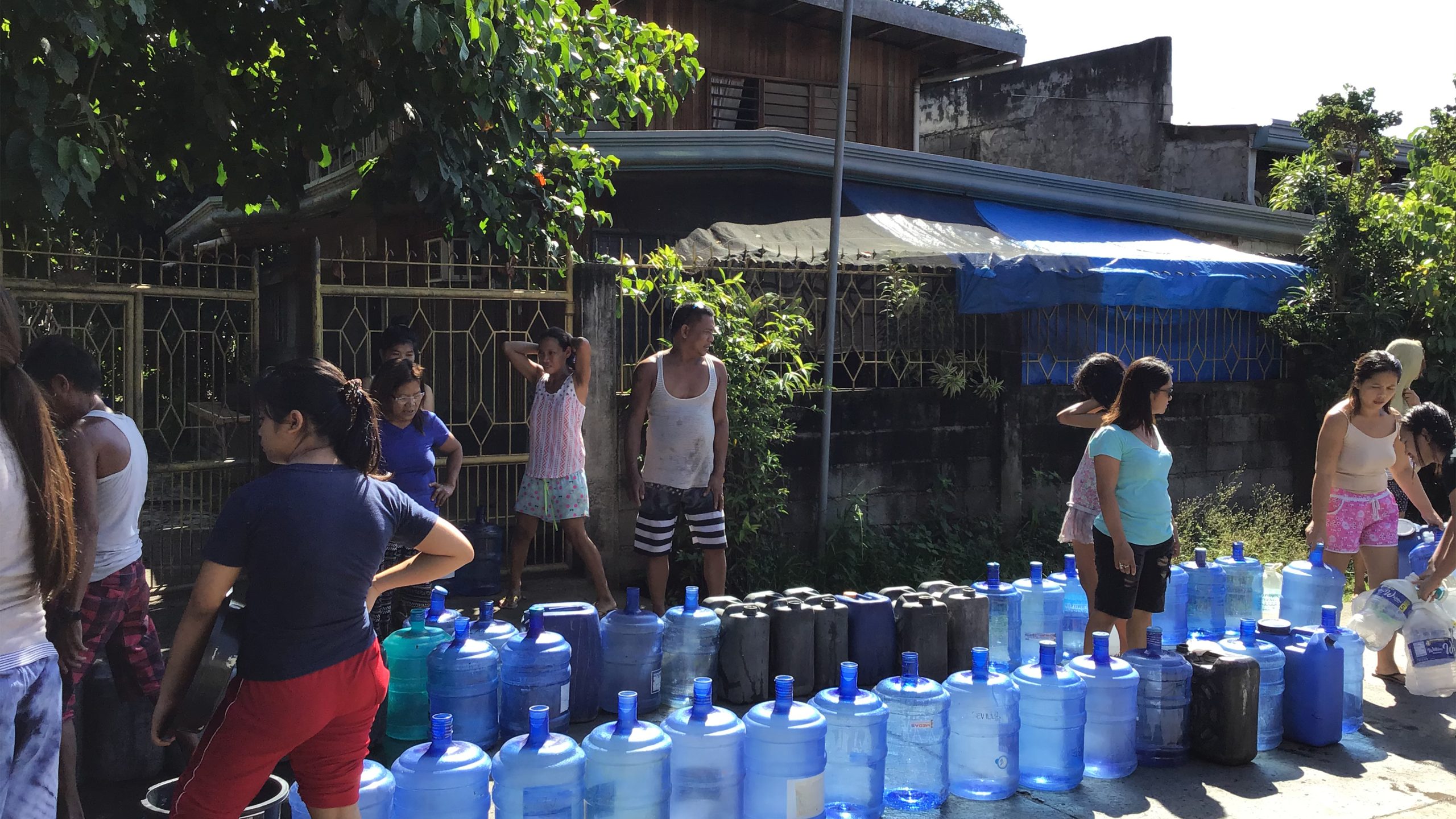
Water districts Philippines are falling behind as growing demand continues to exceed supply, according to a recent PIDS study.
Water districts across the country are struggling to keep pace with growing demand, as service delivery systems fall short despite the Philippines’ available water resources.
A new study by the Philippine Institute for Development Studies (PIDS) titled, “Securing Tomorrow’s Water: Insights on Groundwater, Surface Water, and the Role of Water Districts in the Philippines,” found that across 532 water districts, annual demand consistently exceeds effective supply—contributing to persistent service gaps even as 87.7% of the population is reported to have access to safe water.
Fewer than half of Filipino households have piped water connections at home, while 332 municipalities remain classified as “water-less,” with more than half of residents lacking reliable supply.
Authored by PIDS Supervising Research Specialist Adrian Agbon, the study points to structural challenges in water service provision, particularly persistent supply deficits among water districts, that threaten long-term water security even in areas where water resources are available.
Service delivery, not resource scarcity, drives supply gaps
The Philippines appears water-rich on paper.
The National Water Resources Board (NWRB) estimates that the Philippines has about 226 billion cubic meters of water available each year, including around 20 billion cubic meters of groundwater and about 206 billion cubic meters of surface water, such as rivers and lakes.
However, most of this water—about 83% to 85%—is used for agriculture, leaving a smaller share for households, businesses, and industries.
The study notes that current supply gaps are driven less by raw water availability than by system capacity constraints among water districts.
As the population increased from 77 million in 2000 to over 103 million in 2016, the amount of water available per person each year dropped from 1,907 cubic meters to just 1,400 cubic meters.
Water quality is also deteriorating. Of the country’s 623 classified water bodies, only a limited number meet the highest potable standard.
About 36% fall under Class C (primarily suitable for fisheries), while 33% are rated Class D, requiring substantial treatment before they can be used for drinking.
Rising groundwater dependence heightens water stress
A key concern raised in the study is the country’s heavy and growing reliance on groundwater—the main source of supply for most water districts nationwide.
Globally, groundwater accounts for about 99% of liquid freshwater and supplies roughly half of domestic water use.
In the Philippines, extraction has steadily increased, rising by an average of 3.8% annually from 2014 to 2023.
A sharp 17.7% jump was recorded from 2019 to 2020, driven largely by mining, manufacturing, quarrying, and construction. During this period, groundwater use far exceeded surface water use in both volume and growth rate.
Overdependence on aquifers can increase the risk of saline intrusion in coastal areas, land subsidence, falling water tables, and long-term deterioration of water quality. In 2018, total water withdrawals peaked at 92.3 million cubic meters, with water stress reaching 28.21 percent—highlighting how demand is increasingly pressing against available supply.
Water districts face widening supply deficits
The impact of these system constraints is evident among the country’s 532 water districts.
From 2019 to 2024, average annual demand reached 10.6 million cubic meters, while effective supply stood at only about 7 million cubic meters—resulting in a persistent 3.6 million cubic meter deficit. Luzon recorded the largest shortfall, followed by gaps across the Visayas and Mindanao.
Many communities continue to rely on shared sources such as public wells or springs for domestic use. These supply gaps constrain water districts’ ability to expand coverage and meet growing demand.
Governance and institutional complexity
The supply deficits faced by water districts are not driven by resource constraints alone—they are also shaped by governance and institutional complexity.
Water governance in the Philippines is fragmented. Around 30 public sector agencies—national and local—share responsibilities over water quality, watershed management, irrigation, hydropower, sanitation, flood control, research, and water supply.
Weak coordination and overlapping mandates can delay permitting, infrastructure investment, and service expansion, contributing to persistent supply shortfalls at the local level.
Why action is urgent as 2030 nears
“Securing the Philippines’ water future requires shifting from fragmented, source-specific responses toward integrated planning, stronger monitoring, and better-supported water service providers,” Agbon said.
Since most districts depend on groundwater, which is harder to measure and manage, pricing water fairly and efficiently remains a challenge. While current rate structures aim to promote fairness and conservation, some pricing practices may create unintended effects and deserve closer review.
With less than five years remaining to meet national water supply and sanitation targets, the study underscores the need to strengthen water districts’ capacity to expand coverage, improve system efficiency, and manage groundwater resources sustainably.
Improving service reliability will require closer institutional coordination, targeted infrastructure investments, and pricing and financing mechanisms that support both affordability and long-term system sustainability, the study said. (PR)
Photo by Henrylito D. Tacio


 Facebook
 Twitter