
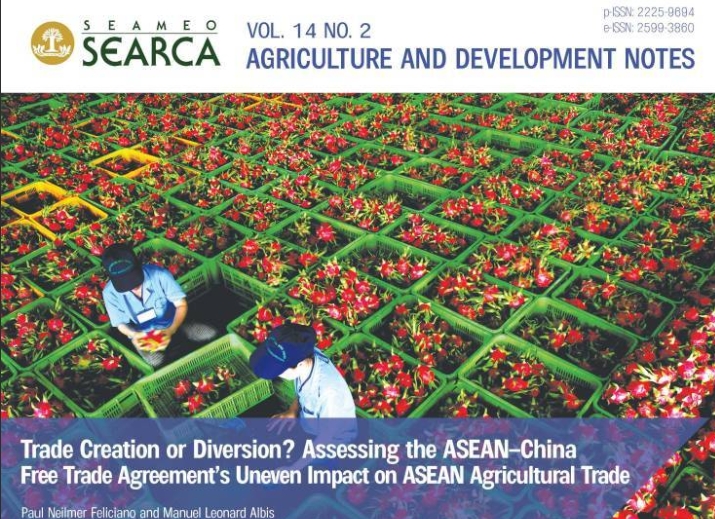
ASEAN-China FTA agricultural trade has expanded significantly in recent years, but a new SEARCA study shows that its benefits remain uneven across Southeast Asian countries.
LOS BAÑOS, Philippines—A new issue of the Agriculture and Development Notes (ADN) series published by the Southeast Asian Regional Center for Graduate Study and Research in Agriculture (SEARCA) reveals that while the ASEAN-China Free Trade Agreement (ACFTA) has substantially expanded regional trade, its benefits for agriculture are uneven across Southeast Asian countries.
Titled “Trade Creation or Diversion? Assessing the ASEAN-China Free Trade Agreement’s Uneven Impact on ASEAN Agricultural Trade,” the ADN is co-authored by Mr. Paul Neilmer Feliciano, a program manager and economist at the Ateneo Policy Center, and Mr. Manuel Leonard Albis, an assistant professor at the University of the Philippines School of Statistics.
The publication draws on research supported by SEARCA’s Seed Fund for Research and Training (SFRT), a grant program that provides start-up funds for projects that advance agricultural and rural development in the region.
The study finds that since the ACFTA–Agreement on Trade in Goods (ATIG) took effect in 2004, total trade between ASEAN and the People’s Republic of China (PRC) has increased fourfold, while trade in agricultural commodities has grown nearly fivefold.
However, the gains are concentrated in a few countries. Vietnam emerged as the primary beneficiary, achieving what the researchers describe as “unparalleled” success, with significantly higher agricultural trade within ASEAN alongside strong growth in exports to and imports from the rest of the world.
Indonesia and Thailand also recorded substantial net trade creation. By contrast, Malaysia and the Philippines increased their agricultural trade mainly by exporting to markets outside the ACFTA bloc, while Brunei Darussalam, Cambodia, Lao PDR, and Myanmar experienced net trade diversion effects.
To replicate Vietnam’s success and fully harness the benefits of free trade, Feliciano and Albis stress the need for ASEAN Member States to adopt a comprehensive policy framework. This should include targeted investments in technology, such as mechanization; in infrastructure, such as farm-to-market roads and irrigation systems; and in training and extension services to strengthen human capital.
The authors underscore the importance of a national agriculture blueprint that provides an overarching strategy for research, development, and evidence-based regulations.
The study concludes that agriculture authorities should treat free trade agreements as strategic policy tools for sectoral expansion. With a clear agriculture policy framework—backed by initiatives such as the SEARCA SFRT, which links research to practical pathways for growth—countries can create an enabling environment to respond to structural changes and seize new opportunities in foreign markets.

 Facebook
 Twitter