
The 2023 National Nutrition Survey Philippines shows that food sources and access shape how Filipinos eat, according to findings from the Department of Science and Technology’s Food and Nutrition Research Institute (DOST-FNRI).
Food sources and access shape how Filipinos eat, according to findings from the 2023 National Nutrition Survey conducted by the Department of Science and Technology’s Food and Nutrition Research Institute (DOST-FNRI).
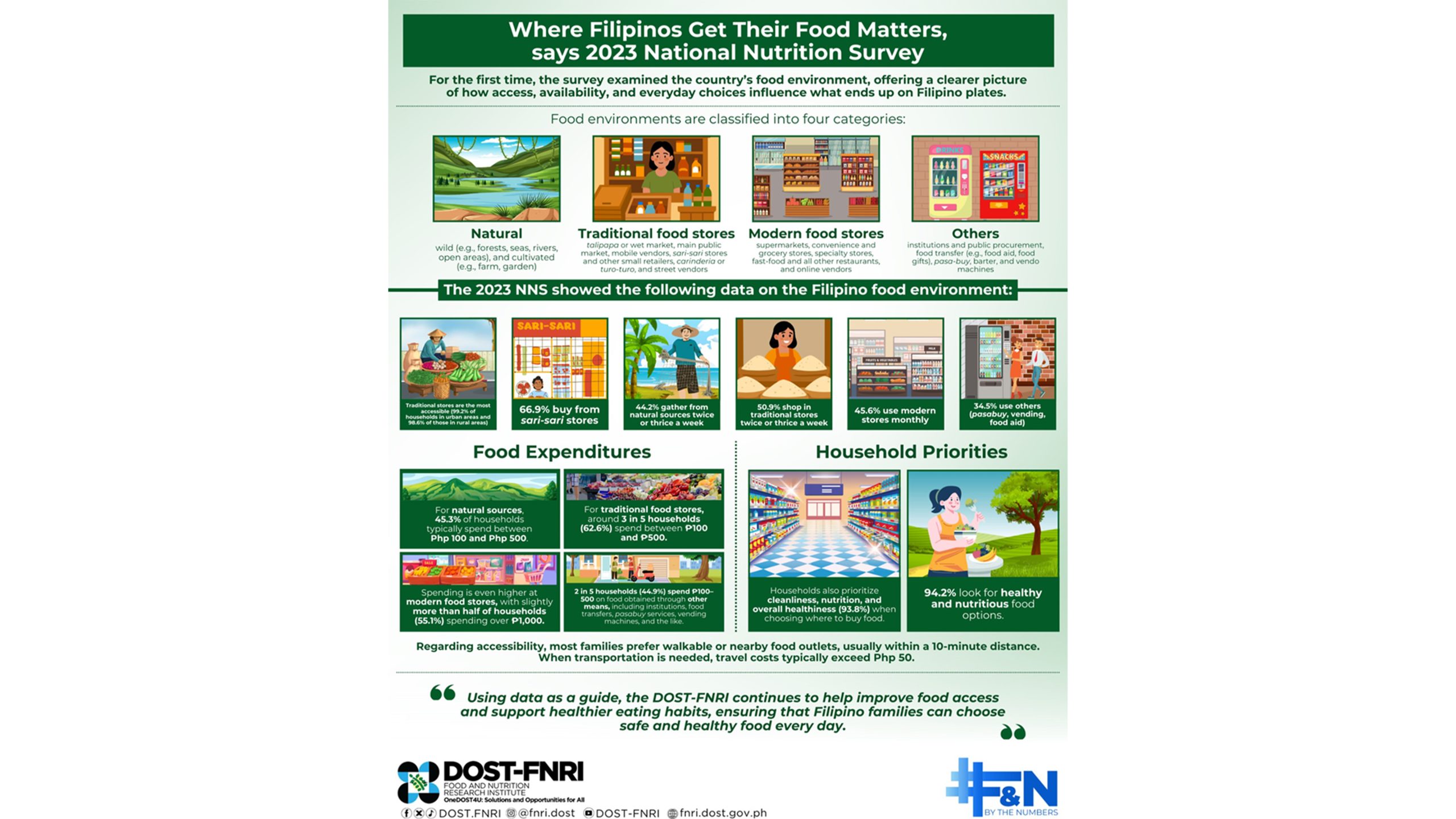
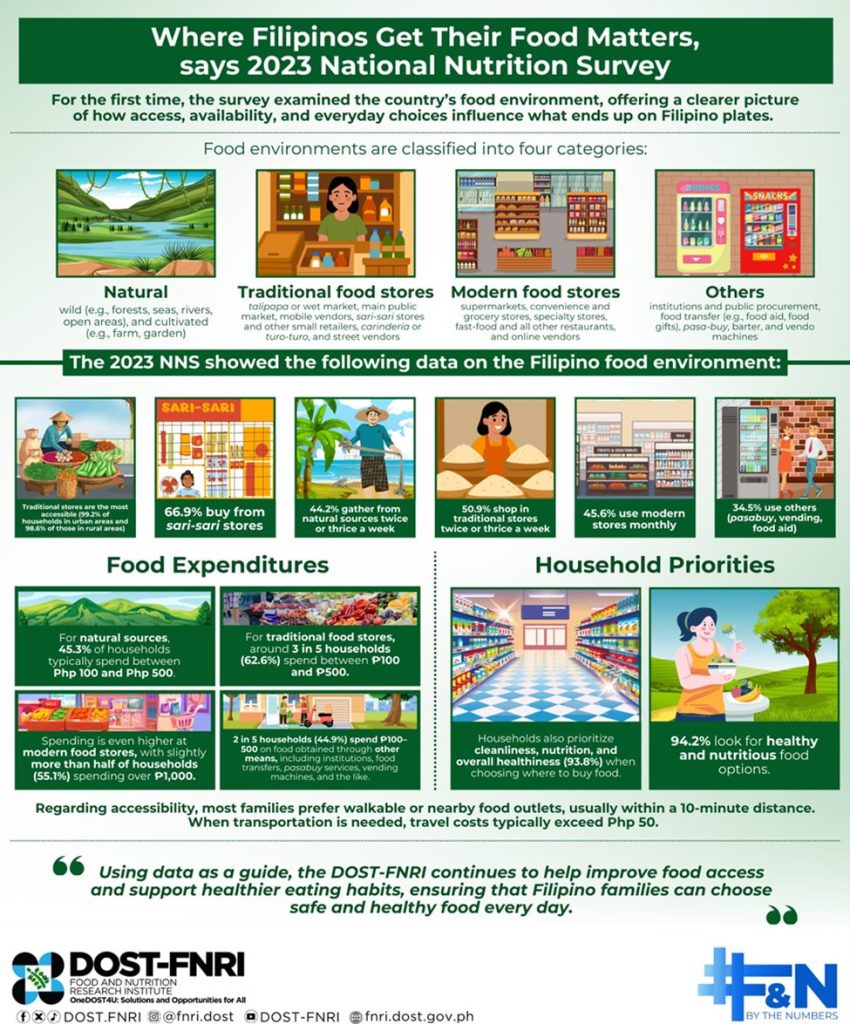
For the first time, the survey examined the country’s food environment, offering a clearer picture of how access, availability, and everyday choices influence what ends up on Filipino plates.
The survey categorized food environments into several types: natural sources like farms, rivers, and coastal areas; traditional food stores such as talipapa or wet markets, sari-sari stores, carinderia or turo-turo, and street vendors; modern food stores like supermarkets, convenience stores, grocery stores, fast-food restaurants, and online sellers; as well as other sources such as food aid, food gifts, and institutional environments (e.g., school cafeterias/canteens, workplaces, childcare facilities, hospitals, and recreation centers), along with pasa-buy services and vending machines.
Key findings revealed that traditional food stores are the most accessible nationwide, reaching 99.2 percent (%) of urban households and 98.6% of rural households. Around two out of three households (66.9%) regularly buy food from sari-sari stores and other small retailers, while about two out of five households (44.2%) get food from natural sources two to three times a week.
About half of Filipino households (50.9%) purchase food from traditional food stores two to three times per week. Meanwhile, nearly half (45.6%) shop at modern food stores, such as supermarkets or restaurants, once or twice a month. Around three in ten households (34.5%) obtain food monthly from transfers, online vendors, or vending machines.
Household spending patterns vary depending on where food is purchased. Many households spend between Php 100 and Php 500 when sourcing food from natural areas (45.3%) or traditional outlets (62.6%). Spending tends to be higher in modern stores, where more than half of households (55.1%) spend over Php 1,000. For other sources, such as institutions, food transfers, pasa-buy services, and vending machines, 44.9% of households spend between Php 100 and Php 500.
Understanding where households buy food helps guide programs that make healthier and more affordable options easier to access.
Regarding accessibility, most families prefer walkable or nearby food outlets, usually within a 10-minute distance. When transportation is needed, travel costs typically exceed Php 50.
Households also prioritize cleanliness, nutrition, and overall healthiness when choosing where to buy food. About 93.8% consider clean selling areas important, while 94.2% look for healthy and nutritious food options.
These findings highlight both opportunities and challenges for improving access to healthy, affordable food. Key priorities include strengthening local food systems, increasing the availability of nutritious options at frequently visited food outlets, and empowering families to make informed food choices.
As the Institute prepares for the release of the 2025 Updating of the Nutritional Status of Filipino Children and Other Population Groups, also known as the 2025 Updating Survey, DOST-FNRI continues to unpack key findings from the 2023 survey to provide deeper context and actionable insights. These releases serve as an important baseline for understanding nutrition trends and informing evidence-based decisions ahead of the upcoming survey results.
To support better planning and decision-making, the DOST-FNRI encourages policymakers, local government units, researchers, and the public to explore official nutrition data through eNutrition (https://enutrition.fnri.dost.gov.ph/), the Institute’s online portal for the latest National Nutrition Survey findings.
Using data as a guide, the DOST-FNRI continues to help improve food access and support healthier eating habits, ensuring that Filipino families can choose safe and healthy food every day.
The National Nutrition Survey is one of the key programs of the Department of Science and Technology (DOST) aimed at providing science-based, innovative, and inclusive solutions across four strategic pillars: human well-being, wealth creation, wealth protection, and sustainability. These pillars embody the mantra OneDOST4U: Solutions and Opportunities for All.
By DOST-FNRI

 Facebook
 Twitter