
Tungro disease in rice is one of the most destructive viral diseases affecting rice production, making early detection essential for protecting yields and preventing crop loss.
Rice, known in the science world as Oryza sativa, is “the principal food for over 60% of mankind,” said the Laguna-based International Rice Research Institute (IRRI). The crop is especially important in Asia where over half of the world’s population lives.
Rice has been cultivated for such countless ages that its origin must always be a matter of conjecture. D.H. Grist, in his book entitled Rice, pointed this out: “We do not know the country of origin of rice, but the weight of evidence points to the conclusion that the center of origin of rice is southeast Asia, particularly India and Indo-China, where the richest diversity of cultivated forms has been recorded.”
Grist further noted: “Cultivation of rice dates to the earliest age of man. Carbonized paddy grains and husks, estimated to date 1000 to 800 B.C., have been found in excavations in Uttar Pradesh, India. Specimens of rice have been discovered in China dating from the third millennium B.C.
“Paddy cultivation is of great antiquity in the Philippines. It is thought that immigrant people from south China in the second millennium B.C. constructed the wonderful system of terraces on the mountainsides of Banaue and its neighboring areas. These people were reportedly driven into the hills by subsequent invasions of Malays.”
Filipinos consider rice as their staple food. The late epicurean Doreen Fernandez wrote: “If we did not have rice, our deepest comfort food, we would probably feel less Filipino.”
In his survey of rice in the visual arts, Patrick D. Flores wrote: “Because rice inscribes nature, it makes use of it as an endowment, a source of life that is socially produced. Rice is produced by and produces this culture as nature and its transformations are performed as a rite of passage, a cycle of seasons, and the practice of internalized habits.”
Like most crops, rice is attacked by various pests and diseases. In 1939, a rice crop failure at Buenavista Estate in Bulacan was reported and the cause was a viral pathogen that stunted the crop. The Ilocanos called it “tungro,” which means “degenerative growth.” The term caught the attention of the rice-growing world and the name stuck.
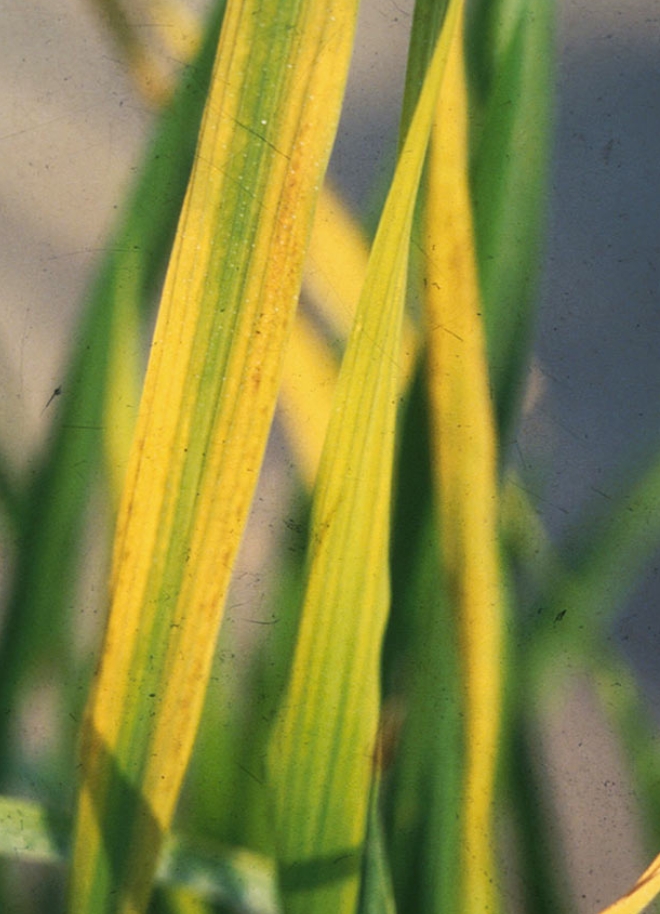
Photos courtesy of International Rice Research Institute
As affected rice plants by tungro are stunted, they have reduced the number of tillers. The young emerging leaves develop interveinal chlorosis leading to discoloration of the leaves, starting from tip downwards. More often than not, the whole leaf is discolored; plants infected at an early stage generally die prematurely.
According to IRRI, infected plants take more time for maturity because of delayed flowering. The panicles are often poorly developed and the grains are also often covered with dark brown blotches and are lighter than those of healthy plants. “Grains, if any, are usually brown or rusty,” Grist wrote.
The disease is transmitted by rice tungro bacilliform virus (RTBV) and it is now widely distributed not only in the Philippines but also in other rice-growing areas in South and South-East Asia, and in southern China.
Plantwise.org reports: “Tungro became a serious problem after the release of high-yielding rice cultivars which are short statured and photo-insensitive, have shorter growth duration, and allow rice growers two crops of rice in a year. Staggered planting under the double-cropping rice systems is the major reason why tungro disease predominated after the 1960s.”
IRRI says tungro disease viruses are transmitted from one plant to another by leafhoppers that feed on tungro-infected plants. The most efficient vector is the green leafhopper.
“Leafhoppers can acquire the viruses from any part of the infected plant by feeding on it, even for a short time,” IRRI says. “It can, then, immediately transmit the viruses to other plants within 5−7 days. The viruses do not remain in the leafhopper’s body unless it feeds again on an infected plant and re-acquires the viruses.”
Tungro infection can occur during all growth stages of the rice plant. However, it is most frequently seen during the vegetative phase. “Rice plants are most vulnerable at the tillering stage,” IRRI says.
Rice tungro disease is one of the most destructive diseases of rice in the Asian tropics, the plantwise.org says. The incidence of tungro is generally high in irrigated areas, where rice is planted throughout the year. It is generally endemic but occasionally becomes epidemic and causes devastating losses over huge areas.
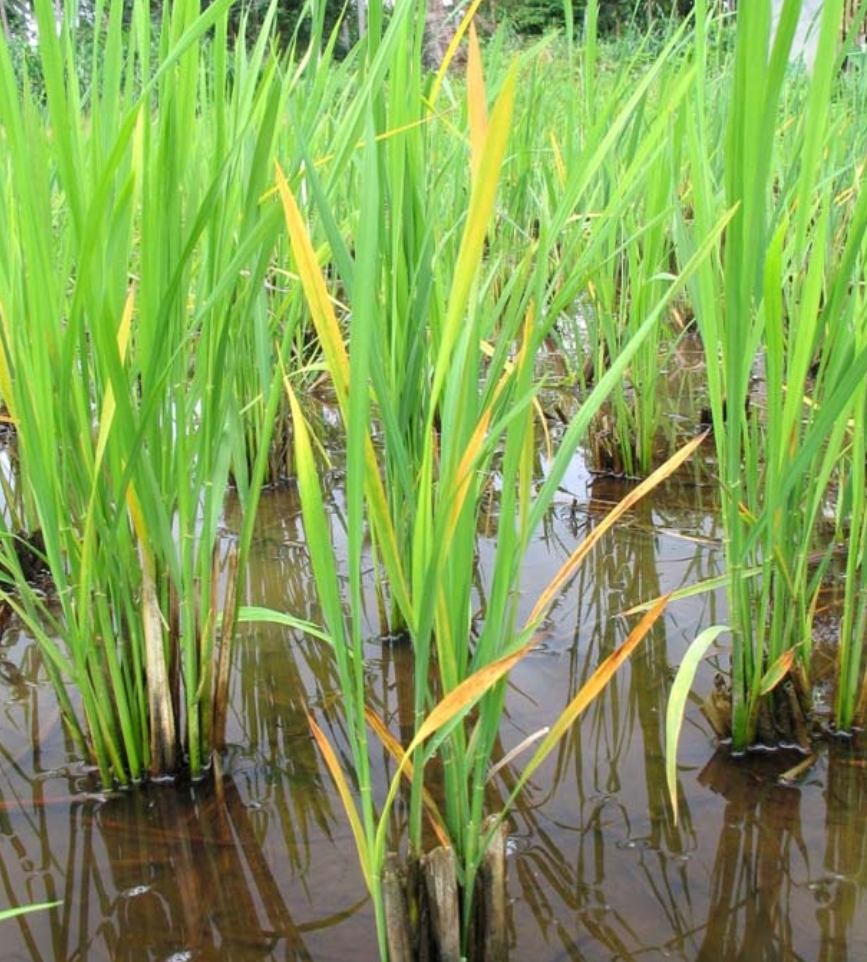
Photos courtesy of International Rice Research Institute
But there’s good news. Scientists at the Philippine Rice Research Institute (PhilRice) have adapted a simplified method to detect RTBV in rice plants even before common symptoms become noticeable by using the loop-mediated isothermal amplification (LAMP) technique.
“Through this application, major rice virus diseases and insect vectors can be diagnosed in a fast, efficient, and accurate method,” said Dr. Emmanuel Tiongco, who headed the team composed of Dr. Xuan Hoai Truong, Maria Johna Duque, and Dr. Rubigilda Paraguison-Alili (who is from Central Luzon State University).
LAMP assay has been proven useful in detecting viruses in animals and humans. The team, however, extended the application of this method to rice viruses in the country.
Using the method, RTBV can be detected 1 day after infection, said a press statement released by PhilRice. The widely used enzyme-linked immunosorbent assay (ELISA) detects RTBV 3 days after infection.
In addition, the LAMP assay detects the rice ragged stunt virus (RRSV) and the rice dwarf virus (RDV) not only in rice plants but also in their respective brown planthopper and green leafhopper vectors, according to Dr. Tiongco.
“This way, the impending virus spread is known even before rice crop establishment,” Dr. Tiongco says.
The current existing virus detection tools, according to Dr. Tiongco, have difficulties in detecting viruses that are of low titer (strength of a substance’s solution) aside from being arduous and time consuming.
“Easy to follow procedures, cheaper equipment required, high level of specificity, and simple result determination by merely looking at the change in color of the test solution are among the advantages of the newly developed method,” the press statement said.
Once a rice plant is infected by tungro, it cannot be cured. “Preventive measures are more effective for the control of tungro than direct disease control measures,” IRRI cautions.
“Using insecticides to control leafhoppers is often not effective, because green leafhoppers continuously move to surrounding fields and spread tungro rapidly in very short feeding times.


 Facebook
 Twitter