
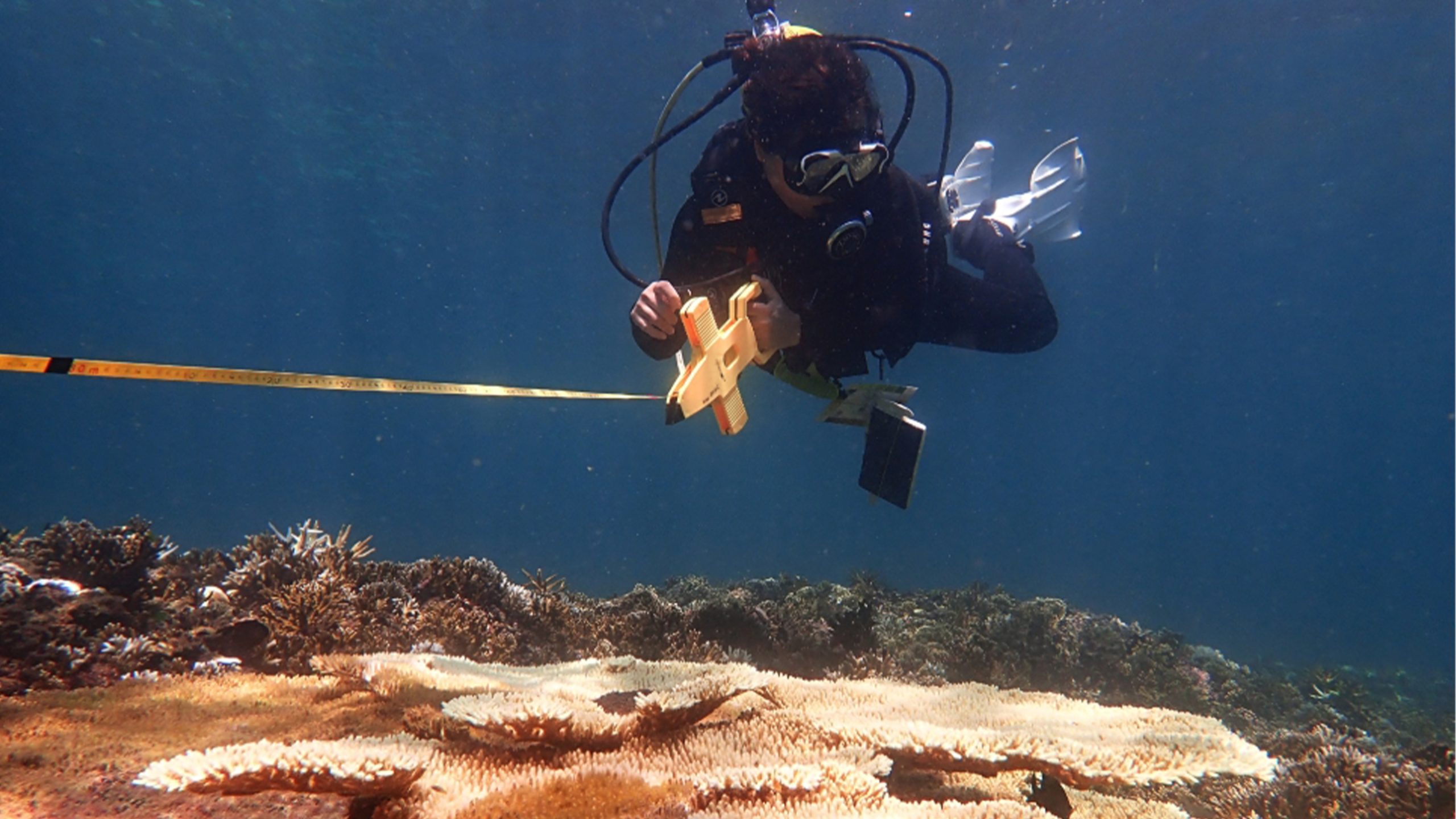
Coral reef resilience varies across the Philippines, with some coral species showing stronger resistance to bleaching caused by rising ocean temperatures.
Some corals are more resilient against coral bleaching than others.
By monitoring coral reefs in the West Philippine Sea from 2022 to 2025, researchers from the University of the Philippines Marine Science Institute (UP MSI) found that the effects of coral bleaching are site-specific.
In Bolinao and Anda, Pangasinan and Iba, Zambales, 60% to 77% of hard corals were bleached, most to a severe degree. In Lobo, Batangas and Puerto Galera, Oriental Mindoro, bleaching was milder and only affected 20% to 43% of the corals.
This reflects the strong effects of the record-breaking sea surface temperatures observed during the 2024 Global Coral Bleaching event. Severe coral bleaching and death will lead to dramatic long-term shifts in reef community composition.
Meanwhile, the new dominance of heat-tolerant corals suggests that marine biodiversity in the area may decline as warming hastens.
Either way, these extreme changes in Philippine reefs are undeniable.
The project, “Impacts of Marine Heatwaves in Select West Philippine Sea Reefs,” highlights the connection between increasing ocean temperatures and coral reef health. This project is funded by the Philippine Council for Agriculture, Aquatic and Natural Resources Research and Development of the Department of Science and Technology (DOST-PCAARRD).
It is a part of a larger collaborative effort with Indonesia’s Ministry of Education, Culture, Research and Technology and Japan’s Science and Technology Agency, “Marine Heat Waves in the Western Pacific: Detection, Mechanisms and the Impacts on the Coral Reef Ecosystem,” which aims to determine when and where the marine heatwaves occur, what causes them, and how they affect coral reefs.
Among the international team of experts leading the project is Dr. Maria Vanessa Baria-Rodriguez of UP MSI, working together with Prof. Anindya Wirasatriya of Diponegoro University in Indonesia and Prof. Toshio Suga of Tohoku University in Japan.
To assess the state of corals in the West Philippine Sea, UP MSI researchers regularly conducted underwater reef surveys for three years. These surveys enabled them to analyze and determine the percentage of hard corals, soft corals, macroalgae, algal assemblages, and dead corals within a patch of reef.
Sites where coral bleaching was severe, such as the reef sites in Bolinao, Anda, and Iba, had declined by 51-59% percent in hard coral cover in only two years.
In contrast, sites where coral bleaching was milder had declines that were much less extreme. In Puerto Galera, the decline was only 2%. There was also a 20% increase of hard coral cover in Lobo.
Concurrently, the Marine Heatwave Tracker was jointly developed by Dr. Charina Lyn Amedo-Repollo of UP MSI with support from DOST-PCAARRD. This tracker is an online tool that provides daily updates on marine heatwave events across the Philippine seas, using the latest sea surface temperatures from the Global OSTIA NRT dataset.
Partnering coral reef monitoring with marine heatwave monitoring is becoming increasingly essential as sea temperatures continue to rise and global warming worsens.
Studies suggest that marine heatwaves will become longer, more intense, and more frequent in the future. With less time to recover between bleaching episodes, 70-90% of the world’s reefs could be lost by 2050.
Through the project’s initiative, it is now possible to determine the location of marine heatwave events in near real-time. It is hoped that this can help local stakeholders identify sites under threat and focus monitoring efforts on potentially affected areas.
For longer-term mitigation, it is necessary to identify and prioritize resilient areas as potential climate refugia, and to enhance coral reef monitoring to detect early warning signs of bleaching. It is also advisable to continue monitoring affected areas to determine recovery potential. For recently damaged reefs requiring restoration, priority should be given to coral populations that survived thermal stress events, while also incorporating hydrodynamics in the planning process.
The continued monitoring of coral reefs, together with the timely detection of marine heatwaves, is essential to understanding where resilient coral reefs are and how this resilience can be replicated in other reefs.
However, these strategies can only be effective if climate change is also addressed.
Written By Dr. Maria Vanessa Baria-Rodriguez

 Facebook
 Twitter