
Chico fruit (Manilkara zapota) is often described as one of the sweetest tropical fruits in the world. Gonzalo Hernandez de Oviedo, one of the first Europeans to study the plants of the New World, called it “the best of all fruits.” French botanist Michel Etienne Descourtilz also praised chico fruit for its sweet perfumes of honey, jasmine, and lily of the valley.
“The best of all fruits” – that was how Gonzalo Hernandez de Oviedo, who was one of the first Europeans to study the plants of the New World, described chico (scientific name: Manikara zapota). Poetic French botanist, Michel Etienne Descourtilz, hailed the fruit as having “the sweet perfumes of honey, jasmine, and lily of the valley.”
Generally round, the thick skin of the fruit is rusty brown and somewhat scurvy. The flesh in the ripe fruit is yellow-brown, translucent, soft, sweet, and delicious, but when immature it contains tannin – one reason why it should not be eaten until fully ripe.
If you haven’t tasted chico yet, the flavor is likened to that of pears and brown sugar together; it is rich, slightly fragrant, and very pleasing to those who like sweet fruits (it contains 14 percent sugar, of which 7.02 is saccharose, 3.7 dextrose, and 3.4 levulose). Although a poor source of vitamin C, it abounds in calcium, phosphorus, and iron.
Chico can be processed as an ingredient in ice creams, made into jams or butter, vinegar and preserves. Chico jam or butter is flavored with calamansi juice (1 cup for every four tablespoons). Chico vinegar comes from the fermented syrup of chico juice. Sweet chico preserve is made by sterilizing the fruit in boiling water for 25 minutes using a sugar-water solution (1:1).
Some parts of chico trees have medicinal properties. The leaves contain weak alkaloids while young bark possesses saponins and alkaloids. The flowers are used as ingredients for a powder preparation used by women after giving birth. The tannin taken from matured barks is used as a cure for diarrhea and fever in Cambodia.
Chico has other economic uses – aside from its sweet fruits. The bark produces a milky latex, the source of chicle (a major ingredient of chewing gum). The trunk is used in port construction, and for making furniture and cabinets. Tannins from mature trees are excellent in treating ship sails and fishing gadgets.
In spite of good prospects, chico is not grown commercially. In fact, only about 3,100 hectares are planted to chico, most of them are found in Southern Tagalog and Ilocos region. In Visayas, it is grown mostly in Western and Central Visayas. Most of the chico grown in Mindanao can be found in Southern Mindanao.
To think of it, chico grows anywhere in the country. It grows at an elevation of up to 10,000 meters. It can be grown in a wide range of soil types; it can even grow well in sandy soil with soft limestone underneath. But for optimum production, it must be grown in rich, well-drained, sandy loam or clay loam soils. Waterlogged areas must be avoided as they retard the growth of chico trees.
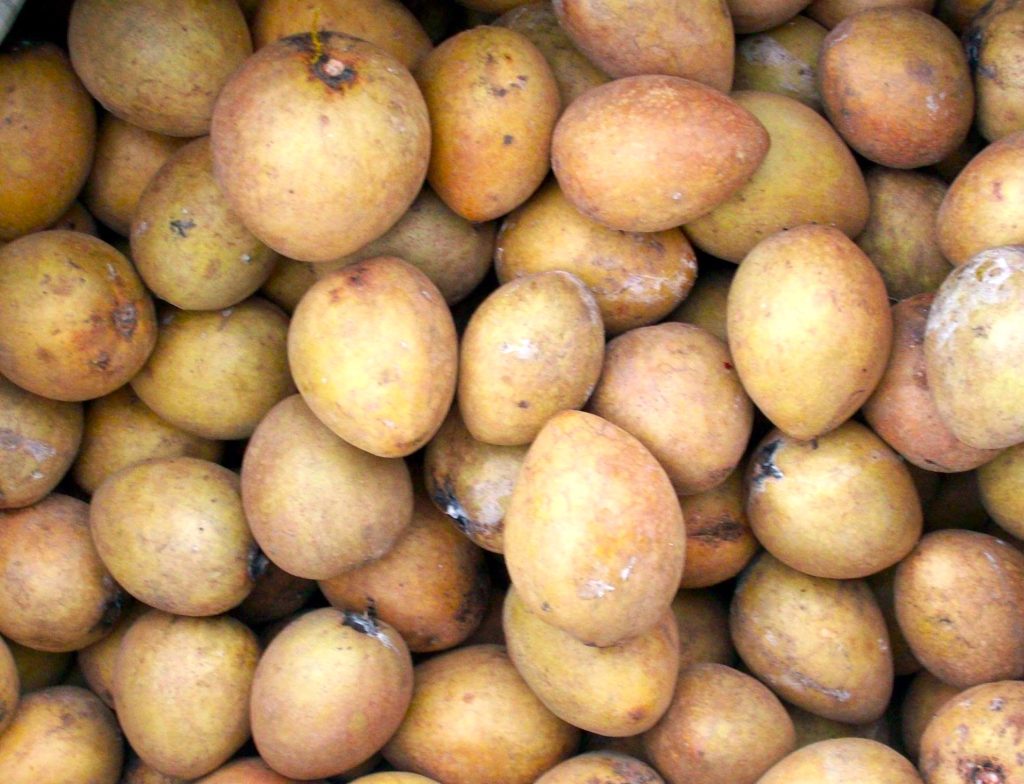
There are four types of varieties you can grow: Pineras, Ponderosa, Sao Manila and Gonzales. Pineras is also known as the native chico and its fruit is thin-skinned, firm, very sweet, juicy and aromatic. Ponderosa was introduced from Java and the size of its fruit is variable. Its flesh is very smooth in texture, very sweet, and juicy and melting in taste.
Sao Manila, whose fruit is very sweet, juicy and smooth-textured, came from Indonesia. The fruit of Gonzales ripens uniformly and is very sweet, juicy and very fine in texture. Both varieties are prolific.
Chico can be propagated by seeds but it is not recommended since it takes a long time. Budding, grafting, and marcotting are the common vegetative means of propagation. Grafted trees bear fruit in 4 to 5 years after planting. The fruit matures throughout the year, but is most abundant during March and April.
For backyard planting, simply dig a hole large enough for the ball of soil supporting the plant. Set the plant in the hole and fill up the space with soil.
For large-scale planting, the land must be plowed and harrowed several times. Chico seedlings can be planted 6-8 meters apart using the triangular or square system of planting. This spacing can accommodate about 156 to 256 plants per hectare for the square system and 180 to 318 plants per hectare for the triangular system.
According to Agribusiness Opportunities, planting should be done at the start of the rainy season (May to June) to reduce the need for frequent watering. “Water the plants immediately after transplanting,” the book said.
Watering is done after transplanting. “The plants should be watered at least once every two weeks during the dry months,” wrote Flordeliza B. Javier, author of Chico Production. “It is recommended to water plants or apply irrigation in the first 3-4 years after planting in the field to ensure proper growth and establishment.”
Even when the chico trees are flowering and bearing fruits, they need water. “Water greatly improves the quantity and quality of fruits,” Javier informed.
Like most crops, chico trees need fertilizer. “Determine the nutrients status of the soil by chemical analysis,” suggests Agribusiness Opportunities. “This will tell you how much fertilizer is needed. If that is not possible, just follow the general fertilizer recommendation for chico.”
For young trees, application of 250-500 grams of ammonium sulfate per tree per year is recommended. Good nutrition will sustain the growth of the plant. But once they have grown and start to bear fruits, the amount of fertilizer applied should be increased.
During the tree’s formative years, very low branches should be removed. “Prune dead, weak or diseased branches as well as those that rub other branches,” Agribusiness Opportunities points out.
The major pests of chico trees in the country are aphids, borers, fruit flies, mealy bugs, moths and scale insects. Consult the Department of Agriculture in the area on how to control them. When using pesticides, be sure to follow what is recommended in the label.
On when to harvest, Javier wrote: “Fruits are ready for harvest when they can be easily detached from the stem with little or no latex flowing. They ripen in one to three days. Another harvesting index is the color of the skin. Mature fruits have yellowish brown color while immature fruits have greenish skin after the removal of the brown powdery material covering the skin.” The fruits are harvested by hand or by using poles called sigpaw.


 Facebook
 Twitter