
Farm productivity remains a major challenge for upland farmers in Barangay Kinusksan, Bansalan, Davao del Sur, despite the use of high-yielding crop varieties and commercial fertilizers.
Upland farmers near the vicinity of barangay Kinuskusan in Bansalan, Davao del Sur complained that their corn production continued to decline despite the fact they were planting high-yielding varieties and using commercial fertilizer.
Some of the farmers came to the Mindanao Baptist Rural Life Center (MBRLC), a non-government organization which conducts regular training for farmers in the area. When Harold R. Watson, the center’s director at that time, heard of their problems, he sent some of his extension workers to look at the situation.
After a thorough investigation, the extension workers reported that the problem of the farmers wasn’t the varieties they were planting or the use of commercial fertilizer but it was underneath. The land they were using was devoid of topsoil, the upper layer of soil which has the highest concentration of organic matter and microorganisms.
Studies show that soil can be formed in as little as 200 years, but the process normally takes far longer. Under most conditions, soil is formed at a rate of one centimeter every 100 to 400 years, and it takes 3,000 to 12,000 years to build enough soil to form productive land.
Soil erosion
Soil is the world’s most precious natural resource. “Essentially, all life depends upon the soil,” said Charles Kellog, an American conservationist. “There can be no life without soil and no soil without life; they have evolved together.”
Unfortunately, unprotected soil is washed out in a matter of seconds when there is heavy rain. “Without soil, there would be no food apart from what the rivers and the seas can provide,” said Edouard Saouma, former director general of the UN Food and Agriculture Organization.
A farm experiences a reduction in its topsoil as a result of erosion. While this phenomenon has always occurred naturally, it was noted that during the 19th century, the rate of topsoil loss attributed to agricultural practices exceeded the rate of soil formation, as stated by Lester Brown, president of the Earth Policy Institute.
In the Philippines, soil erosion is regarded as one of the most significant environmental challenges. The country’s steep terrain, deforested uplands, and frequent heavy rainfall contribute to its heightened vulnerability to soil erosion.
Soil erosion poses a significant challenge to agriculture, representing a critical concern that undermines sustainability and productivity. Its repercussions extend to the climate crisis and threaten food security.
“Soil erosion decreases soil fertility, which can negatively affect crop yields,” declares the Washington, D.C.-based World Resources Institute. “It also sends soil-laden water downstream, which can create heavy layers of sediment that prevent streams and rivers from flowing smoothly and can eventually lead to flooding. Once soil erosion occurs, it is more likely to happen again.”
The Department of Environment and Natural Resources (DENR) reported that 75% of the country’s cropland is at risk of erosion to varying extents, resulting in an annual loss of approximately 457 million tons of soil. Furthermore, 2.2 million hectares are experiencing inadequate soil fertility, exacerbated by the misuse of fertilizers and pesticides.
“Soil erosion is an enemy to any nation – far worse than any outside enemy coming into a country conquering it because it is an enemy you cannot see vividly,” said Watson when he received the 1985 Ramon Magsaysay Award for peace and international understanding. “It’s a slow creeping enemy that soon possesses the land.”
Sloping Agricultural Land Technology
Watson was cited for helping control erosion not only in the Philippines but also in various parts of Asia. Watson, an American agriculturist from Mississippi, and his Filipino associates developed Sloping Agricultural Land Technology (SALT) as a method which could abate soil erosion.
SALT is actually a systematized scheme of growing crops (both field and permanent) between contoured rows of nitrogen fixing trees and shrubs (NFT/S) like Flemingia macrophylla, Desmodium rensonii, Indigofera anil, Gliridicia sepium and Leucaena leucocephala, which are set up 4-6 meters apart.
The NFT/S are planted in very dense double rows to make hedgerows that serve as erosion barriers. When the NFT/S are 1.5 to two meters tall, they are cut back to about 40 centimeters and the cuttings are placed in the 3-5 meter alleys where crops are growing. The leaves of NFT/S make very good nitrogen-rich fertilizer and also add organic matter to the soil.
“SALT is a diversified farm system,” says Jethro P. Adang, the current MBRLC director. In addition to NFT/S, rows of perennial crops such as coffee, bananas, and citrus may be grown among the corn. The annual crops are rotated: corn is followed by soybeans or peanuts and then followed again by corn. “In this way, a farmer has something to harvest year-round,” he adds.
In a study conducted at the MBRLC farm, it was found that SALT really helps in controlling soil erosion. The study showed that traditional farming practices result in soil erosion at a rate of 1,163.4 metric tons per hectare annually. In contrast, a SALT farm experiences significantly lower erosion, with a rate of only 20.2 metric tons per hectare per year during the same timeframe.
The soil loss rate on a SALT farm is measured at 3.4 metric tons per hectare per year, which falls within the acceptable limits. Soil scientists generally consider the tolerable soil loss for tropical countries, like the Philippines, to be between 10 and 12 metric tons per hectare annually. Conversely, the non-SALT farm exhibits a much higher annual soil loss rate of 194.3 metric tons per hectare.
Vetiver grass
On the other side of the MBRLC farm is Balutakay of barangay Managa in the rolling foothills of Mount Apo, the country’s highest peak. It used to be a forested area but is now teeming with agricultural crops. Aside from coffee and bananas, farmers are also planting high-value crops like cabbage, carrots, green onions, potatoes, ornamentals, and strawberries.
Aside from soil erosion, Balutakay is also experiencing a water crisis. Experts claim that when an area is devoid of trees, the evaporation level is disturbed, which in turn dries up the moisture needed to continue the water cycle. The water cycle balance is greatly affected, leading to drought in critical agricultural areas.
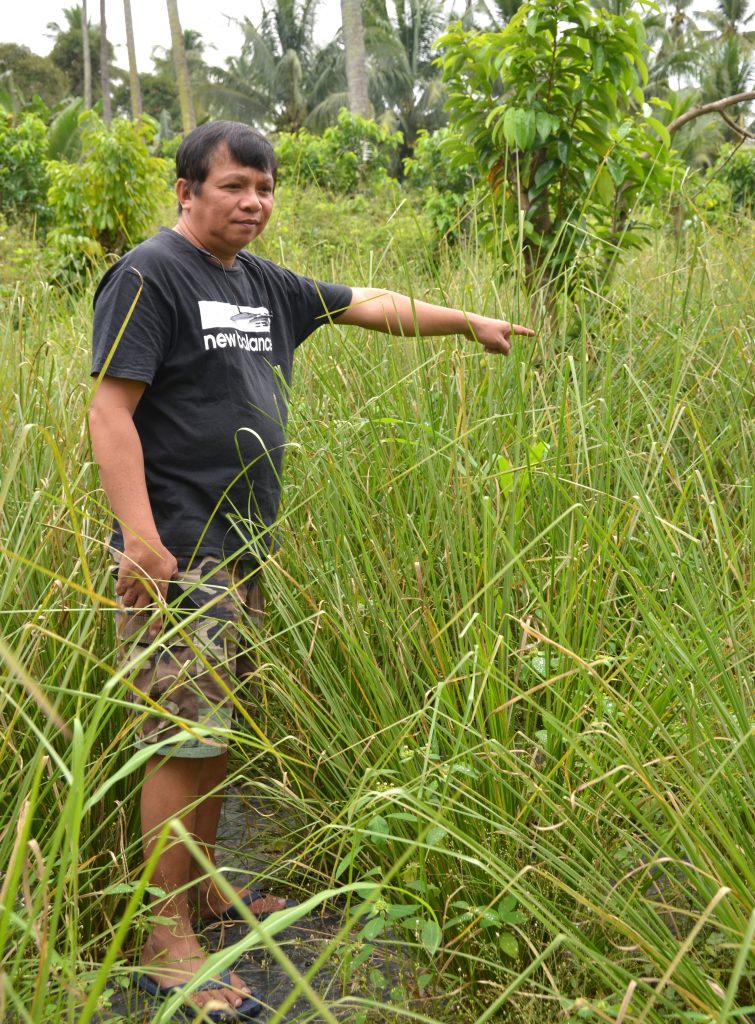
Allan B. Ampoloquio, a business administration graduate who loves farming, is very much aware of these consequences. “Our precious highland resources are our best protection against hazards, disasters and drinking water problems,” he said Ampoloquio. “Trees that prevent soil erosion and excellent aid in water conservation through absorption and percolation of rain water to the ground are sadly gone.”
The slopes of Balutakay, for instance, no longer have natural hedges against soil erosion and rainwater runoff. “Clearing the upland’s forest covers coupled with conventional farming techniques of tilling and using synthetic fertilizers have hardened the soil,” he pointed out.
If he has his way, he wants to bring the greenery of Balutakay. It may not be accomplished by planting trees but instead by incorporating vetiver grass into the crops planted by farmers.
“God has given us a simple, nature-based solution to the problem,” Ampoloquio said, adding that the vetiver grass technology is aided by years of research and experience by more than 100 countries around the world.
“Vetiver grass is known to offer a green and cost-effective way to slope protection, soil erosion, rehabilitation of degraded land, restoring soil health, and preserving water,” he said.
Ampoloquio believed that by embedding vetiver grass in farms, the soil—which has been exposed for several years and now heavily compacted due to the absence of organic matter—can be restored. “The benefits of companion planting, mulching, and integrated pest management is projected to provide farmers with better harvest, profitability and sustainability,” he said.
Soil testing
But it’s not enough to control soil erosion to make the farm productive. The soil should be healthy enough to make crops grow and provide a good harvest. This could only be known by testing the soil.
“I believe the lack of soil information among farmers is the main cause of soil infertility,” says Dr. Johnvie B. Goloran, who has a PhD in soil science and postdoctoral training in soil health and plant nutrition from Australia’s Griffith University and the Laguna-based International Rice Research Institute.
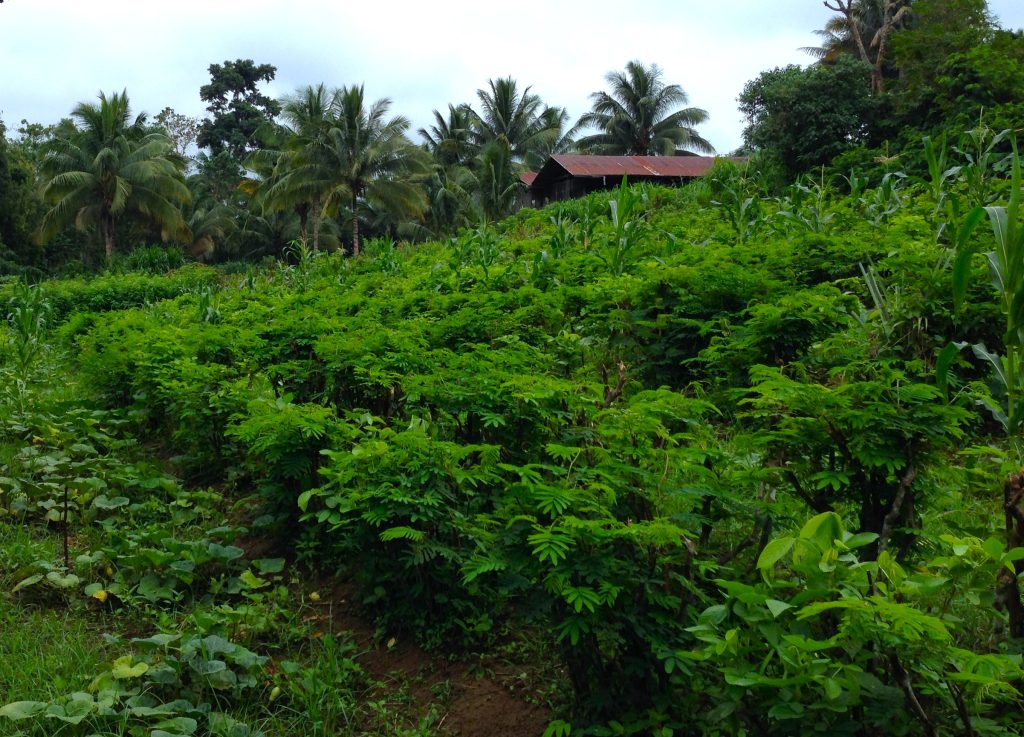
The reason why crops – cereals, fruits and vegetables – grow in fields is because the topsoil contains lots of nutrients. “Some forms of nutrients such as phosphorus and nitrate are highly mobile in water,” Dr. Goloran explains. “This is the reason why minimum tillage and cover cropping are recommended as these provide protection of the topsoil.”
In a natural state, plants grow and die. The nutrients they contain return to the soil and new plants use them to grow. But agriculture disturbs the cycle: farmers harvest the plants and people eat them.
Even in the past, farmers have unearthed several ways to prevent crop yields from declining over time. “First, farmers need to have good soil information for their farm lands, and based on these soil data, they can develop a suitable nutrient management practice for their farms,” Dr. Goloran says.
This is where soil testing comes in. “Soil testing gives you the critical information on the nutritional status of your farm,” he says. “This means that farmers would be able to select what type and rate of fertilizers are suitable to maintain a good nutritional status of the soils and at the same time address the nutritional requirements of the crops.”
Soil testing can really help farmers in optimizing their crop production. “The standard practice should be that farmers would get not just the soil test results but also a set of recommendations for the crop that they prefer to plant on their farms,” Dr. Goloran says.
Doing so, the farmer can have a saving. “You don’t give your plants what they don’t need,” he says.
Farmers can use both organic and inorganic fertilizers to restore the fertility of their farmers. “We have to understand that organic and inorganic fertilizers are both food to crops,” he points out. “The former takes time as it needs to be mineralized before it will be taken up by the plants. The latter is already available for crop uptake.”
Farmers are also urged to understand the time element on the effects of both organic and inorganic fertilizers. “If their crops need urgent attention, farmers have an option which one to choose,” Dr. Goloran says. “One thing that I would like to emphasize, regardless of fertilizer sources, be it organic or inorganic, both require soil testing as a prerequisite, so that farmers would know the rate and type of fertilizer to be applied to their crops.”
Both organic and inorganic fertilizers have drawbacks. “Both have disadvantages when we are talking about excessive rates of application,” he points out. “I think the discussion should not only be about the sources or types of fertilizer but about the rate. At the moment, farmers do not have the luxury to determine the appropriate rate because they do not have the critical soil information.


 Facebook
 Twitter