
Integrated pig-fish farming is an effective method to optimize fishpond production while increasing farm income. By combining pig raising with aquaculture, farmers can improve pond fertility, reduce feed costs, and promote sustainable agricultural practices.
Farmers can optimize production in their fishponds by raising pigs, according to the Davao-based Mindanao Baptist Rural Life Center (MBRLC) Foundation, Inc.
“The raising of pigs can profitably be blended with fish culture by constructing animal housing units on the pond embankment or over the pond in such a way that the wastes are directly drained into the pond,” explains Jethro P. Adang, MBRLC Director.
MBRLC is a non-government organization based in Kinuskusan, Bansalan, Davao del Sur. Its former director, Harold R. Watson, received the 1985 Ramon Magsaysay Award for peace and international understanding.
Integrated pig-fish culture, as the scheme is called, is not a new concept. It has been practiced for many years in most Asian countries, particularly India.
The system has obvious advantages:
· The pig manure acts as excellent pond fertilizer and raises the biological productivity of the pond and consequently increases fish production;
· Some of the fish feed directly on the pig excreta, which contains 70 percent digestible food for the fish;
· No supplementary feed is required for the fish culture which normally accounts for 60 percent of the total input cost in conventional fish culture;
· The pond serves as a sanitary disposal place for animal wastes. Pond water, on the other hand, may be used for cleaning the pigsties and for bathing the pigs; and
· Backyard integrated pig-fish culture provides additional income and a cheap source of animal protein for the farm family.
To start this system, MBRLC recommends that the fishpond be established near a water source. The site must also be free from flooding.
According to Adang, one pig can sufficiently fertilize a 100 to 150 square meter pond with its manure. The water depth should be maintained at 60 to 100 centimeters.
“With this recommended pond area and water depth, together with the right stocking density, problems of organic pollution are minimized if not avoid,” Adang says.
MBRLC also encourages the construction of a diversion canal to channel excess manure into a compost pit or when manure loading needs to be stopped.
As for the pig pen, it must be constructed over the dikes near the fishpond. Preferably, the floor should be made of concrete and should slope toward the pond. A pipe is necessary to convey the manure into the pond.
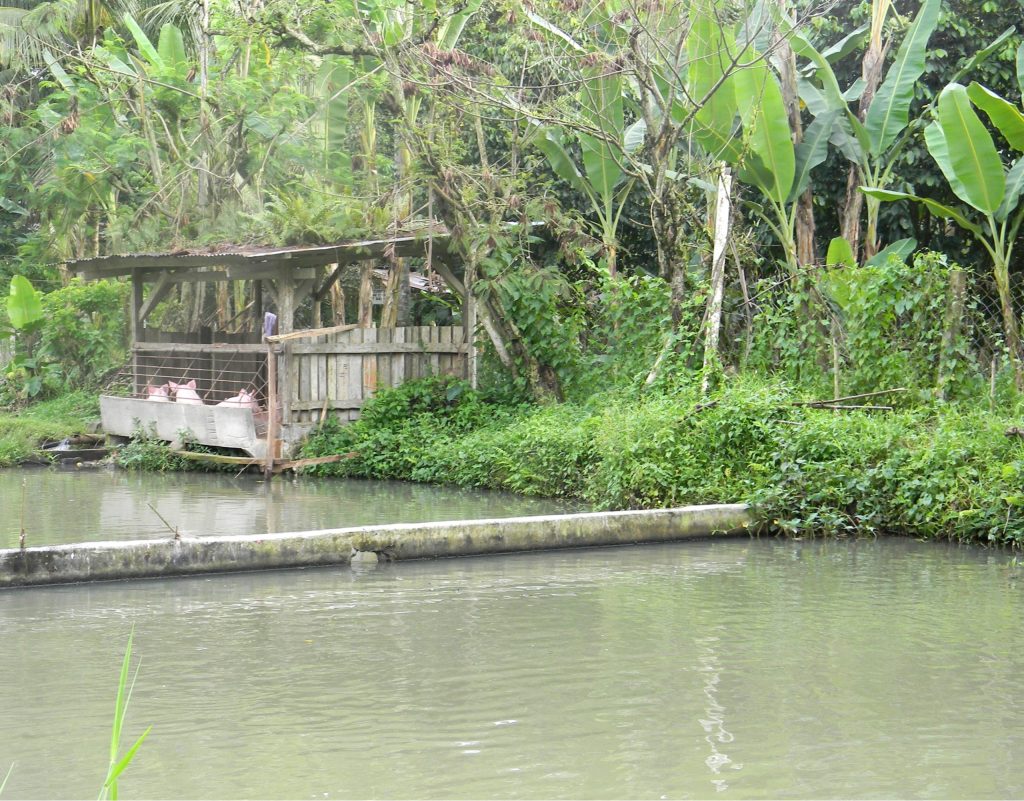
An alternative design is to construct the pig pen over the pond. The floor is made of bamboo slats spaced just enough to allow manure to fall directly into the pond. “But the distance of the bamboo slats must not be too wide for the feet of the pigs to slip into thus causing injuries,” Adang reminds.
The recommended floor area of the pond is one meter by one-and-half-meters for each pig.
The pond is stocked with fingerlings once it is filled up with water. The recommended stocking rate for monoculture of tilapia is two fish (with average weight of three to five grams) per square meter.
For polyculture, 200 fish per 100 square meters is highly recommended. The suggested combination is 85 percent tilapia (170 fingerlings), 13 percent common carp (26 fingerlings), and 2 percent of snake heads (four fingerlings).
The pig pen, on the other hand, is stocked with 8 to 10 kilograms or one-and-a-half months-old weanlings. Fish and piglets may be stocked simultaneously.
The pigs must be fed twice a day, MBRLC says. Supplemental feeds like ipil-ipil and kangkong may be given. The pigs may be sold after four to five months. “If you sell your pigs beyond five months, it may no longer be profitable as they will consume too much feeds already,” Adang says.


 Facebook
 Twitter