
Pine tree pollen tilapia research has revealed that compounds found in pine pollen can trigger sex reversal in female tilapia, a discovery with potential benefits for aquaculture.
Although it is not an endemic fish in the country, the Philippines is now one the world’s largest producers of tilapia, according to a fishery expert who used to be the executive director of the Philippine Council for Marine and Aquatic Research and Development.
“The Philippines is now the fourth largest producer of tilapia in the world,” said Dr. Rafael D. Guerrero III, an Academician of the National Academy of Science and Technology, adding that the country is just behind China, Egypt and Indonesia.
“Tilapias are early-maturing and prolific breeders,” he said. “The fishes become sexually mature at two to three months and females are capable of spawning a hundred to a few hundred eggs, depending on size.”
Sexes are differentiated externally by examining the structure behind the anus. The male has only one opening in the structure while the female has two openings. Male tilapias grow faster than females.
Tilapia’s high production rate often results in overcrowded ponds and stunted fish. In the past, hand sexing — separating males from females — was the solution being used. But doing so takes time. That’s why Dr. Guerrero developed the sex reversal technology.
According to him, artificial sex reversal is considered the most effective, efficient and economical method for solving the major drawback of growing tilapias to market-size caused by unwanted reproduction.
“With mix-sex (male and female) stocks, the fish matures early and breeds frequently resulting in stunted growth due to overpopulation in ponds,” he explained. “By growing all-male tilapia produced through hand-sexing (manual separation of sexes), hybridization (crossbreeding of two appropriate species) or sex reversal, the yield of large-sized tilapias is significantly increased by 30% to 50% because of the faster-growing males compared to females and the control of reproduction.”
In his study, he used a tilapia sex reversal feed – called SR Premix – which he himself formulated. For his discovery, he received several citations from different award giving bodies. In 2004, he was conferred the Mgr. Jan D.F. Heine Memorial Award by the International Tilapia Foundation.
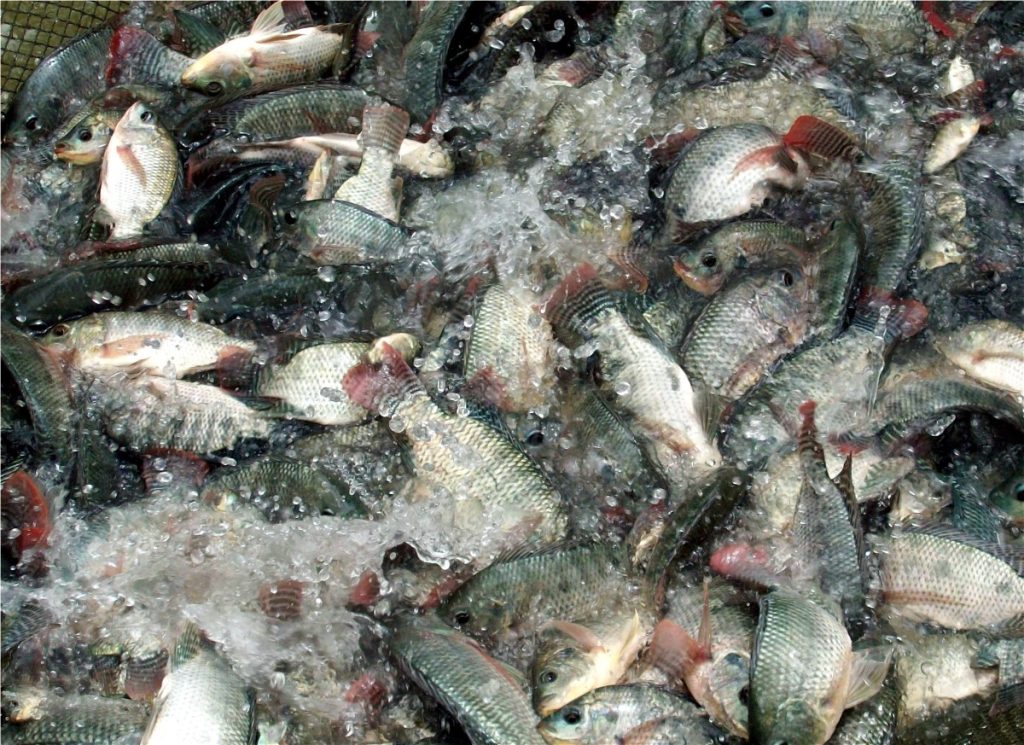
The synthetic sex hormone used in sex reversal technology is called methyltestosterone, a man-made form of testosterone. A naturally occurring sex hormone, testosterone is produced in a man’s testicles. Small amounts of testosterone are also produced in a woman’s ovaries and adrenal system.
“Methyltestosterone is used in men and boys to treat conditions caused by a lack of this hormone, such as delayed puberty or other hormonal imbalances,” the www.drug.com informed. “Methyltestosterone is also used in women to treat breast cancer that has spread to other parts of the body.”
But instead of using a commercial sex hormone, pollen from pine trees may do the same trick, according to a study of the Central Luzon State University (CLSU).
“The use of pine pollen in its unprocessed condition enables the change of sex of young fishes used for breeding, turning in 84.59-90.46% males,” said Dr. Ravelina R. Velasca, of CLSU’s Freshwater Aquaculture Center, who headed the study.
Unprocessed condition means the pollen still has a protective cover.
“The use of pine pollen technology in tilapia sex change eliminates health hazards associated with all-male tilapia production,” she added. “It is an environment-friendly approach and could be an alternative to the use of high-priced standard hormones in sex change.”
Should the synthetic sex hormone be banned, the pine pollen – particularly from Benguet pine (Pinuskesiya) could be used in reversing the hormone of tilapia.
But the good thing about pine pollen technology is that it does not cause deposits of harmful chemicals onto the soil of the pond, which is common in using the standard hormone. “Using the natural product contributes to improving management and standard practices of tilapia culture,” Dr. Velasca wrote in a report published by Bridge, a compilation of success stories collected by the Department of Science and Technology (DOST).
Pine pollen is the male part of the pine tree. A raw pine pollen, it has been discovered, contains the richest seedbed of male hormone, the testosterone derived from plants. “The male and the female reproductive organs are found in the same tree,” Dr. Velasca said.
Pine pollen is easily absorbed by tilapia when taken in powder or in liquid form dissolved in alcohol.
In the CLSU study, the young tilapia fingerlings with no identified sex are fed with different concentrations of pine pollen dissolved in alcohol for 28 days. “For example, 40 milligrams of pine pollen are added and soaked with 62.5 millimeters of alcohol. After seven days of soaking, the filtered liquid is added to 125 grams of commercial feed, fry mash,” Dr. Velasca said.
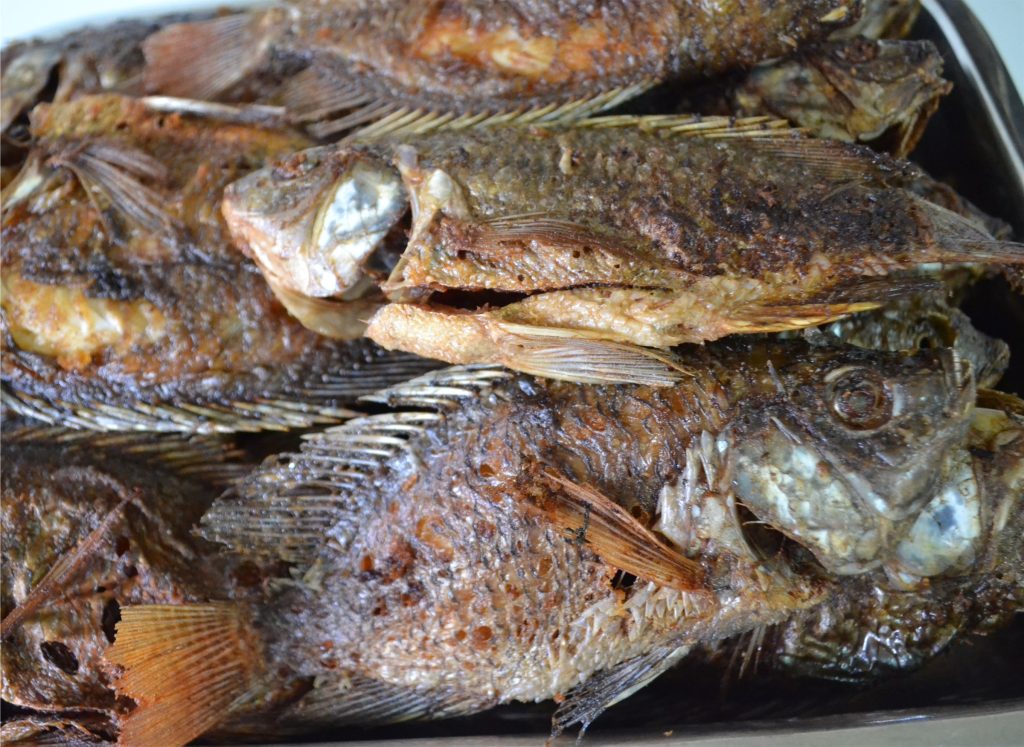
The feed with the pine pollen solution is air dried and fed to the young fish for 28 days. The feed with pine pollen solution is given 6-8 times per day. After the 28th day, the fish fed with pine pollen solution is transferred to a bigger area and allowed to grow bigger.
“We check the number of males by visually looking at the hole in the belly,” Dr. Velasca said. “In cases it is hard to identify the sex by just looking at the belly, we cut the belly and check the reproductive organ under the microscope.”
But are these tilapia given pine pollen solution safe to eat?
Dr. Guerrero said the oral treatment with methyltestosterone in tilapia is only for 3-4 weeks during the sexless stage of the fry or what he calls as “the stage of sexual differentiation.”
“After withdrawal of the treatment,” he assured, “there are no residuals left in the system of the fish after 92 hours. Since the fry are grown for at least 3-4 months for market and human consumption, it is very safe. There can, therefore, be no side effects if there is no synthetic hormone left in the systems of the fish.”
The use of methyltestosterone for tilapia sex reversal is generally accepted throughout the world except in Europe which has a strict organic (no synthetics) policy. “So far, since its application more than 30 years ago, there has been no negative or harmful effect on humans reported,” Dr. Guerrero said.
If synthetic sex hormone is safe to eat after 3-4 months, how much more for the natural pine tree pollen?


 Facebook
 Twitter