
Sustainable farming technologies are becoming essential in addressing soil erosion, a growing threat to agricultural productivity and environmental stability. Farmers worldwide are adopting innovative methods to protect topsoil, reduce land degradation, and ensure long-term food security.
“For the wages of sin,” says the Holy Bible, “is death” (Romans 6:23).
“When man sins against the earth, the wages of that sin is death or destruction. This seems to be a universal law of God and relates to all of God’s creation,” Harold R. Watson, then the director of the Davao-based Mindanao Baptist Rural Life Center (MBRLC) told this author.
“We face the reality of what man’s sins against the earth have caused,” he further said. “We see land degradation expressing itself in destruction of forests, loss of topsoil, pollution of streams and even the air we breathe. We are not just facing a mere problem; we are facing destruction and even death if we continue to destroy the natural resources that support life on the earth.”
He was talking from experience. “When I got here, I had no idea what the problems were up in the hills,” recalled Watson, who came to the Philippines in the early 1960s. “Farming looked pretty good on the surface.”
Watson soon came to realize that the issue lay with the surface, which was eroding. Loggers – both legal and illegal – were extracting timber from the previously verdant mountains, resulting in barren hillsides. Indigenous communities and migrants were employing slash-and-burn techniques to clear and cultivate the highlands, leading to a rapid loss of topsoil. This situation resulted in diminished agricultural yields, widespread hunger, and a sense of despair.
“Soil erosion is an enemy to any nation – far worse than any outside enemy coming into a country and conquering it because it’s an enemy you cannot see vividly,” said Watson when he received the Ramon Magsaysay Award in 1985 for international understanding. “It’s a slow creeping enemy that soon possesses the land.”
For developing countries like the Philippines, soil erosion is among the most chronic environmental and economic burdens. “Erosion is a double disaster: a vital resource disappears from where it is desperately needed only to be dumped where it is equally unwanted,” said the Nobel Prize-winning Norman E. Borlaug.
Watson warned that soil erosion will imperil the country’s food supply in the coming years. “Land is not being remade,” he averred. “Soil is made by God and put here for man to use, not for one generation but forever. It takes thousands of years to build one inch of topsoil but only one good heavy rain to remove one inch from unprotected soil on the slopes of mountains.”
Under most conditions, soil is formed at a rate of one centimeter every 100 to 400 years, and it takes 3,000 to 12,000 years to build enough soil to form productive land. “This means that soil is, in effect, a non-renewable resource,” says the UN Food and Agriculture Organization (FAO). “Once destroyed, it is gone forever.”
The factors contributing to soil erosion are widely recognized, as are the methods employed to mitigate it. Over the years, a diverse range of strategies aimed at controlling erosion has been systematically developed and enhanced.
Sloping Agricultural Land Technology
In the Philippines, one of the most advanced erosion controls is the Sloping Agricultural Land Technology (SALT) developed by the MBRLC.
“SALT significantly mitigates the risks associated with drought, landslides, floods, the silting of low-lying areas, and wind erosion, all of which are connected to the drastic alteration of the natural environment and the devastation of mountain forests,” said Jethro Adang, the current MBRLC director. “It also transforms unsightly eroded and barren slopes into vibrant landscapes adorned with lush vegetation.”
More importantly, SALT helps control soil erosion. A research study carried out at the MBRLC farm revealed that traditional farming practices result in soil erosion at a rate of 1,163.4 metric tons per hectare annually. In contrast, a SALT (Sloping Agricultural Land Technology) farm experiences significantly lower erosion, with a rate of only 20.2 metric tons per hectare per year during the same timeframe.
The soil loss rate on a SALT farm is measured at 3.4 metric tons per hectare per year, which falls within the acceptable limits. Soil scientists generally consider the tolerable soil loss for tropical countries, such as the Philippines, to be between 10 and 12 metric tons per hectare annually. Conversely, the non-SALT farm exhibits a much higher annual soil loss rate of 194.3 metric tons per hectare.
The SALT scheme necessitates meticulous management of the spacing between hedgerows. It is advisable to implement a blend of permanent, semi-permanent, and annual crops to restore the ecosystem and optimize yields, while also allowing farmers to manage their time effectively.
Within a SALT farm, you can find a combination of permanent crops, cereals, and vegetables. Typically, every third strip of land is allocated to permanent crops (coffee, banana and cacao), while the remaining two strips are utilized for various cereals (corn, upland rice and sorghum) and vegetables (bush sitao, sweet potato, mung bean, etc.).
Each type of crop is given a specific area to facilitate seasonal rotation. According to Adang, the significance of regular crop rotation is that it aids in maintaining the regenerative qualities of the soil and mitigates the infertility issues commonly associated with conventional agricultural methods.
The success of the SALT initiative have led to the development of three additional systems: Simple Agro-Livestock Technology (SALT), which incorporates livestock management into the SALT framework; Sustainable Agroforest Land Technology (SALT 3), which focuses on the dual production of food and timber; and Small Agrofruit Livelihood Technology (SALT 4), which involves the simultaneous planting of fruits and trees in a shared space.
“All the SALT systems can aid in restoring productivity to degraded lands. They are also applicable in newly cleared areas to mitigate soil erosion,” Adang pointed out.
Vetiver grass
Vetiver grass is recognized for its environment-friendly and economical approach to slope stabilization, soil erosion control, land rehabilitation, soil health restoration, and water conservation. Those words were from the mouth of Allan B. Ampoloquio, a business administration graduate with a passion for agriculture.
This is why he is encouraging farmers in barangay Balutakay, located in Bansalan, Davao del Sur, to incorporate vetiver grass into their agricultural practices. The majority of farmers in this region cultivate high-value crops such as cabbage, carrots, radishes, sweet peppers, tomatoes, and green onions. Historically, many farmers focused on coffee cultivation.
Balutakay, situated at the gentle slopes of Mount Apo, has gained recognition for its award-winning coffee. Consequently, some farmers are returning to coffee cultivation. Ampoloquio is convinced that integrating vetiver grass into coffee plantations can rejuvenate the soil, which has become heavily compacted over the years due to a lack of organic matter.
“The advantages of companion planting, mulching, and integrated pest management are expected to enhance farmers’ yields, profitability, and sustainability,” said Ampoloquio.
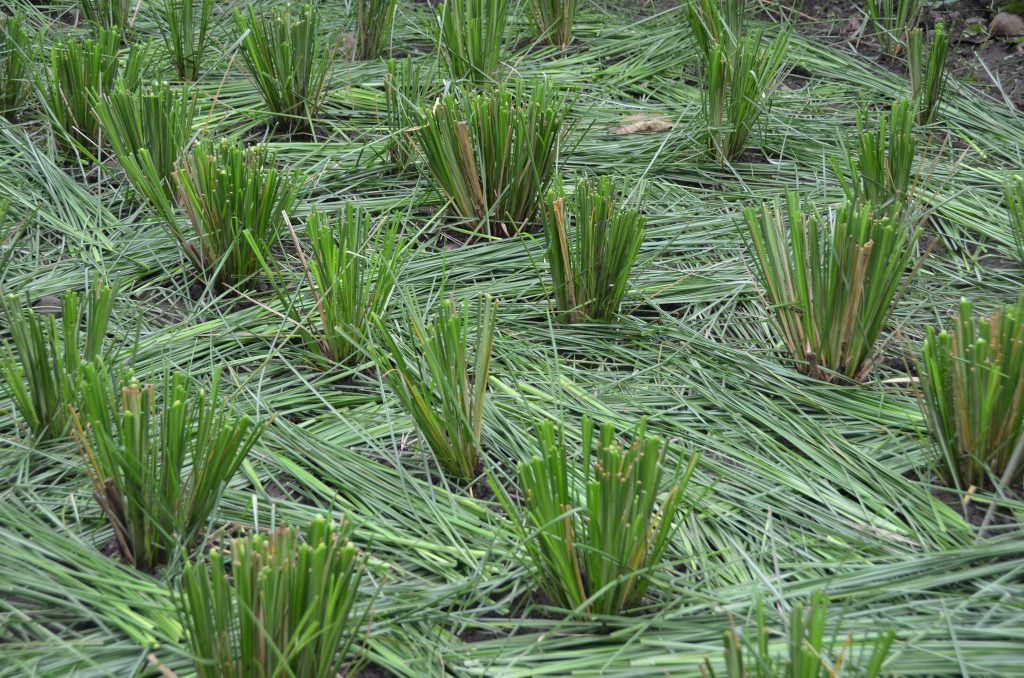
Vetiver grass, locally called rimoras or moras, is easy to grow with minimal maintenance. If allowed to grow further for a long period of time, vetiver grass can live up to 10 years. Once established, it is not easily killed by cogon grass. It can be planted as a hedgerow (planted in a row) across the sloping contour of a farm. It forms a dense barrier that slows down and spreads rainfall runoff.
Vetiver grass contributes much to the control of topsoil erosion, according to a study conducted by the Visayas State University. The transported soil is accumulated along the vetiver hedgerows where it is trapped. Vetiver grass has an expanded/dense base which can serve as a physical barrier preventing soil and water from passing through.
The Laguna-based International Rice Research Institute (IRRI) has conducted a study using vetiver grass as a way to reduce erosion in upland rice fields and to reinforce the bunds around the paddies in the lowlands.
Terracing
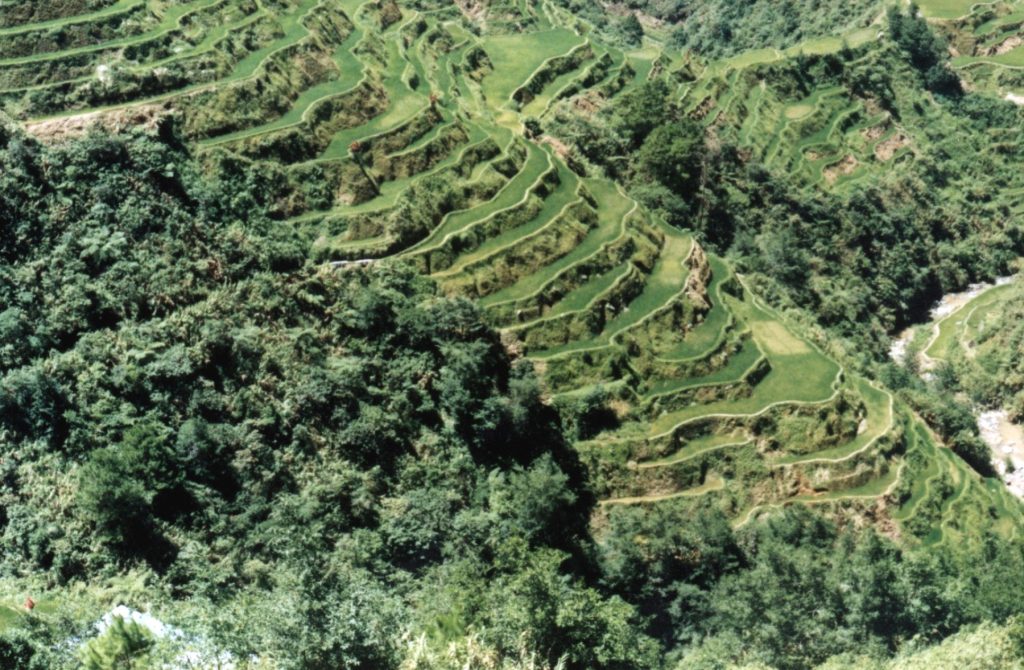
Historians said the rice terraces were ingeniously carved out of the mountains by the Ifugaos for rice farming. Archaeologists believe that the Ifugaos, who began constructing the terraces 20 centuries before Christ, migrated from Indo-China to Luzon.
Despite its high labor requirements during construction and maintenance, terracing for erosion control is widespread in Asia. “That they are efficient and effective measures against erosion and in productivity maintenance is amply demonstrated by the fact that the Ifugao rice terraces are still productive today despite their old age and long history,” noted Dr. Napoleon T. Vergara, one of the country’s agroforestry experts.
Unfortunately, the technology has not spread beyond Ifugao, Bontoc and Benguet. “The high labor inputs needed for construction and maintenance of terraces, coupled with the lack of terracing expertise among the other upland dwellers have probably inhibited the expansion of the technology to other mountain regions of the Philippines,” Prof. Vergara surmised.
Rock-walling and contour ditching
Another technology being popularized is rock-walling, which is being promoted by the World Neighbors in Cebu. In practice, the original objective was to clear the fields of scattered rocks to render them cultivable. When the problem arose as to how to dispose of the collected rock, the logical solution was to pile them along contour lines to serve as erosion barriers. This is the proverbial “shooting two birds with one stone.”
Another is contour ditching, developed by the Cebu-based Soil and Water Conservation. This involves digging shallow ditches or troughs across the slope or along the contours to catch and slow down the surface runoff and the eroded soil. When the troughs are filled with silt, the farmers can recover and spread them back onto the fields. It has one other useful result: the amount of soil trapped in the ditches graphically demonstrates to the farmers the quantity of surface soil that would have been washed down and lost to the sea had the ditches not been in place.
Whichever of these technologies are applicable in the area, farmers need to follow or modify it. Soil erosion has to be curbed if the Philippines want to address the food crisis. As FAO puts it: “If the soil is not well cared for, a country can never develop a sound agricultural base. And without that, national development plans rarely succeed. Soil conservation effectively increases today’s agricultural yields while ensuring the well-being of future generations.”


 Facebook
 Twitter