
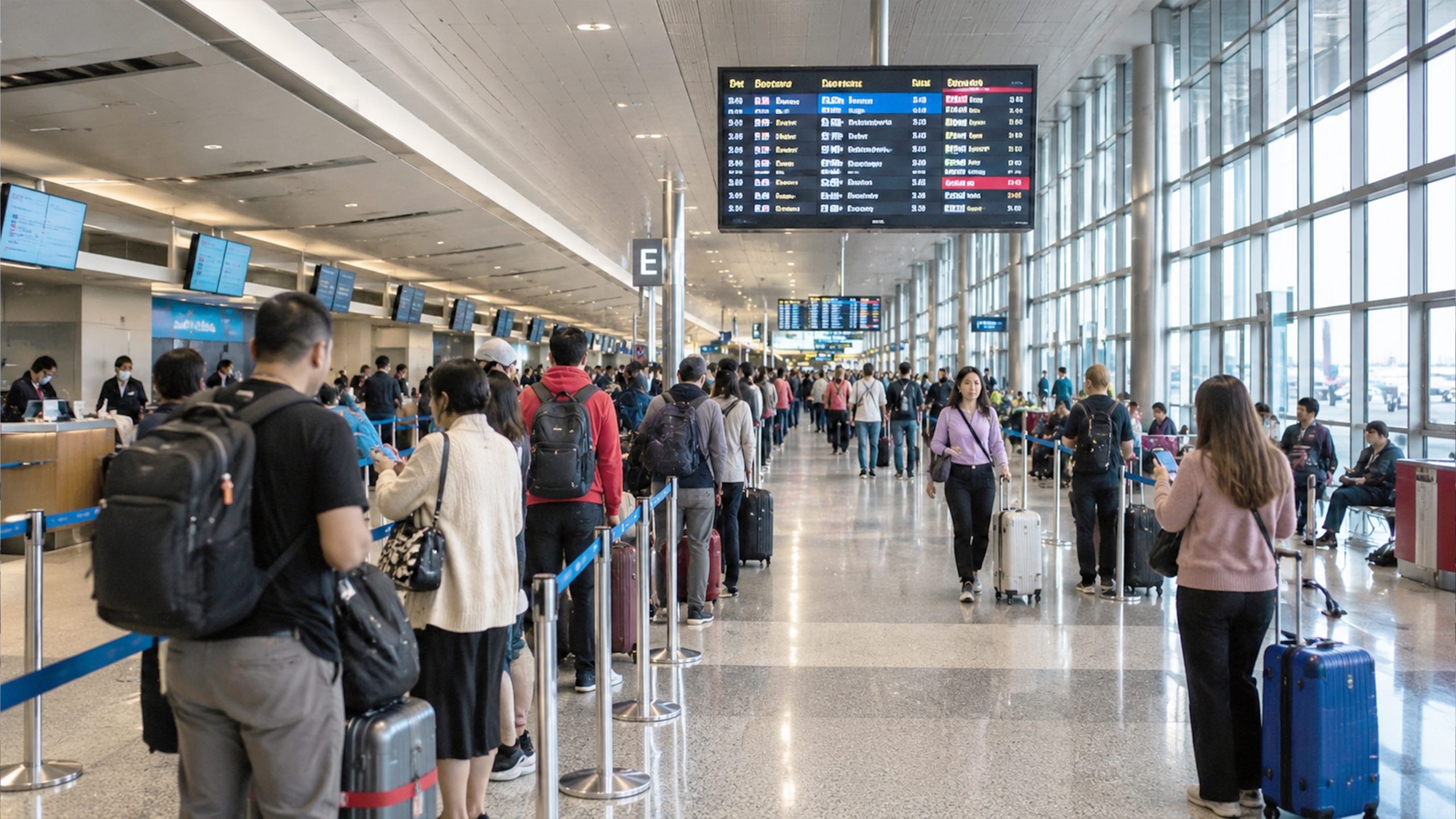
WASHINGTON, D.C. — A US flight ground stop disrupted air travel nationwide on November 13, 2026, after a telecommunications outage affected the Federal Aviation Administration’s (FAA) air traffic control network, forcing airlines to adjust departures and leaving thousands of passengers facing travel delays.
The disruption prompted the FAA to temporarily halt departing flights across the United States while technicians worked to address the communications problem.
The outage affected the 22 regional Air Route Traffic Control Centers responsible for coordinating aircraft movements across the country.
Transportation officials said the decision was made to maintain aviation safety while the technical problem was being investigated.
Although the restriction affected departures nationwide, it did not mean that every aircraft was grounded. Planes already airborne were generally allowed to continue to their destinations, while certain international flights were handled on a case-by-case basis.
Telecommunications Outage Disrupts US Air Traffic Control
The disruption centered on a telecommunications failure involving systems used by air traffic controllers to coordinate aircraft movements.
The 22 regional control centers play an important role in managing flights traveling between airports and across different parts of the country.
When communications systems become unavailable or unreliable, controllers may face difficulties safely coordinating aircraft movements, particularly in busy airspace.
The FAA therefore ordered the temporary suspension of departures while the situation was assessed.
US Transportation Secretary Sean Duffy confirmed that the government was responding to the communications problem, with aviation officials prioritizing safety while technical teams investigated the outage.
The incident highlighted how heavily modern aviation depends on interconnected communications infrastructure to maintain the safe and efficient movement of aircraft.
Thousands of Flights and Passengers Face Disruptions
The US flight ground stop affected airline operations across the country, with consequences extending beyond passengers waiting to board at airports.
According to Associated Press reporting, at least 600 flights had been diverted by approximately 5:50 p.m. Eastern time on November 13.
Around 11,000 departures and more than 1.5 million passengers were potentially affected during the disruption.
These figures reflected the situation at the time of reporting and should not be interpreted as the final number of cancelled flights or passengers who experienced delays.
Airlines were forced to adjust schedules, manage aircraft movements, and assist passengers whose journeys were interrupted.
The disruption also affected cargo operations, adding pressure to an aviation network that plays a major role in domestic and international transportation.
Even after departure restrictions are lifted, flight operations can take time to return to normal because aircraft and crew members may be in different locations from where they were originally scheduled to operate.
Officials Investigate Cause of Communications Failure
The technical cause of the telecommunications outage remained under investigation in the initial reports.
US officials said there was no indication at the time that the incident was caused by a terrorist attack or deliberate sabotage.
Authorities described the problem as a communications outage, while technicians worked to identify the source of the failure.
Questions also emerged about possible connections to other technology disruptions and newer air traffic management systems.
However, officials had not established a confirmed connection to those systems or services.
The incident renewed concerns about the reliability of aviation infrastructure and the potential consequences of technical failures affecting critical transportation networks.
Possible Impact on Filipino Travelers
The US flight ground stop could also affect Filipinos traveling between the Philippines and the United States, particularly those with connecting flights through major American airports.
Passengers departing from the US for Manila or other Philippine destinations may experience schedule adjustments if their flights or connecting services are affected.
Filipinos traveling from the Philippines to the United States could also encounter delays if their connecting flights involve airports affected by the disruption.
International airlines may need to adjust aircraft schedules and passenger connections as operations recover.
However, there was no confirmation in the reports reviewed that Philippine airports or all Philippine Airlines flights were directly affected by the US ground stop.
Passengers are advised to check their flight status through their respective airlines before leaving for the airport.
Travelers with connecting flights should also confirm whether their onward services remain scheduled and review the airline’s rebooking policies if their original itinerary is disrupted.
US Aviation System Faces Questions Over Reliability
Nationwide flight ground stops are rare in the United States.
The November 2026 disruption recalled the January 2023 incident when a malfunction involving the FAA’s Notice to Air Missions system forced the agency to temporarily halt departures across the country.
That earlier incident also caused widespread delays and raised questions about the reliability of the country’s aviation technology infrastructure.
The latest communications outage again demonstrated how a technical problem affecting essential aviation systems can disrupt thousands of flights and affect millions of travelers.
As airlines work to restore normal operations, attention is expected to remain on the investigation into the outage and measures that could help prevent similar incidents.
For Filipino travelers and other international passengers, checking airline advisories and confirming flight schedules remain important steps while the situation develops.
The FAA’s investigation into the communications failure is expected to provide further information about what caused the disruption and whether additional safeguards are needed to protect the country’s air traffic control network.
Philippine Morning Post will continue monitoring developments and provide updates as more verified information becomes available.

 Facebook
 Twitter