
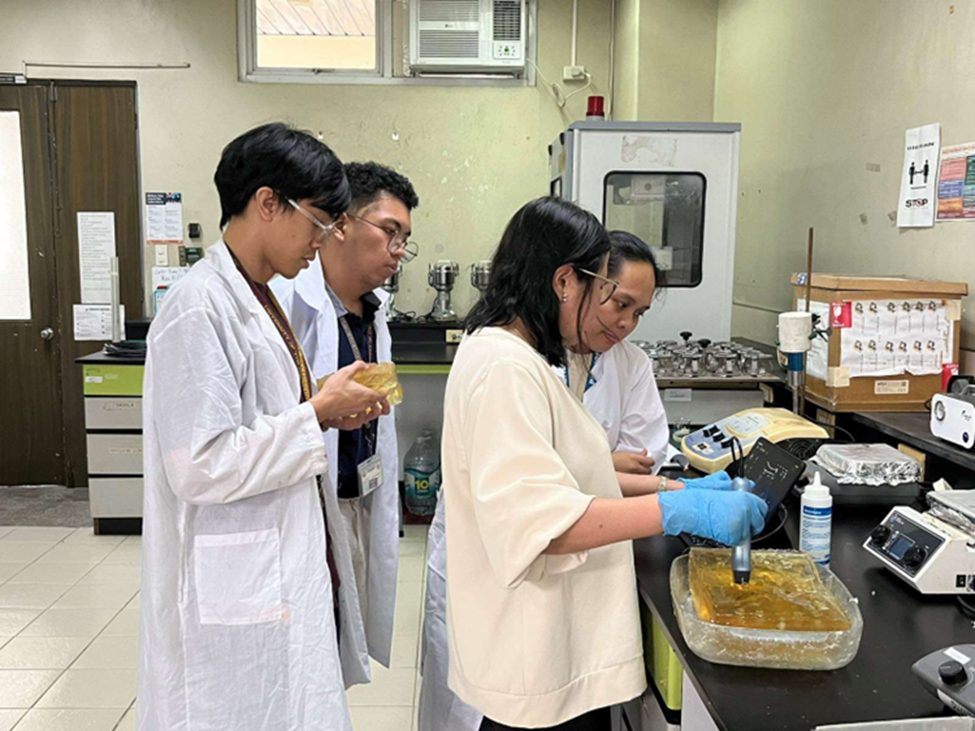
Ultrasound training phantom model technology is becoming increasingly important in helping clinicians develop the skills needed for ultrasound-guided procedures. These procedures rely on real-time imaging to accurately guide medical instruments within the body, requiring precise hand-eye coordination and specialized training to reduce risks and improve patient outcomes.
In the context of these two fields, ultrasound-guided procedures are used as a diagnostic imaging technique, where the clinicians rely on real-time visualization to monitor and navigate a needle into the abdominopelvic region to reach the reproductive system. Performing this procedure requires expert hand-eye coordination to minimize the risk of injury or compromising other critical organs in the area.
To capacitate Filipino clinicians in conducting such procedures, a research team led by Dr. Melissa Amosco of the University of the Philippines Manila (UPM) is developing a local version of the phantom model system which can be more accessible and flexible than currently available models. According to Dr. Leslie Joy Lantisce-Diaz, co-investigator, existing tools are often rigid and difficult to customize for varying patient cases. Additionally, since these tools are procured from abroad, they are usually expensive and largely inaccessible to local clinicians.
“The DOST, through the PCHRD, allocated more than ₱4.99 million pesos to support this initiative, in recognition of the critical importance of nurturing the skills of our Filipino clinicians,” said DOST Secretary Renato U. Solidum Jr. “By utilizing home-grown tools to empower our own pool of medical professionals, we can overcome resource and skill gaps, tailor processes to the needs of our communities, and ultimately enhance patient care and outcomes,” he added.
The current prototype of the local phantom model system already has two types of tissue-mimicking materials (TMMs), which imitates the abdominopelvic region comprising muscle, fat, and skin. These TMMs can be adjusted to reflect the correct acoustic and mechanical signals used to define organs or masses such as tumors and cysts. The phantom model system is already integrated into the curriculum of the UP-Philippine General Hospital, where 124 graduates have been trained and deployed across several regions in the country.
Set to be completed by August 2026, the project team is refining the prototype based on the clinicians feedback. According to Dr. Lantisce-Diaz, the team plans to conduct small-volume manufacturing to optimize the packaging of the system which will enable its deployment in different areas. Once completed, the system is expected to be available for use and distribution in the Philippines at a lower cost.
The Philippine Council for Health Research and Development (PCHRD) is one of the attached agencies of the Department of Science and Technology (DOST) aimed at providing science-based, innovative, and inclusive solutions across four strategic pillars: human well-being, wealth creation, wealth protection, and sustainability. These pillars embody the mantra OneDOST4U: Solutions and Opportunities for All.

 Facebook
 Twitter