
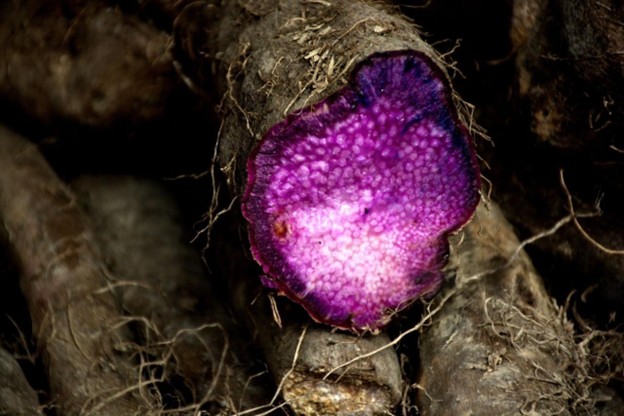
Philippine Ube Production is drawing increased attention as global demand for the country’s iconic purple yam continues to rise. From specialty beverages and desserts to international food festivals, Ube has become a sought-after ingredient worldwide, prompting experts and industry stakeholders to examine whether local production can keep pace with expanding international markets.
Commonly mispronounced as ‘Oob’ in the global scene, the Philippine’s famous purple dessert is making its way to the spotlight. It was being used in drinks, pastries, and even in culinary dishes across Europe, Australia and America.
For instance, as featured on various social media platforms, New York City has recently kicked off its very own Ubeland food festival, dedicated to Philippines’ vibrant Ube delicacies.
A well-known international cafe has also launched its seasonal “Ube Spring Drinks” series available in the USA, United Kingdom, New Zealand, Australia, Italy and the Netherlands.
This growing global traction of Ube has raised concerns over whether the Philippines can meet the surge in global demand.
However, purple yam or Ube production in the country has significantly slowed down even before its global domination. Data from the Philippine Statistics Authority (PSA) showed that the Philippines produced 30,074 metric tons of ‘Ube’ in 2006. This number is more than 50% lower than the total recorded production of 14,000 metric tons in 2020.
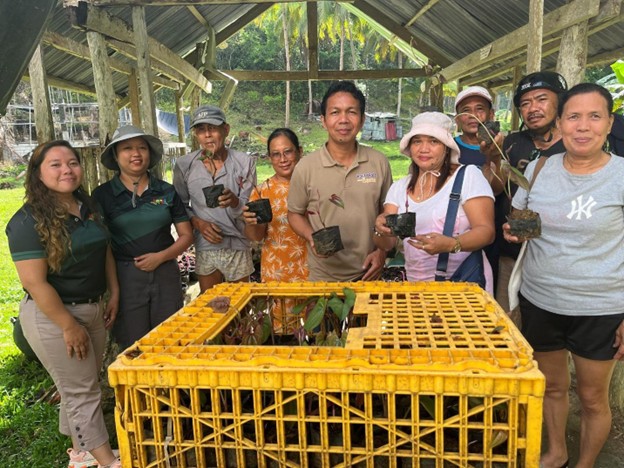
Historically, Bohol province is the largest producer of Ube in the Philippines, accounting for about 35% of the country’s total production. However, Director Marlon M. Tambis of the Philippine Root Crop Research and Training Center said that Bohol farmers are facing significant challenges in farming.
“First is the lack of planting materials. Based on our scoping studies, their production practices are really not very scientific. So, there is a low adoption of necessary recommended practices or S&T-based practices, which we need to address to improve the yield,” Tambis said in an exclusive interview.
To address this problem, the Philippine Root Crop Research and Training Center of the Visayas State University (VSU-PhilRootcrops) together with the Bohol Island State University (BISU) led the development of advanced propagation techniques and introduce it to Bohol Ube farmers.
Through the project titled, “Enhancement of Ubi Production through Trials and Demonstrations of S&T-Based Farm Practices to Support Industry Development in Bohol”, VSU-PhilRootcrops was able to train farmers in producing quality planting materials using advanced methods like the minisett.
Minisett is a method used in agriculture, as a rapid propagation technique specifically in yams, which involves cutting a healthy, whole “mother” tuber into small pieces.
Tambis also explained that in traditional planting, farmers can only produce 7-10 planting materials from one kilo of Ube. But through the minisett propagation technique, farmers can produce more than 30 quality planting materials.
Tambis said these planting materials cannot be directly planted in the field. Since they are smaller than those used in traditional planting, they would need ‘extra care’ before planting. This includes preparing it first on a seedbed for germination.
Moreover, Tambis said their team is also working on a project to craft protocols on the use of the tissue culture method, which is also a potential help to produce more quality planting materials in the future.
“Tissue culture will also be a big help later because we are also reproducing it now. [But] we haven’t released yet this year, but we target to produce millions of ube planting materials next year from the tissue culture. We haven’t released it yet because we are still establishing hardening protocols,” Tambis said.
According to Tambis, hardening is a crucial part in growing tissue cultured Ube as this will determine whether the plant is ready to be transferred to the field.
“When we say tissue culture, it means it is produced from the lab [laboratory]. It goes through a very artificial condition and there is a long process before you can put it in the actual conditions in the field. It first goes through incubation and hardening and hardening is the critical part that will determine if it is really ready to be transferred to the field,” he further explained.
Aside from the lack of quality planting materials, another challenge for farmers is that Ube is considered a seasonal root crop, where farmers can only plant it during May-June, using the traditional planting method.
With that, Tambis’ team has also identified Ube varieties appropriate for year-round planting, including commercial varieties like ‘Baligonhon,’ ‘Inoringnon,’ ‘Kabus-ok,’ and ‘Zambal (VU2),’ as well as ‘Ubi Kinampay’—a native variety known for its superior aroma, color, and taste. These varieties are also grown in other provinces across the country.
“In our project, we have proven [that] February planting is possible. There are only aids in how to germinate ube in that month when it shouldn’t have germinated. So far, we have shown that we also have a breaking of dormancy and propagation protocol in months when it doesn’t really grow naturally. And so far, we have demonstrated that [to farmers],” Tambis said.
Funded by the Department of Science and Technology-Philippine Council for Agriculture and Aquatic Resources Research and Development (DOST-PCAARD), the project intends to address the insufficient supply of Ube planting materials and increase the production of purple yams in the Bohol province.
Using these science and technology-based interventions, the Philippines could meet the global Ube demand especially when farmers from across the country will adopt these advanced propagation techniques developed by the PhilRootcrops.
“Of course, it’s a big help to the farmer because that can potentially increase their income from root crops. So, it became a tool to expand the value chain and benefit more people,” Tambis explained.
Tambis thanked the DOST for its support for improving Ube production in the country, as it continues to gain popularity worldwide. He said the center is also hoping for sustained or further increased funding support from DOST-PCAARD for more research and development (R&D) projects in the future.

 Facebook
 Twitter