
By Henrylito D. Tacio
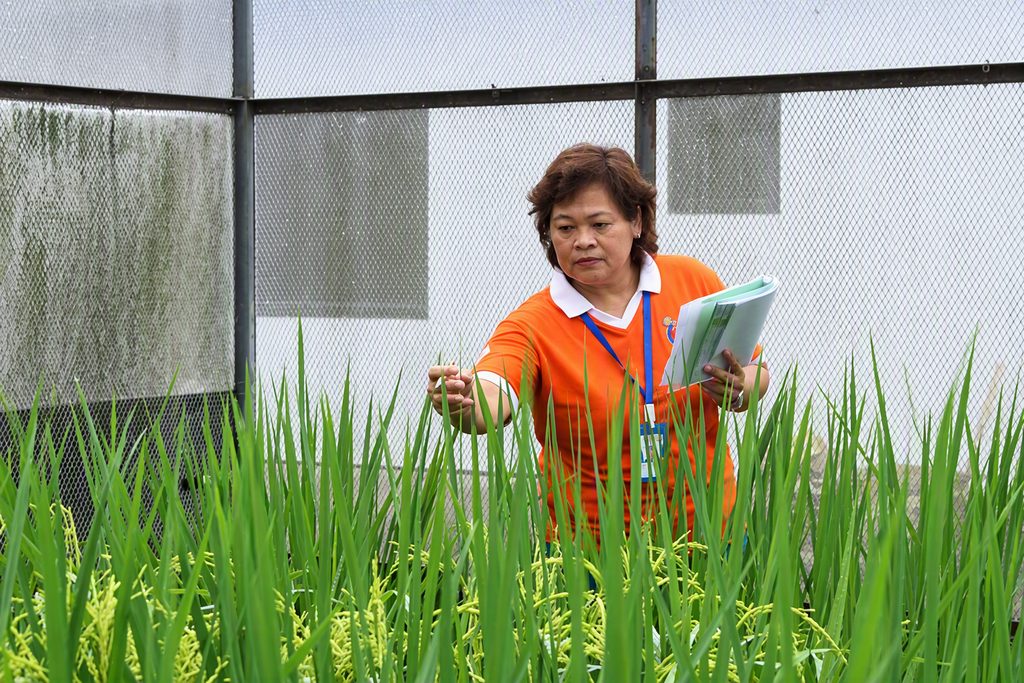
Research by a newly conferred career scientist of the Philippine Rice Research Institute (PhilRice) could help rice breeders identify traits linked to stemborer resistance as farmers prepare for El Niño and other threats to rice production.
The Bureau of Plant Industry recently warned that stemborer is among the pests that may affect rice fields in this year’s last quarter based on historical pest data. Studies show that stemborer can reduce rice yields when 30% of plants show deadheart during tillering or 20% develop whiteheads from flowering to maturity.
Imeldalyn G. Pacada, PhilRice senior breeder, has patented an imaging method that uses an affordable pocket microscope and image-processing software to examine tiny hair-like structures on rice leaves that may help researchers identify plants with natural defenses against the pest.
Called trichomes, these structures can act as physical barriers against insects.
“Their number, direction, and arrangement may help researchers identify rice plants with traits useful in breeding for stemborer resistance,” Pacada said.
Pacada shared that the tool uses free, open-source, Java-based software to analyze rice leaf images and measure the density, direction, and distribution of tiny hair-like structures. The software follows programmed instructions to examine the images and measure the leaf traits.
Pacada’s method replaces broad visual descriptions of rice leaf hairiness with measurable image records, giving researchers more detailed information when comparing promising breeding materials.
“This aims to support the Philippines’ goal of rice self-sufficiency by enabling faster and more accurate identification of desirable traits for rice breeding,” Pacada said.
Her research with Jerick A. Viz identified traditional rice varieties Red 18, Inarciaga, and Mukol as promising sources of leaf traits associated with protection against stemborer.
Pacada also developed VarMix®, a technology that can help farmers maintain stable yields during El Niño by combining rice varieties such as NSIC Rc 298, Rc 216, Rc 238, and PSB Rc 82 or VM-L8, which performed well together in her 2024 study, and is now being adopted in Western Visayas.
Pacada’s other innovations include a digital seed classification system, an image-based tool that uses artificial neural networks to assess milled rice quality, and breeding materials carrying genes for bacterial leaf blight resistance.
She was among the government researchers conferred as Career Scientist I under the Scientific Career System in September this year for her contributions to agricultural research and technology development. (PR)

 Facebook
 Twitter