
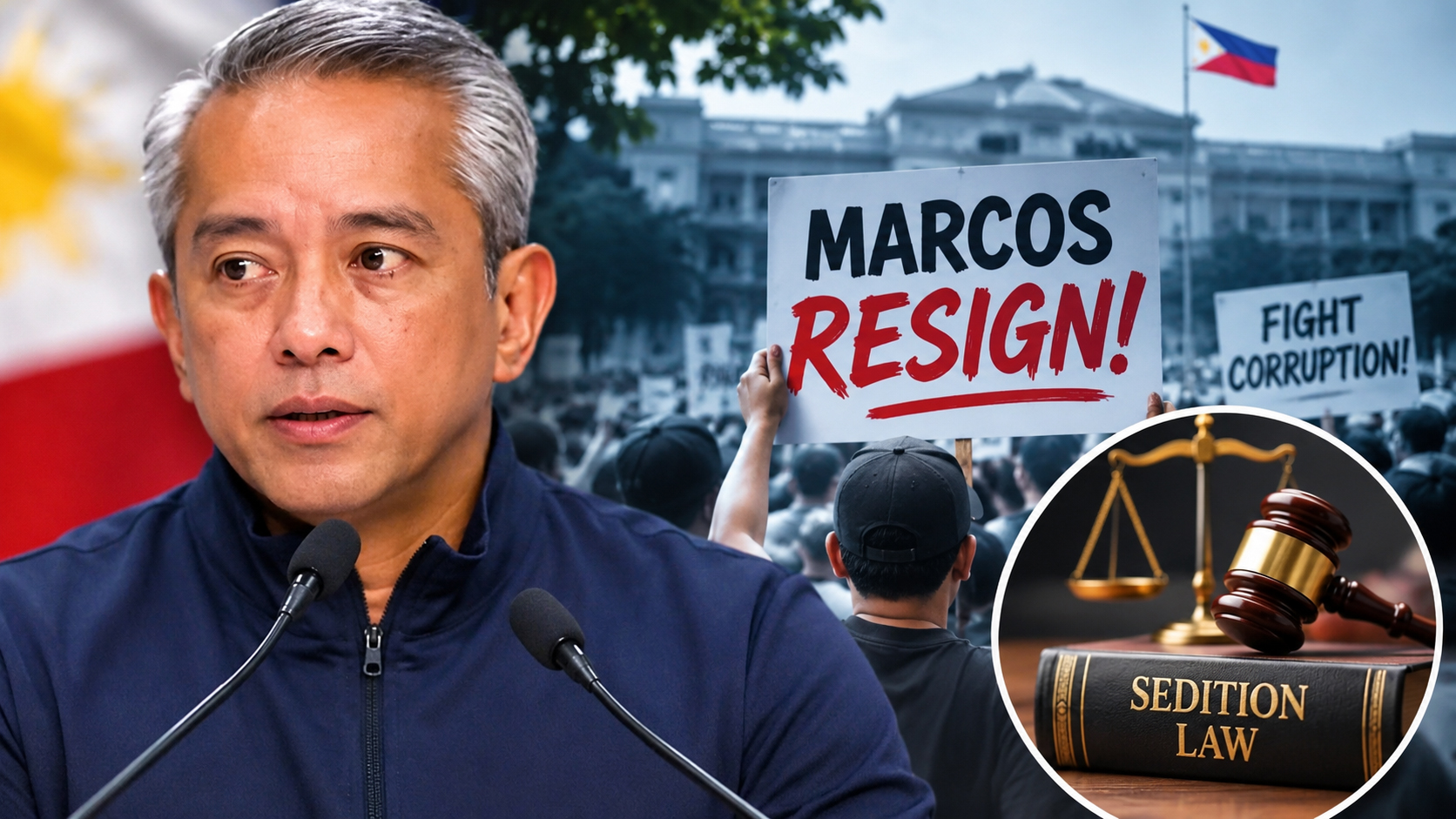
MANILA, Philippines — November 20, 2026. Jonvic Remulla resignation warning has returned to public discussion after social media posts revived the DILG secretary’s November 2025 statements about potentially seditious remarks during anti-government protests. The controversy involves calls for President Ferdinand Marcos Jr. to resign and for the military to withdraw support from his administration, raising questions about freedom of speech, peaceful demonstrations, and the legal limits of political expression in the Philippines.
The controversy originated in November 2025, when Remulla announced that authorities would investigate statements made during anti-corruption demonstrations calling for President Ferdinand Marcos Jr. to resign and urging the Armed Forces of the Philippines (AFP) to withdraw support from his administration.
Although the warning has recently circulated on social media, available reports establish that the original statements were made in November 2025. There is no confirmed evidence in the material reviewed that Remulla issued a new warning on November 20, 2026.
Remulla Warns Against Potentially Seditious Statements
During anti-corruption demonstrations in Metro Manila in November 2025, protesters expressed dissatisfaction with government officials and demanded accountability over allegations of corruption.
Some demonstrators also called for President Marcos to step down from office.
In response, Remulla said authorities would examine statements that appeared to encourage the military to withdraw support from the government.
He raised concerns that certain remarks could potentially constitute incitement to sedition under Philippine law.
However, the DILG did not establish that every individual calling for the President’s resignation had committed a criminal offense.
The distinction between peaceful political expression and unlawful incitement became a central issue in the public discussion.
DILG Emphasizes Public Order and Legal Procedures
The DILG maintained that the Constitution protects the right of Filipinos to express their opinions and participate in peaceful demonstrations.
However, the department argued that these protections do not extend to statements that meet the legal requirements for criminal incitement.
Remulla’s warning focused particularly on calls for the military to withdraw support from the administration.
The department indicated that authorities would examine the circumstances surrounding the statements before determining whether legal action was appropriate.
An investigation does not automatically establish criminal responsibility. Any charges would need to be supported by evidence and the applicable provisions of Philippine law.
Lawyers Defend the Right to Call for Resignation
The warning drew criticism from legal advocates, including the National Union of Peoples’ Lawyers (NUPL).
In statements reported in November 2025, the lawyers’ group argued that peacefully demanding the resignation of an elected official is a form of political expression protected by the Constitution.
The group emphasized that citizens have the right to criticize public officials, express dissatisfaction with government policies, and demand accountability.
Legal advocates also warned that broadly characterizing political criticism as sedition could discourage citizens from participating in lawful demonstrations.
Their position highlighted the importance of distinguishing between expressions of political opposition and statements that satisfy the legal elements of a criminal offense.
What Does Philippine Law Say About Sedition?
Under the Revised Penal Code, sedition and inciting to sedition are separate offenses governed by specific legal requirements.
Article 139 addresses sedition, while Article 142 covers inciting to sedition.
The law does not automatically classify every demand for a public official’s resignation as a criminal act.
Whether particular statements violate the law depends on their content, context, and the legal elements that prosecutors must establish.
The Philippine Constitution also guarantees freedom of speech, expression, and peaceful assembly.
These constitutional protections play an important role in allowing citizens to question government decisions and participate in political discussions.
Legal experts have therefore emphasized that authorities must carefully assess the circumstances before treating protest statements as criminal conduct.
Political Reactions to Remulla’s Warning
The controversy also attracted reactions from political figures.
Davao City First District Representative Paolo Duterte criticized the suggestion that resignation calls could be treated as sedition, emphasizing the importance of constitutional rights.
The disagreement reflected broader political tensions surrounding demonstrations against the Marcos administration.
Supporters of the government’s position argued that authorities have a responsibility to protect public order and investigate statements that could encourage unlawful actions.
Critics maintained that peaceful demands for political accountability should not become grounds for criminal investigations simply because they challenge the administration.
These competing positions contributed to a wider national discussion about the government’s responsibilities and the public’s right to express political disagreement.
Freedom of Speech and Peaceful Protests
The controversy raises an important question about how authorities should respond when public demonstrations include strong criticism of elected officials.
Peaceful protests provide an opportunity for citizens to express concerns about government policies, corruption allegations, and political leadership.
Calls for resignation are not unusual in democratic political systems, particularly during periods of public dissatisfaction.
At the same time, law enforcement agencies are responsible for responding to credible threats and investigating conduct that may violate existing laws.
Maintaining a distinction between lawful criticism and criminal incitement is essential to protecting constitutional rights while preserving public order.
The debate surrounding Remulla’s statements illustrates the challenges authorities face when responding to politically sensitive demonstrations.
Social Media Posts Bring the Warning Back Into Discussion
Images and headlines referring to Remulla’s warning have circulated online, including posts suggesting that individuals repeatedly calling for President Marcos to resign could face charges.
However, the original reports date back to November 2025.
The circulation of older political statements without their original dates can create confusion about whether a government official has issued a new announcement.
Readers are encouraged to examine the publication dates and original sources of political news before interpreting social media posts as recent developments.
As of November 20, 2026, the available material does not establish a new DILG directive specifically targeting individuals who continue to demand the President’s resignation.
Public Accountability and Constitutional Rights Remain Central Issues
The discussion surrounding Remulla’s warning continues to highlight the relationship between government authority and democratic freedoms.
Public officials have a responsibility to enforce the law, while citizens retain constitutional protections allowing them to question political leaders and participate in peaceful protests.
The legal debate centers on whether particular statements cross the threshold from protected political expression into unlawful incitement.
Ultimately, determining criminal liability requires evidence, due process, and a proper application of the law.
The controversy serves as a reminder that political disagreement, even when strongly expressed, must be assessed within the framework of the Philippine Constitution and existing legal protections.
For now, the documented issue remains a November 2025 controversy that has resurfaced in online discussions, rather than a newly confirmed government announcement in November 2026.

 Facebook
 Twitter