
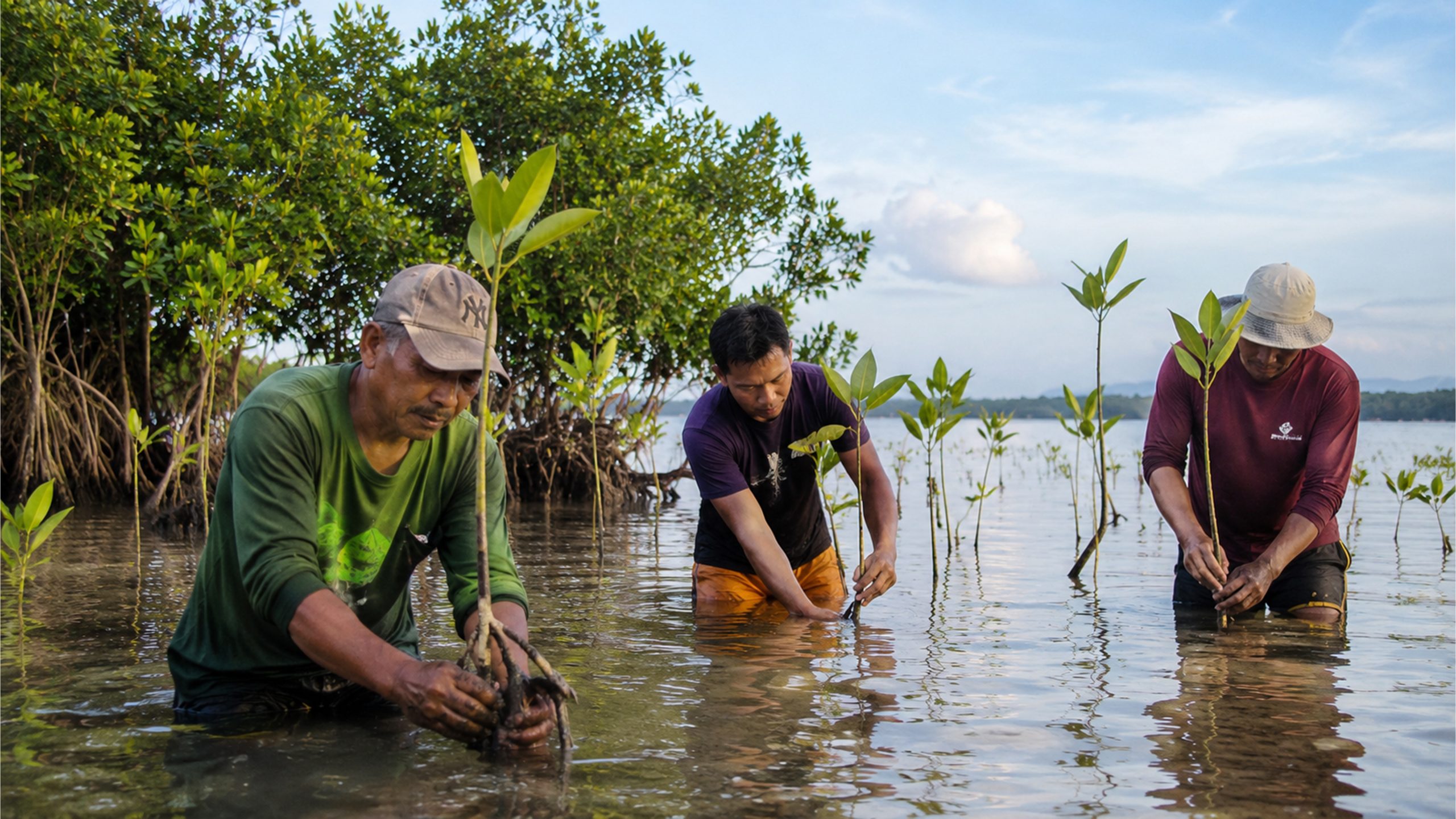
BALANGA CITY, Bataan — Mangrove restoration in Balanga is helping revive coastal ecosystems while creating better livelihood opportunities for local fishing communities. Rehabilitated mangrove forests are providing important habitats for marine species, supporting reported improvements in fish catches and helping protect nearby communities from coastal hazards.
Reports published by the Philippine News Agency (PNA) and Philippine Information Agency (PIA) in November 2026 highlighted the benefits of conservation efforts in the city, including improved fishing conditions and higher reported earnings among some local fishermen.
The development demonstrates how protecting natural coastal resources can benefit both the environment and communities that depend on fishing for their daily income.
Mangrove Restoration Brings New Hope to Local Fishermen
For many families in Balanga, fishing remains an important source of livelihood. However, the degradation of coastal habitats has historically affected fishing opportunities and exposed communities to environmental risks.
Through mangrove restoration in Balanga, degraded coastal areas have been rehabilitated to provide shelter and breeding habitats for fish, crabs, prawns and other marine organisms.
A November 5 report by the Philippine Information Agency featured local fisherman Benjie Manuel, who described improvements in his daily earnings.
According to his account, he previously earned around ₱200 on a good fishing day. His reported daily income has since increased to approximately ₱500 to ₱600.
The Philippine News Agency also reported on November 4 that fish harvests in the area had reportedly doubled following mangrove rehabilitation efforts.
These figures offer an encouraging picture of the benefits experienced by local fishing communities. However, individual income reports and local observations should not be treated as a comprehensive scientific measurement of the total increase in fish production.
Why Mangroves Are Important to Marine Life
Mangrove forests play an essential role in maintaining healthy coastal ecosystems. Their complex root systems provide shelter for juvenile fish and other marine organisms, allowing them to grow in relatively protected environments.
These coastal habitats also support food chains through the natural decomposition of fallen leaves and other organic materials.
For fishing communities, healthy mangrove ecosystems can help maintain the natural habitats that support commercially important marine species.
Beyond fisheries, mangroves provide important habitats for coastal wildlife, including birds and other species that depend on wetlands for food and shelter.
Protecting these ecosystems is therefore important not only for fishermen but also for maintaining biodiversity and ecological balance.
Mangroves Provide Natural Protection Against Coastal Hazards
Another important benefit of mangrove conservation is its contribution to coastal protection.
Mangrove roots and vegetation help reduce wave energy, trap sediments and stabilize shorelines. Healthy mangrove belts can also help limit coastal erosion, although their protective effectiveness depends on forest density, width, species composition and local conditions.
In Balanga, mangrove rehabilitation has been associated with improved protection for communities previously exposed to coastal flooding.
Residents in vulnerable areas have experienced flooding during high tides, particularly when strong winds push seawater inland.
Restored mangrove forests can provide an additional natural barrier against waves and coastal hazards. However, they cannot completely prevent flooding or eliminate the risks associated with powerful storms and storm surges.
Their conservation should be considered part of broader disaster risk reduction and coastal management strategies.
Bataan’s Mangrove Rehabilitation Efforts Have a Longer History
The recent improvements in Balanga build on years of conservation and rehabilitation initiatives.
A technical publication included in the Southeast Asian Fisheries Development Center’s 2015 proceedings documented the implementation of the Philippine National Aquasilviculture Program in Bataan.
The initiative involved the Bureau of Fisheries and Aquatic Resources (BFAR), the Commission on Higher Education (CHED), Bataan Peninsula State University, local governments and fisherfolk organizations.
The documented accomplishments included the planting of 183,300 mangrove seedlings, with a reported one-year survival rate of 85.96 percent.
The program also supported 16 aquasilviculture livelihood projects, demonstrating how environmental rehabilitation can be combined with community-based economic activities.
These historical figures show that mangrove conservation in Bataan has involved more than planting trees. It has also included livelihood development, fisheries enhancement and community participation.
Bataan Strengthens Coastal Protection Through a Greenbelt Ordinance
The provincial government has also introduced additional measures to protect its coastal resources.
Bataan Provincial Ordinance No. 03, Series of 2025, established the Coastal Greenbelt Network to strengthen the protection and rehabilitation of important coastal ecosystems.
According to the geographic inventory cited in the ordinance, Bataan has approximately 262.61 hectares of existing mangroves. The inventory draws on a 2020 survey by the National Mapping and Resource Information Authority (NAMRIA) and a 2024 validation by Wetlands International Philippines.
Of this area, approximately 38.47 hectares are located in Balanga City, while the province has identified another 250.13 hectares of potential restoration sites.
The ordinance includes restrictions against mangrove cutting, clearing, waste dumping and the conversion of protected mangrove areas into incompatible land uses.
It also promotes community participation, rehabilitation activities and the protection of coastal greenbelt areas.
The policy provides a framework for preserving existing mangrove forests while encouraging the restoration of degraded coastal habitats.
Environmental Threats Continue to Challenge Wetland Protection
Despite the progress, mangrove and wetland conservation in Bataan continues to face challenges.
A 2024 report by Philstar highlighted concerns involving land reclamation, agricultural expansion and the conversion of wetland areas for aquaculture and other uses.
The Balanga Wetland and Nature Park is also recognized for its ecological importance as a habitat and stopover for migratory birds along the East Asian-Australasian Flyway.
These concerns demonstrate why restoration efforts must be supported by consistent environmental monitoring, stronger enforcement and responsible coastal development.
Planting new mangroves alone is not enough if existing forests and surrounding wetlands remain vulnerable to degradation.
Community Participation Is Essential to Long-Term Conservation
Sustaining mangrove restoration in Balanga will require continued cooperation among government agencies, local communities, environmental organizations and fishing groups.
Regular monitoring of newly planted mangroves is important to determine seedling survival, identify damaged areas and ensure that rehabilitation projects produce lasting results.
Local fishermen can also play an important role by helping protect coastal habitats, reporting illegal activities and participating in community-based conservation programs.
Government support for alternative livelihoods and sustainable fishing practices can further reduce pressure on vulnerable coastal resources.
These efforts can help ensure that mangrove conservation provides long-term benefits rather than temporary improvements.
Mangrove Conservation Supports Both Nature and Communities
The experience in Balanga demonstrates the relationship between environmental protection and community livelihoods.
Healthy mangrove ecosystems can support fisheries, provide habitats for marine wildlife, stabilize coastlines and help reduce the impact of certain coastal hazards.
For fishing families, these benefits can translate into better opportunities to earn a living while preserving the natural resources that future generations will depend on.
As the Philippines continues to strengthen its environmental protection efforts, the experience of Balanga offers an important reminder that restoring nature can also help strengthen local communities.
Sustaining these gains will require continued government support, community participation and stronger protection of the country’s remaining mangrove forests.

 Facebook
 Twitter