
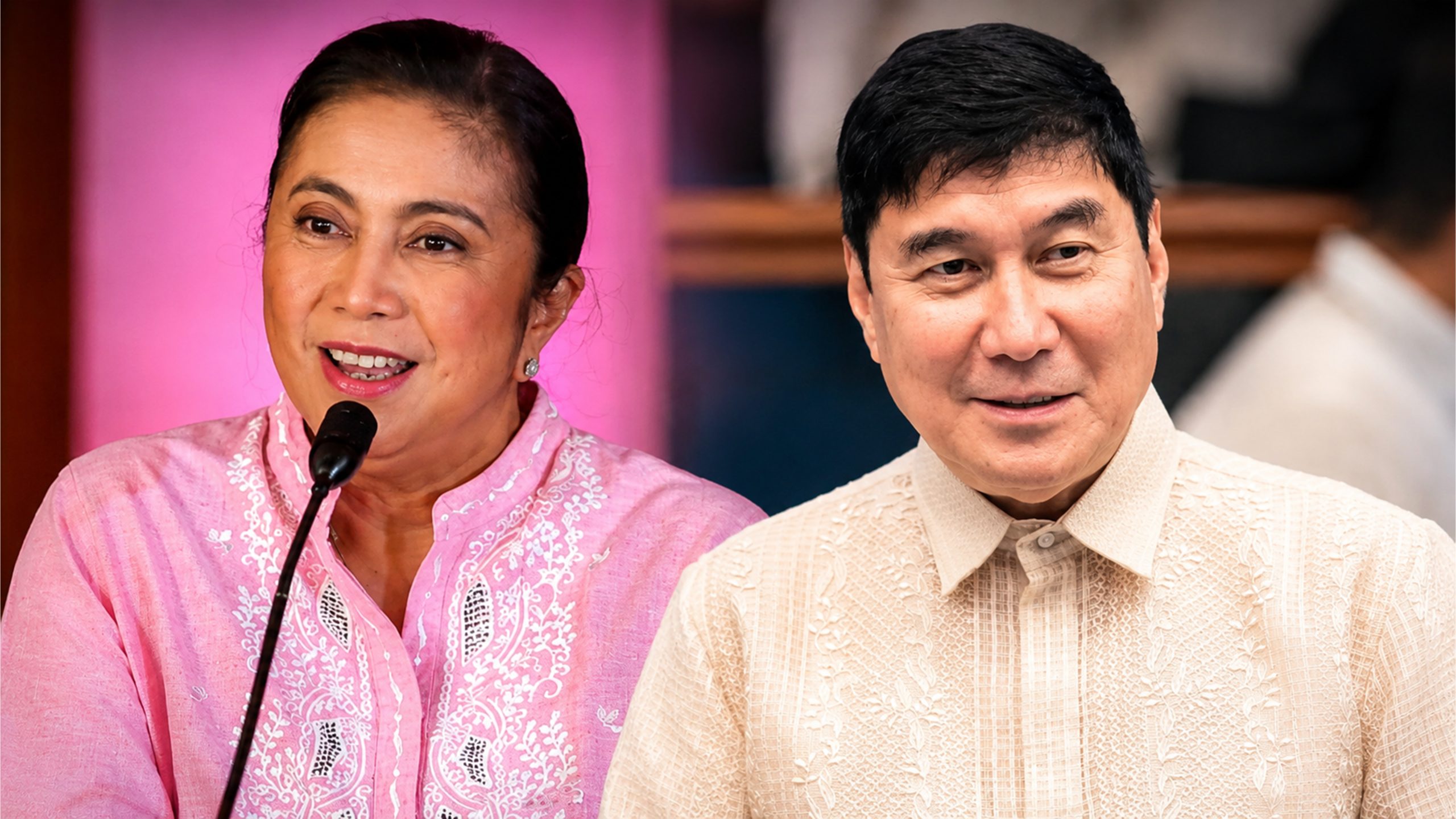
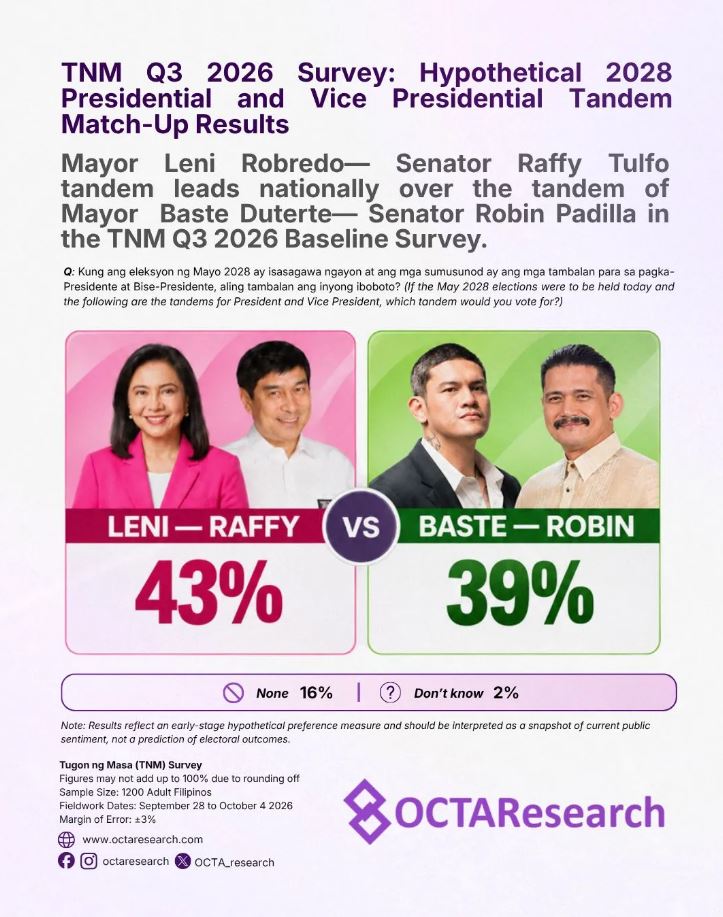
OCTA 2028 survey findings show former Vice President Leni Robredo and Senator Raffy Tulfo leading a hypothetical presidential and vice-presidential matchup against Davao City Mayor Sebastian “Baste” Duterte and Senator Robin Padilla, according to a nationwide poll conducted by OCTA Research in September and October 2026.
The Third Quarter 2026 Tugon ng Masa survey found that 43% of adult Filipinos would support the Robredo–Tulfo tandem if the May 2028 elections were held during the survey period. Meanwhile, 39% expressed preference for the Duterte–Padilla pairing.
Another 18% said they would choose neither tandem or were still undecided, highlighting the possibility of changing voter preferences as the next national elections approach.
Despite the four-percentage-point advantage, OCTA described the Robredo–Tulfo lead as relatively narrow. The difference is only slightly above the survey’s margin of error of plus or minus three percentage points.
Robredo–Tulfo Leads in Luzon and Metro Manila
The survey results showed significant differences in voter preferences across the country’s major geographical regions.
The hypothetical Robredo–Tulfo tandem received its strongest support in Balance Luzon, where 61% of respondents preferred the pairing, compared with 19% for Duterte–Padilla.
In Metro Manila, Robredo and Tulfo also maintained an advantage, receiving 49% against 32% for their potential rivals.
The results were considerably different in the Visayas, where the Duterte–Padilla tandem received 43%, narrowly ahead of Robredo–Tulfo at 41%.
Mindanao showed the widest gap between the two hypothetical pairings. Duterte–Padilla secured 81% of preferences in the region, while Robredo–Tulfo received only 4%.
The regional figures highlight the contrasting political support bases of the two proposed tandems, particularly between Luzon and Mindanao.
Language Groups Show Different Political Preferences
OCTA’s survey also revealed substantial differences when respondents were classified according to their language groups.
Among Tagalog and Filipino-speaking respondents, 54% preferred the Robredo–Tulfo tandem, compared with 24% for Duterte–Padilla.
The advantage was even more pronounced among Ilocano respondents, with Robredo–Tulfo receiving 80% against 8% for the opposing tandem.
However, the results were reversed among Cebuano and Bisaya speakers. The Duterte–Padilla pairing received 75% support, while Robredo–Tulfo registered 10%.
These findings suggest that regional and ethnolinguistic backgrounds are important dimensions of the country’s political preferences. However, they do not establish that language alone determines voting behavior.
Robredo Reiterates Decision Not to Run in 2028
One of the most significant developments surrounding the survey is Robredo’s position on the upcoming presidential elections.
On November 9, Naga City Mayor and former vice president Leni Robredo reiterated that she would not seek the presidency in 2028.
During a media briefing in Naga City, Robredo said she remained open to supporting a capable and deserving candidate but had no intention of returning to national politics herself.
Her statement adds an important dimension to the OCTA findings, considering that she remains a leading figure in the hypothetical presidential matchup.
Robredo has also expressed support for the possibility of other individuals taking on national leadership roles, including Pasig City Mayor Vico Sotto, Quezon City Mayor Joy Belmonte, Senator Risa Hontiveros, Senator Bam Aquino and Senator Kiko Pangilinan.
Her position raises questions about the political significance of the survey results if she maintains her decision not to participate in the 2028 presidential race.
Duterte–Padilla Gains Strong Support in Mindanao
The strong showing of the hypothetical Baste Duterte–Robin Padilla tandem in Mindanao is another notable finding.
The pairing’s 81% preference in the region reflects its substantial support base in an area where the Duterte family has maintained considerable political influence.
However, the survey should not be interpreted as confirmation that Baste Duterte intends to seek the presidency or that Padilla has agreed to become his running mate.
Both pairings remain hypothetical, and the survey measures public preference rather than confirmed political alliances or candidacies.
Survey Methodology and What the Results Mean
OCTA Research conducted the Third Quarter 2026 Tugon ng Masa survey from September 28 to October 4, 2026.
The nationwide study involved face-to-face interviews with 1,200 Filipino adults aged 18 and above. It carried a margin of error of plus or minus three percentage points at a 95% confidence level.
The results provide an early indication of public sentiment toward the proposed presidential and vice-presidential combinations.
However, the figures should not be treated as a prediction of the May 2028 elections. Political alliances, candidate declarations, national issues and changing voter preferences could significantly influence the results in the coming months.
With nearly one in five respondents still uncommitted, the survey also suggests that a considerable portion of the electorate has yet to settle on a preferred political direction.
For now, the OCTA findings offer an early look at the potential political landscape of 2028, with a clear divide between the leading hypothetical tandems and their respective regional support bases.
Sources: OCTA Research, Third Quarter 2026 Tugon ng Masa Survey; GMA News; The Philippine Star; BusinessMirror.

 Facebook
 Twitter