
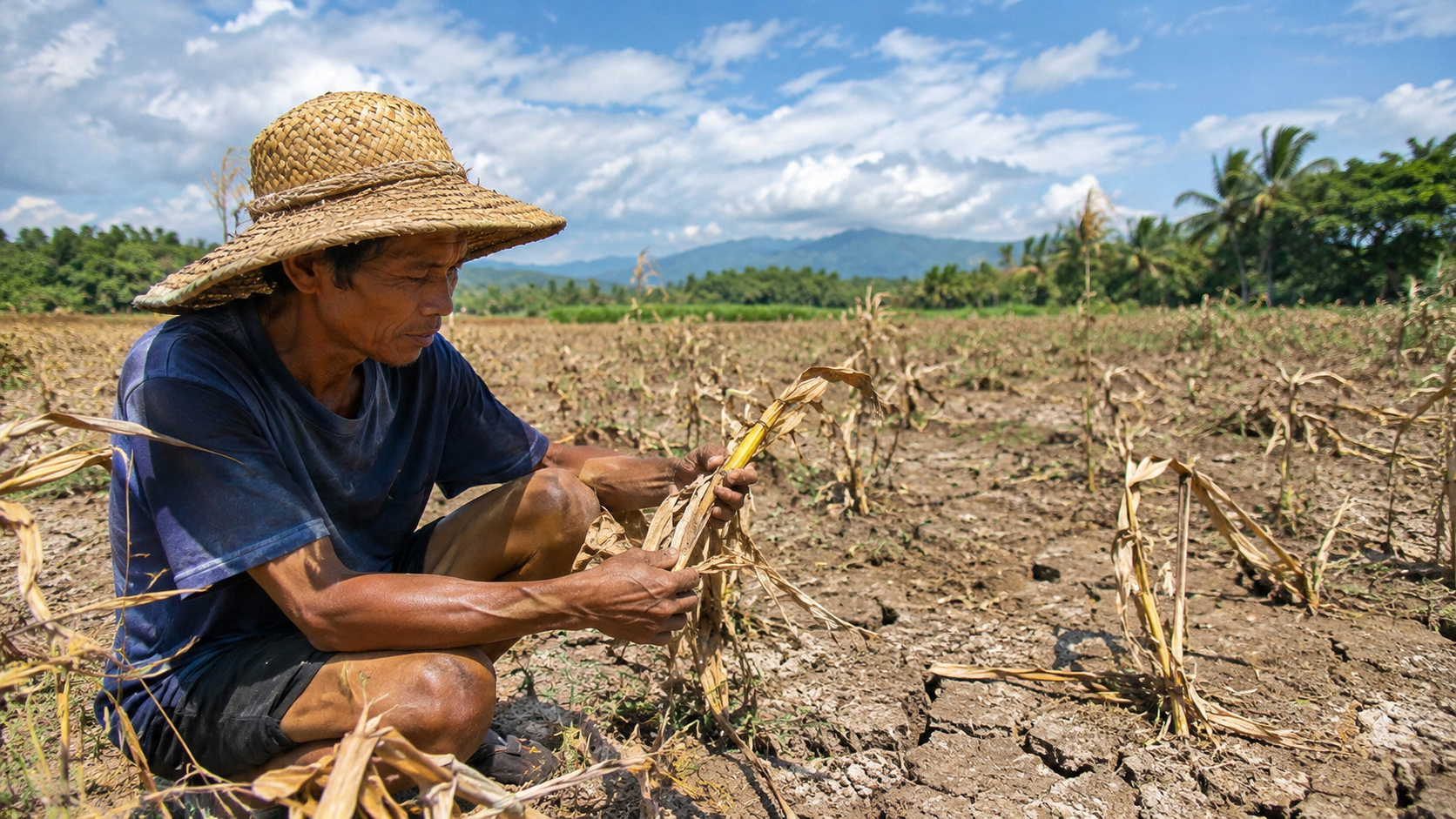
Davao El Niño damage has reached ₱584.68 million, affecting 6,205 farmers and 6,634 hectares of agricultural land, according to figures from the Department of Agriculture (DA) Regional Field Office XI. The reported losses cover rice, high-value crops, corn, livestock and poultry, raising concerns about agricultural production and farmers’ livelihoods as prolonged dry conditions threaten communities across the region.
The figures highlight the growing impact of water shortages on the agricultural sector as the Philippines braces for a Very Strong El Niño that could persist into the first half of 2027.
According to reports citing the DA Regional Field Office XI, the damage includes losses in rice, high-value crops, corn, livestock and poultry. Rice production accounts for the largest share of the reported losses.
Rice Farmers Suffer the Biggest Agricultural Losses
Rice production recorded approximately ₱390.24 million in damage, making it the most affected agricultural sector in the region.
High-value crops followed with ₱126.90 million in reported losses, while livestock and poultry accounted for ₱35.22 million. Corn production also sustained approximately ₱32.32 million in damage.
Fruit crops alone accounted for around ₱96.22 million in losses under the high-value crops category, highlighting the vulnerability of agricultural communities that depend on fruit production.
Areas across Davao del Sur, Davao del Norte, Davao de Oro and Davao City are among those being monitored. Matanao and Bansalan in Davao del Sur were specifically identified as areas experiencing significant water shortages.
DA Prepares More Than ₱729 Million for El Niño Response
To minimize further agricultural losses, the Department of Agriculture has outlined a ₱729.11-million El Niño Action Plan.
The proposed interventions include ₱678.73 million for increasing agricultural production in areas considered less vulnerable to El Niño, ₱40.41 million for preparatory activities and ₱9.97 million for sustaining production in vulnerable areas.
The agency is also seeking an additional ₱268.5 million from its national Quick Response Fund for rehabilitation and mitigation activities.
Davao del Norte and Davao Occidental have been identified as areas with opportunities to increase rice production despite the prevailing dry conditions. The DA is also targeting a 20% to 30% increase in rice production in Davao del Norte during the second semester of 2026.
Meanwhile, the National Irrigation Administration is preparing rotational water distribution and alternative pumping arrangements should water levels in irrigation systems decline further.
Farmers Urged to Report Agricultural Damage
The DA has also urged farmers experiencing crop damage to immediately report their losses to their respective Municipal Agriculture Offices.
Farmers are advised to document affected crops, farm locations, damaged areas and other relevant information. They are also encouraged to coordinate with the Philippine Crop Insurance Corporation if their farms are insured.
Authorities need to inspect and validate reported damage before affected farmers can be considered for appropriate assistance.
Very Strong El Niño Could Continue Into 2027
The situation in Davao Region comes as the Philippine Atmospheric, Geophysical and Astronomical Services Administration (PAGASA) confirmed on November 4 that a Very Strong El Niño is present in the tropical Pacific.
PAGASA expects the phenomenon to potentially peak before the end of 2026 and persist through the first half of 2027. Below-normal rainfall is also expected across most parts of the Philippines during November.
Although rainfall conditions may vary across the country, prolonged dry periods could further threaten agricultural production, irrigation supplies and the livelihoods of farming communities.
With thousands of farmers already affected in Davao Region, government agencies face the challenge of protecting food production and helping agricultural communities cope with potentially worsening dry conditions in the coming months.

 Facebook
 Twitter