
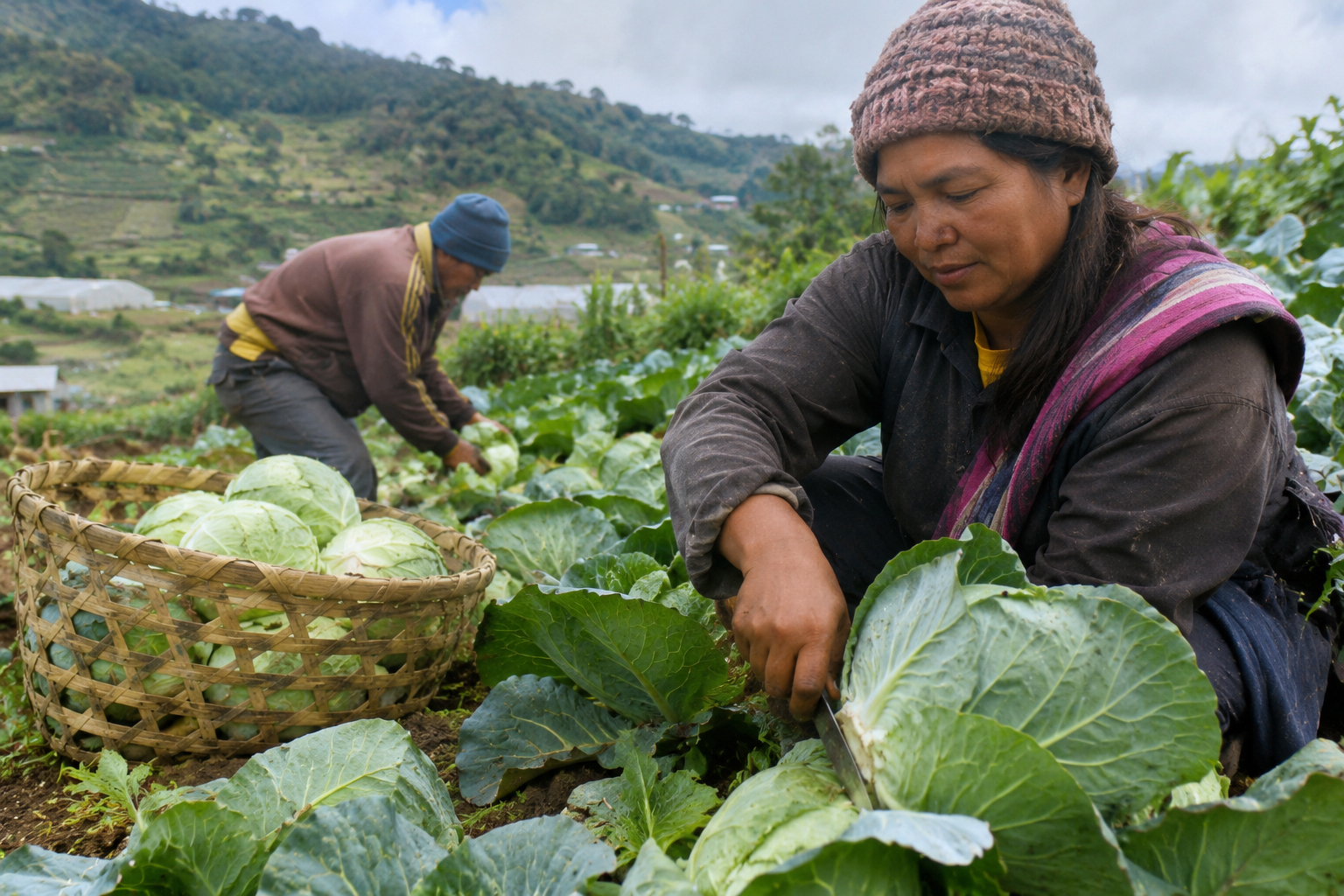
BAGUIO CITY, Philippines — Cordillera farmers protest rising production expenses, declining vegetable prices and competition from imported agricultural products as growers from the region bring their concerns to national government agencies. The mobilization highlights the financial difficulties facing local vegetable producers, who are calling for fair farmgate prices, affordable farming inputs and stronger government support.
The two-day mobilization, scheduled for November 10 to 11 in Metro Manila, is organized by the Kanatengan Network, a coalition of vegetable farmers and agricultural communities in the Cordillera.
The farmers are calling for government intervention to address what they describe as increasingly difficult conditions for local vegetable producers, including expensive farming inputs, transportation costs and unstable market prices.
Their concerns highlight the growing financial pressure on farming communities that supply vegetables to markets across the Philippines.
Farmers struggle with rising production costs
Among the major issues raised by the farmers are the increasing prices of fertilizers, seeds, pesticides and other agricultural supplies.
Fuel and transportation expenses have also added to their financial burden, particularly for growers who need to transport perishable vegetables from mountain communities to trading centers and distribution markets.
For farmers who depend on vegetable production as their primary source of income, rising expenses combined with unpredictable selling prices can significantly reduce their earnings.
The problem becomes more difficult when farmers are forced to sell their harvest at prices that do not cover the cost of production.
Vegetable dumping highlights farmers’ financial difficulties
The economic challenges facing Cordillera vegetable growers were also reflected in reports of unsold produce being dumped because of weak demand and insufficient buyers.
A Philippine News Agency report published on August 31 documented consultations involving the National Anti-Poverty Commission and the Cooperative Development Authority following concerns over vegetable dumping in Benguet.
Some farmers reportedly received farmgate prices as low as ₱5 per kilogram for certain vegetables, highlighting the extent of the losses experienced by growers.
The report also identified market oversupply, transportation expenses and delivery delays as contributing factors.
Road blockages and landslides further complicated deliveries to the La Trinidad Vegetable Trading Post, where delays could cause harvested vegetables to deteriorate before reaching buyers.
For farmers, these problems mean that even a successful harvest does not guarantee a profitable season.
Imported vegetables raise concerns among local growers
Competition from imported vegetables is another major concern behind the farmers’ mobilization.
Local growers have questioned the impact of imported agricultural products on the prices and market opportunities available to domestic producers.
The issue has also drawn attention from the Department of Agriculture.
On October 18, the DA ordered an investigation into alleged smuggling of carrots, broccoli and other highland vegetables following monitoring activities in Baguio City and La Trinidad, Benguet.
The department reported finding imported broccoli being sold in several market stalls, including products bearing labels identifying China as their country of origin.
However, the presence of imported vegetables does not automatically establish illegal importation. The investigation was intended to determine whether violations of agricultural import regulations and the Anti-Agricultural Economic Sabotage Law had occurred.
The distinction is important because legally imported agricultural products that comply with government requirements are permitted to enter the Philippine market.
Farmers demand fair prices and stronger government support
The Kanatengan Network has identified several policy demands aimed at improving the conditions of vegetable-producing communities.
Among its priorities is the establishment of fair farmgate prices that reflect the actual expenses incurred by farmers in producing their crops.
The group is also calling for agricultural subsidies, more affordable production inputs and improvements to farm-to-market roads to reduce transportation difficulties.
Other demands include stronger controls against problematic agricultural imports, relief from excessive land rental and lending costs, and greater government assistance for local farming communities.
The network was formally established in July 2026 following a farmer workshop in Bauko, Mountain Province. The gathering brought together representatives of agricultural organizations and communities from Benguet, Ifugao and Mountain Province to discuss the challenges affecting vegetable production.
Government cites measures to address agricultural costs
The Department of Agriculture has also acknowledged the importance of reducing food production and distribution expenses.
In a November 5 statement, the department outlined several interventions, including fuel and toll assistance, financial support for farmers, agricultural production inputs and insurance programs.
The DA also reported that vegetable, tuber and pulse inflation slowed to 7.9 percent in October from 9 percent in September, based on Philippine Statistics Authority figures.
However, changes in consumer inflation do not necessarily translate into higher earnings for farmers.
Farmgate prices represent the amount growers receive when selling their harvest, while retail prices reflect what consumers pay in markets and stores. Differences between the two can leave farmers struggling financially even when vegetables remain relatively expensive for consumers.
Farmers bring their demands to national agencies
The November 10–11 mobilization includes planned demonstrations and discussions with national government offices.
According to reports on the planned activities, the delegation intends to bring its concerns to the House of Representatives, Department of Agriculture, Department of Environment and Natural Resources, and National Commission on Indigenous Peoples.
A public forum at the University of the Philippines Diliman and a dialogue with Senator Francis Pangilinan are also among the announced activities.
The farmers’ mobilization puts renewed attention on the challenges facing vegetable-producing communities in the Cordillera, where agricultural livelihoods depend not only on successful harvests but also on fair market conditions and accessible distribution systems.
For local growers, the central issue is ensuring that the vegetables they produce can provide a sustainable income rather than leaving them burdened by production expenses, unsold harvests and unstable prices.

 Facebook
 Twitter