
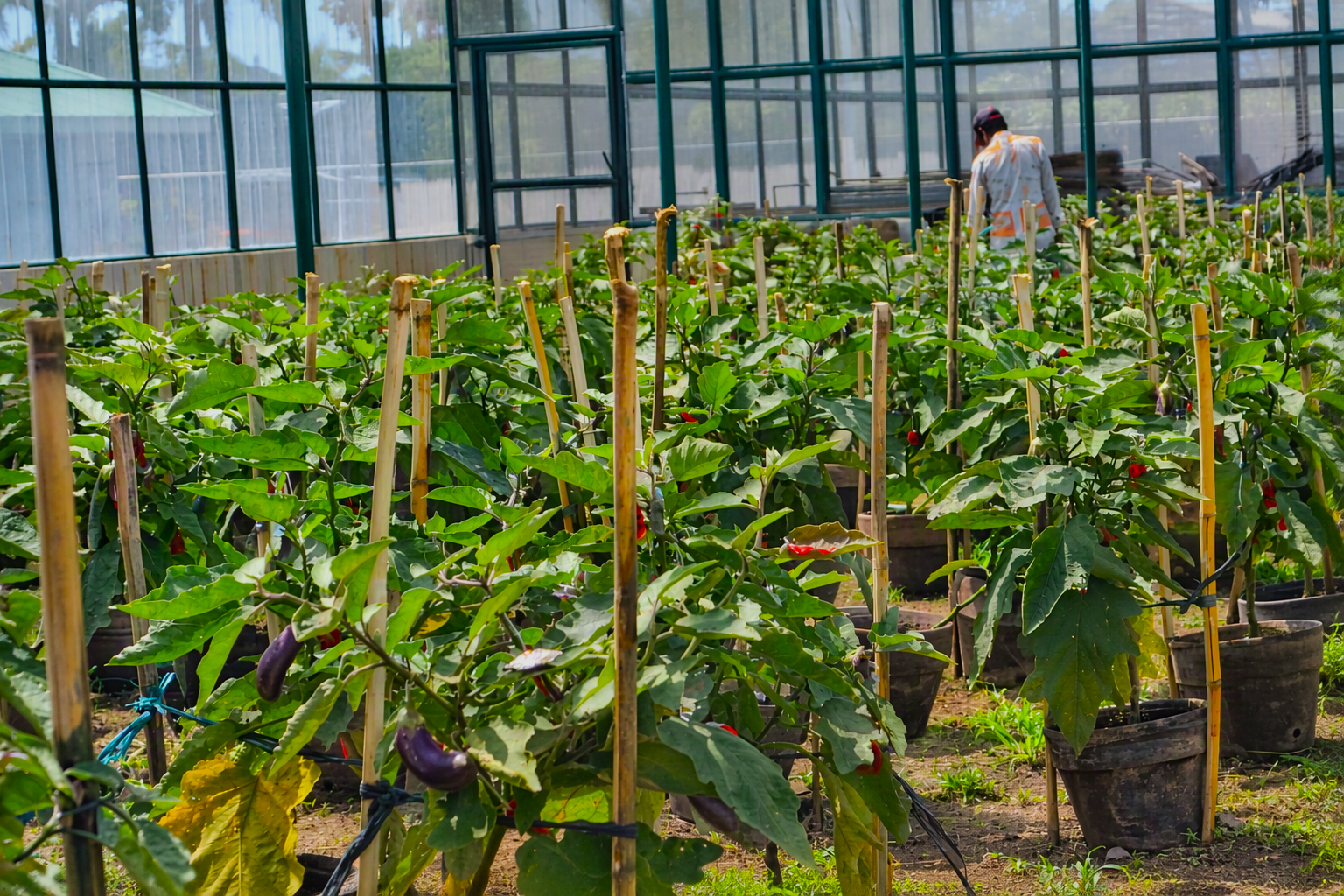
Bt eggplant is being explored as a science-based approach to addressing one of the biggest challenges in eggplant farming in the Philippines: the eggplant fruit and shoot borer (EFSB). This destructive insect attacks the plant’s shoots and fruits, causing significant crop damage and financial losses for farmers. By using a genetic approach designed to target this particular pest, Bt eggplant offers a potential alternative to conventional pest management methods.
Eggplant, or talong, is one of the most popular vegetables in the Philippines. Found in home gardens and commercial farms alike, it comes in various sizes, shapes, and colors, ranging from the familiar purple variety to green, white, and even orange types.
For thousands of Filipino farmers, eggplant is more than just a vegetable. It is a source of livelihood. Harvesting begins approximately two months after planting and continues every five days for up to six months. During productive periods, some farmers can harvest as much as 4,000 kilograms in a day.
Yet behind this seemingly profitable crop lies a serious challenge that has plagued farmers for decades.

The Tiny Pest with a Big Appetite
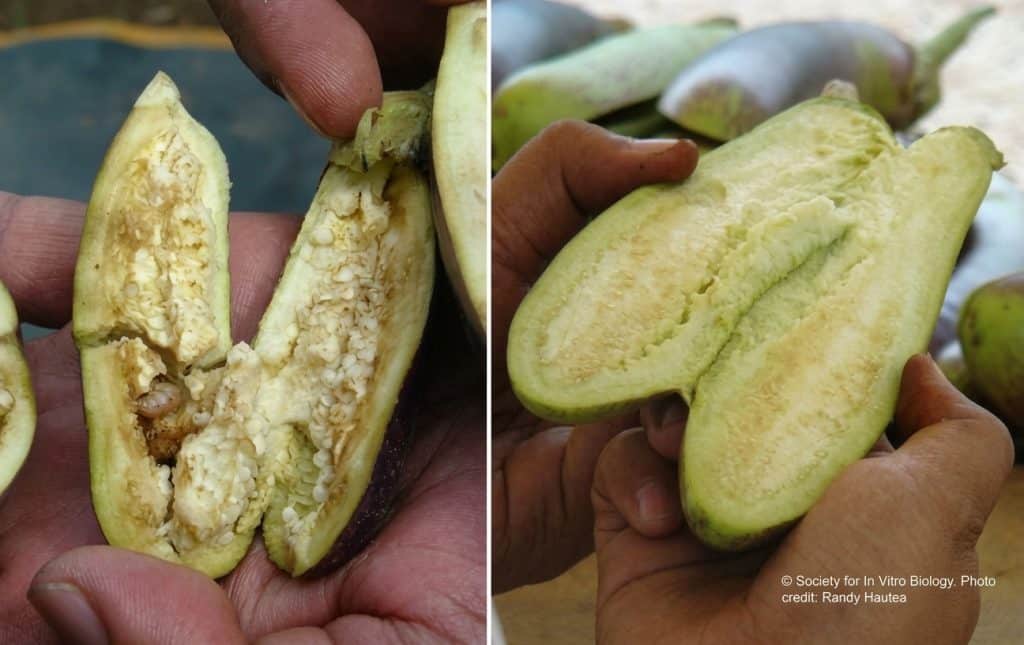
Among the many threats to eggplant production, none is more destructive than the eggplant fruit and shoot borer (EFSB). The insect attacks the crop by boring tunnels through shoots and fruits, severely reducing both yield and quality.
“The EFSB can cause as much as 50-75 percent loss of fruits,” said former Science Secretary Dr. Emil Q. Javier, president of the National Academy of Science and Technology. “The worm of the insect bore tunnels in the fruit, rendering them unfit for consumption.”
What makes the pest especially difficult to manage is that it remains hidden inside the plant tissues. “Unfortunately, there is no known genetic resistance to EFSB in cultivated and wild eggplants,” Dr. Javier explained. “The insects are concealed in the shoots and fruits and are difficult to reach.”
A Dependence on Chemicals
To protect their crops, many farmers rely heavily on chemical pesticides. In some cases, spraying is done almost every other day throughout the growing season.
According to entomologist Dr. Emiliana Bernardo, studies conducted in major eggplant-producing provinces revealed that nearly all growers use chemical insecticides. More alarmingly, some farmers reportedly dip unharvested eggplant fruits into chemical mixtures to ensure the produce remains marketable.
Such practices have raised concerns among scientists and health advocates. “The very basic question is, which is safer, the present practice or the alternative, the Bt eggplant which is rigorously evaluated by experts?” Dr. Bernardo asked. “Is bathing the unharvested eggplant fruits in chemicals, which would end up in people’s dinner tables, safe?”
Biotechnology Steps In
The issue highlights a growing need for safer and more sustainable methods of pest management. Scientists believe biotechnology may offer a solution.
Bt eggplant was developed by introducing a gene derived from a naturally occurring soil bacterium known as Bacillus thuringiensis, commonly referred to as Bt. “Bt eggplant was developed by genetically engineering a gene from the bacteria so that the GM eggplants now produce a protein that defends it against insect attacks,” explained Dr. Michael Purugganan, a Filipino plant geneticist.
The concept is not entirely new. For decades, farmers worldwide have used Bt as a biological insecticide, applying bacterial sprays to protect vegetables from damaging pests.
The Science Behind Bt
According to scientists, Bt is a naturally occurring microorganism found in soils around the world, including the Philippines. “It has been present in the soil for so many years,” Dr. Bernardo said.
Its insect-killing property was discovered in 1901, and by the 1950s it had become widely recognized as a biological insecticide. Instead of depending solely on repeated chemical spraying, Bt technology allows the plant itself to produce a protein that specifically targets destructive insects like the fruit and shoot borer.
This means farmers may be able to reduce pesticide applications while maintaining healthier crops and better yields.
For small-scale Filipino farmers who often spend a significant portion of their income on pesticides, this could translate into lower production costs and increased profitability.
Addressing Safety Concerns
Opponents of genetically modified crops sometimes argue that because Bt produces a toxin harmful to insects, it may also pose risks to human health. Scientists say this claim does not align with how the protein actually works.
Dr. Bernardo explained that the Bt protein becomes active only under alkaline conditions, the type of environment found in the digestive systems of insects. Human stomachs, however, are highly acidic.
“As such, the Bt protein will not be activated to a form that is toxic to insects and will just be quickly denatured,” she said.
She further noted that even if activation were possible, the human digestive system lacks the receptors needed for the protein to bind and accumulate. “If there are no receptors, even the activated Bt protein cannot be absorbed, and therefore it can never accumulate and affect our system,” she pointed out.
Bt eggplant is safe to eat
For consumers concerned about what reaches their dinner plates, scientists offer another reassurance. Cooking breaks down the Bt protein entirely.
“By cooking the Bt eggplant, the Bt protein is completely denatured,” Dr. Bernardo explained. “It is non-detectable in any cooked food therefore there is no human exposure to Bt proteins in eating cooked Bt crops.”
This means that by the time the eggplant is prepared as tortang talong, pinakbet, or any number of Filipino dishes, the Bt protein can no longer be detected in the cooked product.
The debate over genetically modified crops continues worldwide. However, scientists involved in the development and testing of Bt eggplant emphasize that such crops undergo rigorous scientific evaluations before they are considered for release.
Field trials of Bt eggplant have been conducted in several Philippine locations, including the University of the Philippines Los Baños, Pangasinan, Camarines Sur, and North Cotabato.
Supporters argue that the technology offers a practical response to a pest problem that has long burdened farmers, while potentially reducing dependence on chemical pesticides.
The United Kingdom’s GM Science Review Panel echoed a similar position, stating: “For human health, to date there is no evidence currently commercialized GM crop varieties or foods made from them, are toxic, allergenic or nutritionally deleterious. On balance, we conclude that the risks to human health are very low for GM crops currently on the market.”
Harvesting the Benefits of Innovation
As Filipino farmers continue their struggle against the destructive fruit and shoot borer, Bt eggplant represents an example of how science can be used to address agricultural challenges.
The issue is not merely about biotechnology. It is about ensuring that farmers can protect their harvests, consumers can enjoy safe and affordable vegetables, and agriculture can remain productive in the face of persistent threats.
For many scientists, the question is no longer whether the fruit and shoot borer is a problem. The challenge is finding the most effective, safe, and sustainable way to manage it. Bt eggplant, they believe, may be one of the answers.

 Facebook
 Twitter