
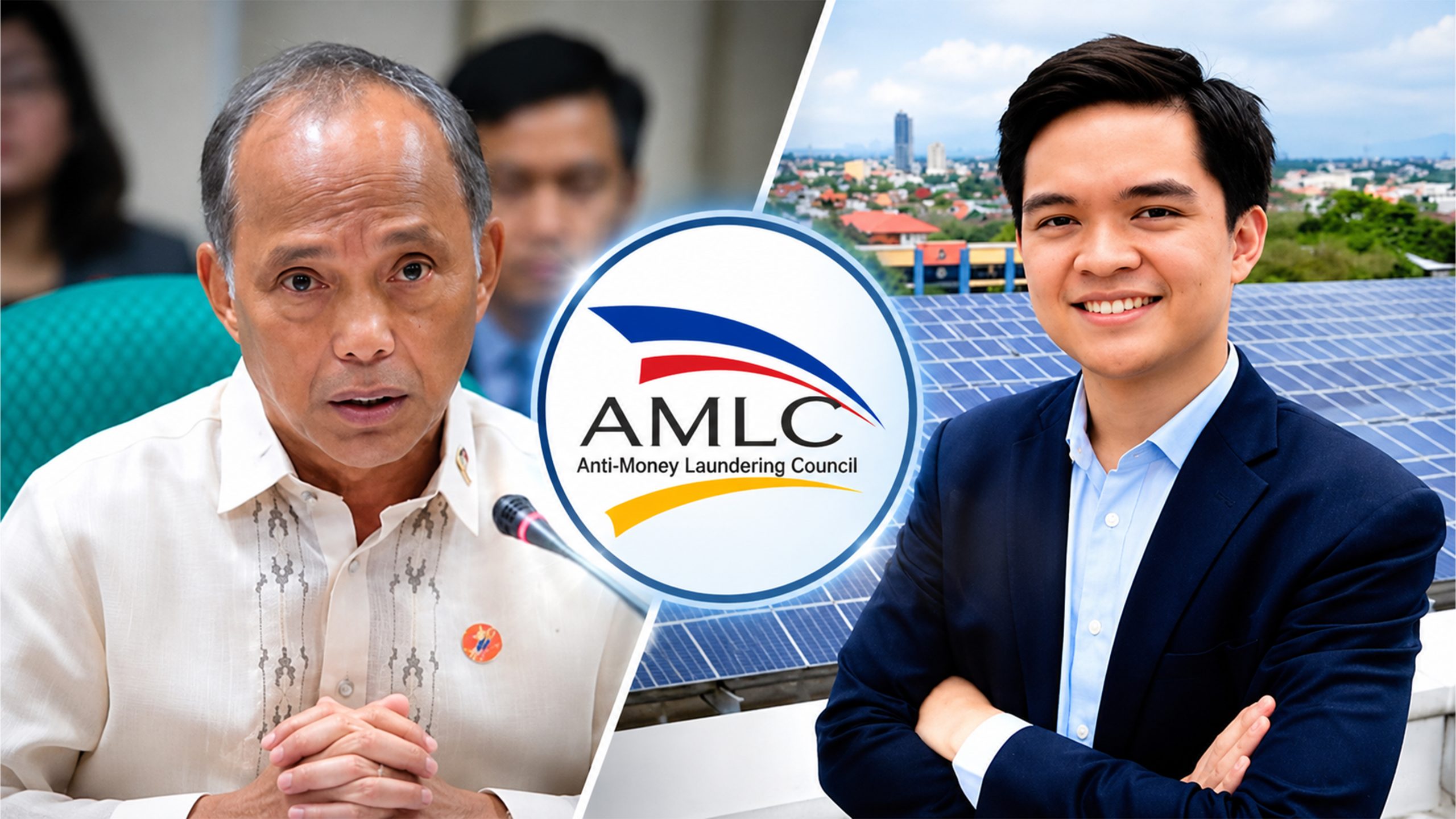
The Alfonso Cusi AMLC investigation has brought renewed attention to alleged irregularities in Philippine solar energy contracts, following reported Court of Appeals orders freezing assets linked to the former Energy Secretary and Batangas Representative Leandro Leviste. The case involves reported cash deposits, billions of pesos in financial transactions, and questions surrounding government-approved renewable energy projects.
The investigation involves hundreds of millions of pesos in reported cash deposits, billions of pesos in financial transactions, and questions surrounding solar energy service contracts awarded during Cusi’s tenure at the Department of Energy (DOE).
The developments have also raised questions about government oversight, compliance with renewable energy contracts, and the handling of public resources.
AMLC flags ₱434.85 million in cash deposits
According to reports detailing the AMLC’s findings, approximately ₱434.85 million in cash deposits were recorded in accounts associated with Cusi between 2016 and 2022.
The deposits reportedly involved 243 transactions, with significant amounts recorded in 2017 and 2022.
Reported figures indicate that cash deposits reached approximately ₱170.32 million in 2017 and ₱195.25 million in 2022.
The investigation also reportedly identified more than ₱11.05 billion in financial transactions associated with Cusi, involving various banking activities, transfers, checks, and investments.
The AMLC findings prompted legal action resulting in a reported provisional freeze order covering 128 asset entries associated with the former energy secretary.
These reportedly include 86 bank accounts, 11 securities accounts, five credit card accounts, four insurance policies, 14 real properties, seven motor vehicles, and one electronic wallet.
The ₱434.85-million figure represents reported cash deposits, not an amount judicially established as stolen or unlawfully obtained.
Solar energy contracts under investigation
A major part of the investigation concerns solar energy service contracts awarded to companies associated with Leviste during Cusi’s leadership at the Department of Energy.
According to reports citing the AMLC’s findings, investigators are examining whether the awarding of certain contracts involved irregularities, particularly where companies reportedly faced compliance issues involving existing agreements.
One incident highlighted in the reports occurred on August 22, 2017.
On that date, the DOE reportedly issued show-cause orders concerning alleged defaults under existing solar energy contracts. The department also reportedly awarded additional solar contracts to a company associated with Leviste.
The AMLC is examining the circumstances surrounding these transactions and whether government contracts were repeatedly granted despite unresolved compliance concerns.
The allegations have placed the department’s contract-awarding procedures under scrutiny, particularly concerning the government’s responsibility to ensure that renewable energy developers meet their contractual obligations.
₱10.44 billion in obligations involving solar contracts
The investigation also involves the reported termination of 26 solar energy service contracts associated with Leviste-linked companies between November 2024 and December 2025.
Reports indicate that approximately ₱10.44 billion in unpaid government obligations were connected to the terminated contracts.
These obligations reportedly involved financial commitments, development assistance, work-program requirements, and other contractual responsibilities.
The matter raises broader questions about whether renewable energy projects awarded by the government are being implemented according to their approved development schedules and contractual conditions.
However, the reported obligations should be distinguished from the separate financial transactions being examined by the AMLC. They do not automatically represent proven losses or criminal proceeds.
Leviste’s financial transactions also examined
Leviste is also facing scrutiny over financial transactions involving his personal accounts and companies connected to his solar energy business.
According to published reports, the AMLC examined transactions reportedly totaling approximately ₱57.89 billion, consisting of around ₱28.07 billion in inflows and ₱29.82 billion in outflows.
A separate reported freeze order involving Leviste covered 54 asset entries, including 41 bank accounts, five securities accounts, and eight real properties.
The figures represent reported financial activity and assets covered by legal proceedings. They should not be interpreted as proof that the entire amount represents illegal proceeds.
Cusi and Leviste respond to allegations
Cusi has reportedly declined to discuss the substance of the investigation, citing the pending legal proceedings.
In a statement reported by Politiko, the former energy secretary said, “I will let the record speak.”
Meanwhile, Leviste defended the transactions involving his businesses, maintaining that they were legitimate commercial activities.
“What you describe are all lawful transactions in the ordinary course of business,” Leviste reportedly said.
He also expressed concern that the allegations could discourage investments and affect employment opportunities in the country.
The political implications of the case have also drawn reactions from PDP-Laban. Party spokesperson Ferdinand Topacio reportedly criticized the freeze order, describing it as politically motivated and calling for its lifting.
What the investigation means for the Philippine renewable energy sector
Beyond the personalities involved, the investigation could have implications for the country’s renewable energy industry.
The Philippines has been encouraging investments in solar, wind, and other renewable energy technologies as part of its efforts to diversify its energy sources and reduce dependence on conventional power generation.
However, the controversy highlights the importance of transparent contract-awarding procedures, consistent regulatory enforcement, and accountability among companies receiving government energy development rights.
Investors also need clear and predictable rules governing renewable energy projects. Allegations involving preferential treatment or inconsistent enforcement could raise concerns about the integrity of the investment environment.
For the government, the case underscores the need to ensure that renewable energy contracts are awarded fairly and that developers fulfill their obligations.
Legal proceedings remain ongoing
The reported freeze orders are provisional legal measures intended to preserve assets while authorities examine potentially suspicious financial transactions.
They do not constitute a criminal conviction against Cusi or Leviste.
The allegations must still be evaluated through the appropriate legal proceedings, where the individuals involved retain the right to respond and defend themselves.
The outcome could have wider implications for government accountability, financial transparency, and the administration of renewable energy contracts in the Philippines.
For now, attention remains on the AMLC investigation, the legal proceedings involving the reported frozen assets, and the questions surrounding solar energy contracts awarded during Cusi’s time as energy secretary.
Sources: Published reports from Bilyonaryo, Politiko, DZRH, and other Philippine news outlets citing AMLC findings and court proceedings.

 Facebook
 Twitter