
By Henrylito D. Tacio
Rio Diaz, the sister of former Miss Universe Gloria Diaz, remembered it well. It was six months after her husband, Charlie Cojuangco, became Congressman. This was in 1998. She went for a routine check‑up when doctors discovered some abnormalities in her stomach area. They told her it could be solved by a minor procedure.
A few days later, her supposedly one‑hour surgery turned out to be a six‑and‑a‑half‑hour ordeal. She was diagnosed with colon cancer, the same type of cancer that snatched the life of President Corazon C. Aquino.
“Cancer?” Diaz said in disbelief. “No one had cancer in the family. My life flashed before me. My world suddenly caved in. The doctors were quite frank. They told us that I had only a couple of months to live. Stage 4 cancer is like a death sentence.”
Diaz was given three months to live. She underwent another operation and received chemotherapy for three months. “By God’s gracious mercy and beyond all medical explanation,” she survived the ordeal.
In 1999, Stanford oncologist Dr. George Fisher declared she had been cured. But cancer cells returned in May 2000, and she had to travel back to Stanford for an eight‑hour surgical procedure and another round of chemotherapy sessions.
She stopped the sessions in 2002, citing her body’s inability to cope further, but her physicians later that year said she had no recourse but to continue treatment. Six years after the original diagnosis, Diaz died on October 4, 2004, at Seton Medical Center in Daly City, California, at the age of 45.
Before she died, Diaz was quoted as saying: “The cancer in my body, I did not choose. But in God’s sovereignty, He allowed this affliction in my life.”
Her story is one of courage, faith, and the brutal reality of colorectal cancer—a disease that continues to claim thousands of Filipino lives each year.
A Growing Threat
Colon cancer is the more familiar term, but medically, the disease includes rectal cancer, thus the combined name: colorectal cancer (CRC). Both are often grouped together because they share many features. They begin in the digestive system—the long, complex pathway that processes food for energy and absorbs fluid to form stool.
In the Philippines, colorectal cancer is now the third leading cause of cancer deaths. What makes this statistic even more troubling is that half of all colorectal cancer deaths could be prevented using screening, monitoring, and treatment methods that already exist.
“Colorectal cancer is a devastating disease that affects thousands of Filipinos each year,” says Dr. Jhade Peneyra of the Philippine Society of Medical Oncology. “We need to highlight the importance of knowing the risk factors and symptoms, so that we can avoid the risk of developing the disease.”
The tragedy is not only in the number of deaths but in the fact that many of these deaths are preventable.
How Colorectal Cancer Begins
Cancer that starts in different areas of the gastrointestinal system may cause different symptoms, but colon and rectal cancers have many things in common. In most cases, colorectal cancers develop slowly over many years.
The disease begins as small, precancerous growths called polyps in the colon. These polyps can easily be found during a screening examination.
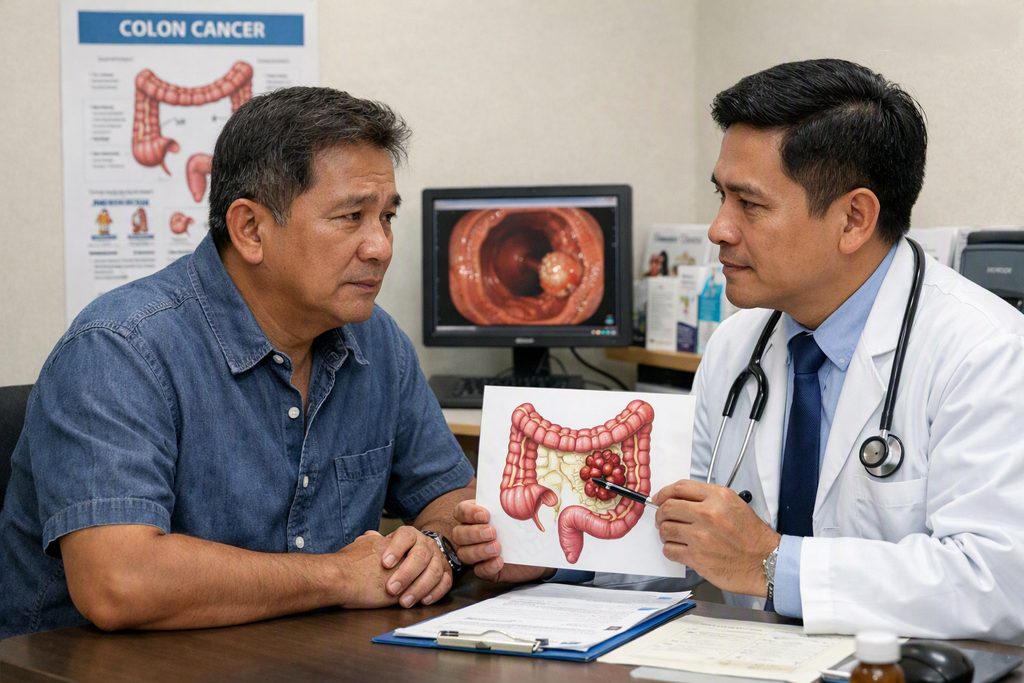
“When we find polyps during screenings, we can remove them and prevent the steady growth and progression,” explains Dr. Thomas Caughey, a hematologist/oncologist at Mount Auburn Hospital. “By doing this, we’ve prevented colon cancer.”
Yet despite being one of the most preventable cancers, CRC often remains undetected until it reaches an advanced stage. The reason is simple: people avoid screening.
“The high incidence of death may be attributed to people being reluctant about screening,” Dr. Caughey adds. “Routine screenings save lives.”
When Should You Get Screened?
The most effective screening method is colonoscopy. Medical experts recommend that screening begin at age 50, and every ten years thereafter.
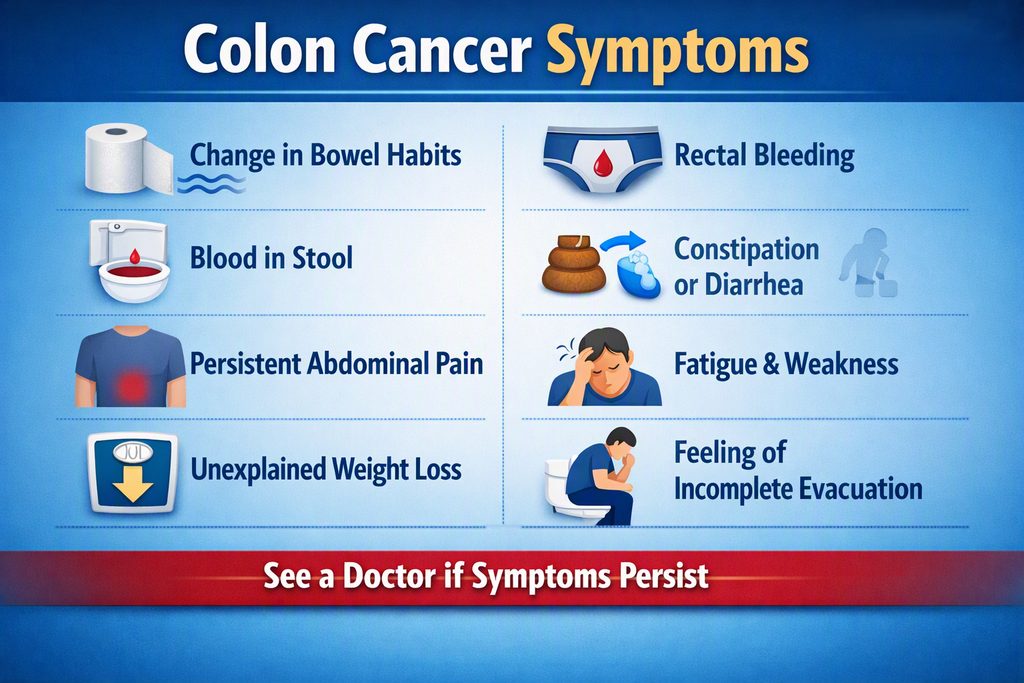
However, people with higher risk should start earlier. These include individuals with:
- A family history of colorectal cancer
- A change in bowel habits
- Blood in the stool
- Unexplained anemia
If cancer is present, treatment usually starts with surgery to remove the tumor.
“This helps us determine the stage the cancer is in, the size of the tumor, and how deeply invasive it is,” Dr. Caughey explains. “We can also determine if the cancer has spread to the lymph nodes or other places.”
For early‑stage cancers, surgery may be the only treatment needed. For more advanced cancers, surgery may be followed by chemotherapy or radiation to prevent recurrence.
If the cancer becomes metastatic, meaning it has spread to other organs, then it generally isn’t curable. However, several new treatments are available to help people manage the disease and prolong life.
Can Supplements Help Prevent Colon Cancer?
Researchers are exploring whether certain supplements, minerals, and vitamins can lower colorectal cancer risk.
Some studies suggest that people who take multivitamins containing folic acid, vitamin D, or calcium may have a lower risk of colorectal cancer than those who do not.
Taking aspirin or other nonsteroidal anti‑inflammatory drugs (NSAIDs) has also been associated with a lower risk.
“We know that people who use NSAIDs reduce their risk of developing colon cancer,” says Dr. Polly Newcomb, head of the Cancer Prevention Program at the Fred Hutchinson Cancer Research Center. “It’s very exciting.”
However, she cautions that researchers still do not know the ideal dosage. Some doctors worry that the risks—such as bleeding and ulcers—may outweigh the benefits.
Diet also plays a role. A diet high in fruits and vegetables seems to lower colorectal cancer risk, although not all studies agree. Still, the American Cancer Society emphasizes the importance of eating at least five servings of fruits and vegetables a day for overall health.
Chemotherapy: A Changing Landscape
Many clinical trials in the United States are testing new chemotherapy drugs or combinations of existing drugs. Other studies are exploring how best to combine chemotherapy with radiation therapy, targeted therapies, and immunotherapy.
“In the early 1990s, we only had one chemotherapy regimen for all stages of the disease,” Dr. Caughey recalls. “Within the last decade, we started using five new chemotherapy drugs that increase the effectiveness of treatment in any stage.”
Dr. Meg Mooney, a senior investigator at the US National Cancer Institute, agrees: “Within the last few years, there’s been tremendous progress. While none of these treatments are the penicillin for colorectal cancer, they’re still important steps forward.”
American researchers are also studying several vaccines designed to treat colorectal cancer or prevent it from returning after treatment. Unlike vaccines for infectious diseases, these vaccines aim to boost the patient’s immune system to fight cancer more effectively.
New Tests and Better Surgery
The American Cancer Society reports that new imaging and lab tests are being developed. These include:
· Fecal immunochemical tests (FIT) – more accurate in detecting blood in the stool
· Stool DNA tests – detect changes in DNA that may indicate cancer
· CT colonography – a special type of CT scan that can find polyps and cancers early
Meanwhile, surgeons continue to refine their techniques. They now better understand what makes colorectal surgery successful, such as removing enough lymph nodes during the operation.
Laparoscopic surgery, done through several small incisions instead of one large one, is becoming more widely used. This approach allows patients to recover faster and with less pain.
Colorectal cancer is preventable. It is treatable. It is survivable—if caught early. The tragedy is not only in the lives lost but in the lives that could have been saved.
In the end, the battle against colorectal cancer is not just a medical challenge. It is a challenge of awareness, courage, and timely action.

 Facebook
 Twitter