
By Karl Jerome A. del Mundo
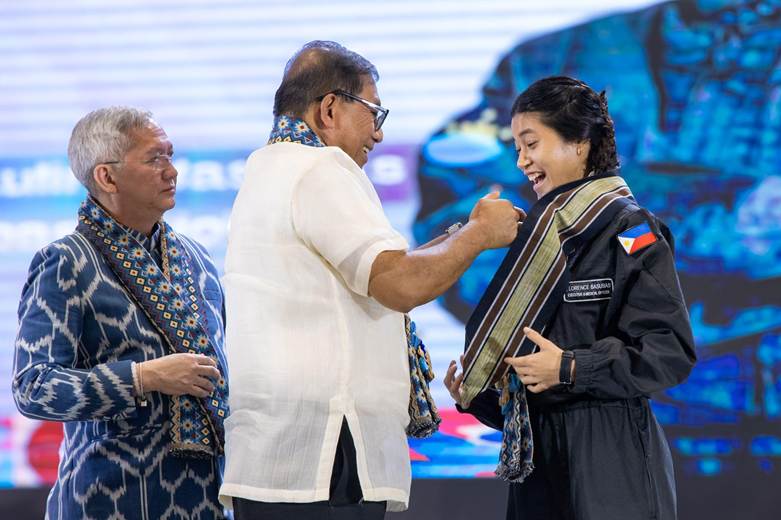
(Right to left) Florence Pauline “Pauli” Basubas receives a symbolic indigenous handwoven lei from Department of Science and Technology (DOST) Secretary Renato U. Solidum Jr., alongside DOST-Davao Regional Director Anthony C. Sales, as recognition of her ambassadorship for DOST-Davao Region during the opening ceremony of the Regional Science, Technology, and Innovation Week (RSTW) in Davao City, October 15.
Life on Earth may learn something from that in outer space—and that is what Pauli Basubas seeks.
Florence Pauline Basubas, known to many as Pauli, is a 28-year-old Filipina space biologist and biomedical scientist who puts her vivid focus on understanding how organisms can survive and thrive in space.
Though she now floats during her near-zero-gravity simulations and experiments, Basubas only dreamt of going to space in her childhood.
And growing up surrounded by nature in the islands of Cebu and Mindanao made her naturally curious about life, leading her to begin her career as a biologist and eventually become a biomedical scientist doing drug discovery research.
“Then when I encountered an opportunity to work in a space biology laboratory, I thought, ‘Oh, it’s so interesting,’” Basubas looked back as she traced her early career. “Why don’t I try it out? And I did.”
Now standing at the intersection of her childhood dream and career, she investigates how life on Earth is much different in space, as different factors may influence life—including gravity, radiation, atmosphere, and nutrients.
Basubas, sharing her most remarkable moment, experienced parabolic flight—flying in a steep up-and-down arc mimicking free fall, which causes microgravity or near-weightless conditions.
But more than a flight, she said they conduct experiments in this condition to help deeply understand how living cells, tissues, and biological systems respond to non-Earth space conditions.
“I think it is still kind of the number one experience in my life. But it’s also really quite remarkable because it is not easy, actually,” she shared. “Being in microgravity where our bodies are not used to it, where we don’t know the orientation, and then you have to do an experiment, it is quite an experience.”
Space biology, as she described, offers critical learnings that can pave the way to improve terrestrial life science, such as how DNA breaks and repairs, or treating genes and cells as plug-and-play, similar to synthetic biology but in space.
“We will be able to better engineer organisms that we can even utilize for applications in daily life here on Earth,” she said.
Now, sharing her learnings, Basubas urged the younger generation interested in the same field of science to focus on the skills that they have and utilize them to work in the space industry the way she did.
“As Filipinos, we have a lot of skills, and I think we should just try because we don’t have anything to lose. And if we give them a chance to give us a chance, who knows where the opportunities might take us,” she said with hope.
She worked with international and national organizations, promoting and democratizing access to analog space missions and microgravity research for developing nations such as the Philippines.
Moreover, she actively uses her platform to advocate for gender equality and institutional support in science, technology, engineering, and mathematics, and even became one of the science ambassadors of the Department of Science and Technology-Davao Region, awarded during its Regional Science, Technology, and Innovation Week in Davao City.
“There are a lot of challenges and issues in the Philippines that we can address and help contribute to with science and technology. So, it really pushed me to be meaningful and purposeful in this endeavor,” Pauli encouraged.

 Facebook
 Twitter