
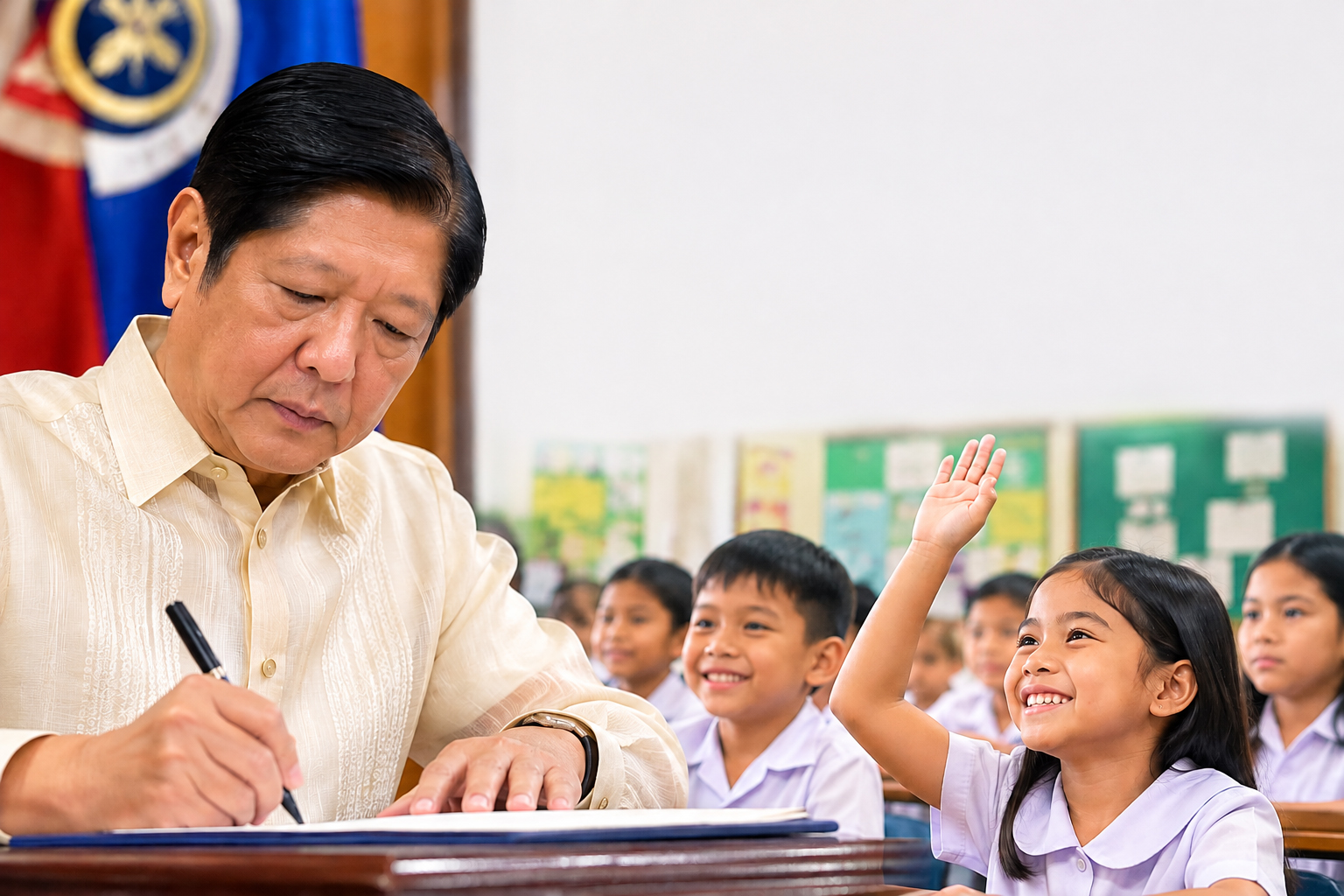
Marcos school voucher law expands government education assistance to kindergarten and elementary students after President Ferdinand Marcos Jr. signed Republic Act No. 12327, also known as the Basic Education Voucher Assistance Act, on November 12, 2026. The measure aims to help eligible Filipino families access participating private schools while addressing classroom overcrowding and limited educational facilities in public schools.
The measure, known as Republic Act No. 12327 or the Basic Education Voucher Assistance Act, was signed on November 12, 2026, and announced publicly on November 20.
The legislation aims to improve access to basic education, reduce overcrowding in public schools, and provide financial assistance to qualified students from kindergarten through Grade 12.
Under the new law, the government will expand its existing education assistance framework to include younger learners who previously had limited access to similar voucher programs.
The Department of Education (DepEd) will oversee the implementation, including identifying eligible students, determining voucher amounts, and accrediting participating private schools.
New Education Voucher Law Expands Assistance to Younger Students
The Basic Education Voucher Assistance Act introduces a broader system of financial support for students who wish to attend participating private educational institutions.
Previously, government voucher assistance primarily supported eligible junior and senior high school students through existing education subsidy programs.
With the signing of Republic Act No. 12327, the government intends to extend similar opportunities to kindergarten and elementary students.
The expansion is expected to begin in School Year 2027–2028, subject to the availability of government funding and the completion of DepEd’s implementing guidelines.
The law does not automatically provide vouchers to all students. Assistance will be distributed according to eligibility requirements, household income classifications, and educational needs.
DepEd will establish procedures to determine which students qualify for financial support.
Who Can Qualify for the School Voucher Program?
The expanded voucher program is designed to prioritize students facing difficulties accessing public education.
Among the intended beneficiaries are children attending overcrowded public schools and those living in communities where public educational facilities are limited or unavailable.
Students whose nearby public schools cannot accommodate additional enrollment may also qualify for assistance.
The law also considers eligible senior high school students who cannot access their preferred academic or technical-vocational pathways in nearby public schools.
Household income will be an important factor in determining eligibility.
The program is intended to support qualified families in income groups classified as middle-middle-income and below, with priority assistance for poor and low-income households.
However, the exact eligibility procedures and documentary requirements will depend on DepEd’s implementing rules and official announcements.
Parents and guardians are encouraged to wait for verified government guidelines before submitting applications.
Government Aims to Reduce Overcrowding in Public Schools
One of the main objectives of the new legislation is to address the continuing shortage of classrooms in the Philippines.
Public schools in different parts of the country have experienced overcrowding, forcing some institutions to implement multiple class shifts or make adjustments to their learning schedules.
According to findings cited by the Second Congressional Commission on Education, the country faces a classroom backlog exceeding 165,000 classrooms.
The shortage has placed pressure on school facilities, teachers, and students.
Through the expanded voucher program, qualified students may be able to transfer to participating private schools with available classroom capacity.
This arrangement is intended to reduce congestion in selected public schools while giving families additional educational options.
However, the voucher program is not a replacement for government investment in public school infrastructure.
The construction of classrooms, recruitment of teachers, and improvement of school facilities remain important responsibilities of the government.
How Will the Education Voucher System Work?
Under the new law, eligible students will receive government financial assistance that can be used toward educational expenses at participating private schools.
DepEd will determine the appropriate voucher amounts based on research, educational costs, and other relevant considerations.
The amounts must be reviewed periodically to determine whether adjustments are necessary.
Families will be able to select schools from an official registry of participating private educational institutions.
However, the voucher amount may not necessarily cover the full cost of tuition and other school expenses.
Parents may still need to pay additional fees depending on the school and the value of the assistance provided.
The law also allows local government units, private organizations, and scholarship sponsors to provide additional support.
This arrangement could help qualified families manage educational expenses while allowing private schools to accommodate more students.
DepEd to Monitor Participating Private Schools
The Department of Education will play a central role in implementing the expanded voucher program.
Its responsibilities will include establishing eligibility guidelines, maintaining a registry of participating schools, and monitoring the distribution of government assistance.
DepEd will also be responsible for ensuring that schools comply with program requirements.
The law includes provisions intended to prevent fraudulent claims, misuse of government funds, and other irregularities.
Participating schools must submit the necessary documentation to receive voucher reimbursements.
The legislation also provides safeguards for students whose schools experience delays in receiving government payments.
Schools are prohibited from withholding student records solely because government voucher reimbursements have not yet been released.
These measures are intended to protect students and promote accountability among participating educational institutions.
Private Schools May Help Address Classroom Shortages
Private educational institutions are expected to play an important role in the implementation of the new program.
By allowing qualified students to use vouchers at participating private schools, the government hopes to make better use of existing educational facilities.
Some private schools may have available classrooms that can accommodate additional students.
The program could also provide support to participating institutions through government-funded enrollment assistance.
However, private schools will need to meet DepEd’s requirements before joining the program.
Their participation will depend on accreditation, available facilities, and compliance with applicable educational standards.
Education officials will also need to monitor whether the program provides meaningful benefits to students in communities with limited access to public schools.
What the New Law Means for Filipino Parents
For Filipino families, the expanded voucher program could offer additional choices when deciding where to enroll their children.
Parents who previously could not afford private school tuition may become eligible for financial assistance.
Families living in communities with overcrowded public schools could also benefit from access to other participating educational institutions.
However, eligibility will not be automatic.
Parents will need to comply with DepEd requirements once the application procedures are officially announced.
The government has not yet established a single fixed voucher amount that will apply to every kindergarten and elementary student.
The actual value of assistance may vary depending on the program’s guidelines and the circumstances of eligible students.
Families should also understand that receiving a voucher does not necessarily mean that private education will be completely free.
Implementation Expected in School Year 2027–2028
The planned expansion to kindergarten and elementary students is expected to begin during School Year 2027–2028, subject to funding availability.
Before implementation, DepEd will need to finalize the necessary guidelines, eligibility requirements, and procedures for participating schools.
The agency will also need to coordinate with relevant government institutions to ensure that funding and monitoring systems are properly established.
Additional announcements are expected to clarify how parents can apply, which schools will participate, and how much financial assistance qualified students may receive.
Until those details are officially released, families are advised to rely on verified DepEd announcements.
Expanding Access to Quality Education
The signing of the Basic Education Voucher Assistance Act represents another government effort to improve access to education in the Philippines.
By expanding assistance to kindergarten and elementary students, the legislation seeks to address educational challenges at an earlier stage of learning.
The measure may help some families manage private school expenses while reducing pressure on overcrowded public schools.
Nevertheless, its effectiveness will depend on government funding, transparent implementation, the availability of participating schools, and proper monitoring.
Education experts and policymakers will also need to assess whether the program improves educational access for children in underserved communities.
As the government prepares for the planned implementation, the expanded voucher program is expected to become an important part of discussions about education funding, classroom shortages, and school accessibility in the Philippines.
Sources
- Philippine Information Agency — President Marcos signs law expanding students’ access to quality education via voucher assistance program, November 2026.
- GMA News — Marcos signs law expanding vouchers for K to 12 students in private schools, November 20, 2026.
- ABS-CBN News — New law establishes basic education voucher program to help address classroom backlog, congestion, November 20, 2026.
- Philstar — Marcos signs law expanding vouchers to kindergarten, elementary students, November 20, 2026.

 Facebook
 Twitter