
Words and Photos by Henrylito D. Tacio
While Hong Kong, Japan, Singapore, and Taiwan have achieved the coveted status of being rabies-free, much of Asia continues to grapple with this ancient and deadly disease. In the Philippines, rabies remains a persistent public health threat, claiming at least 200 lives every year, according to the Department of Health (DOH). The real number, experts warn, may be significantly higher due to underreporting in remote communities.
“Rabies is considered a significant public health problem in the country as it is one of the most acutely fatal infections,” the DOH states on its website. Despite the existence of effective vaccines for both humans and animals, rabies elimination remains elusive. Poverty, limited access to health services, and widespread misinformation continue to hamper progress.
A Global Day for a Global Threat
Rabies is not just a local concern; it is a global health issue. Every September 28, the world marks World Rabies Day, an initiative led by the World Health Organization (WHO) to raise awareness and highlight progress in combating the disease. The date commemorates the death anniversary of Louis Pasteur, the French scientist who developed the first rabies vaccine.
The annual observance serves as a reminder that while some countries have successfully eradicated rabies, others—like the Philippines—still struggle with its deadly consequences.
A Deadly Virus That Strikes Without Warning
The most common pets capable of transmitting rabies are dogs and cats. In Davao City, Councilor Richlyn N. Justol-Baguilod, chair of the Committee on Health, has repeatedly warned residents about the dangers of complacency.
“Rabies is not just a virus that we can cure with just a simple injection, it is deadly,” she emphasized. “We cannot leave our children with our pets knowing they could bite or scratch them anytime.”
In a privilege speech, she urged pet owners to vaccinate their animals. “You are not just saving your lives; you are saving your pets’ lives and the lives of others as well,” she said, as reported by Edge Davao journalist Maya Padillo.
The Deadliest Disease on Earth
The Global Alliance for Rabies Control describes rabies as the “deadliest disease on Earth.” The United States Centers for Disease Control and Prevention (CDC) estimates that one person dies from rabies every 10 minutes worldwide.
The Research Institute for Tropical Medicine (RITM) echoes this concern, noting that the Philippines ranks among the highest globally in terms of rabies prevalence.
Rabies is not new. Historical records from ancient Rome, Greece, and Egypt describe its terrifying symptoms. The word “rabies” itself comes from the Sanskrit rabhas, meaning “to do violence.” For centuries, the disease was also known as hydrophobia, referring to the fear of water caused by painful throat spasms in late-stage patients.
Warm-Blooded Carriers
“Rabies is a viral disease that attacks the central nervous system,” RITM explains. “It is transmitted to a person through a bite of an infected animal. All warm-blooded animals may carry the rabies virus.”
While dogs remain the primary source of human infections, other animals—including cats, cattle, horses, goats, rabbits, monkeys, and even bats—can carry the virus. Human beings, once infected, also become carriers.
The WHO estimates that 99% of human rabies cases worldwide come from infected dog bites. Children are particularly vulnerable, with up to 60% of cases occurring in individuals under 15 years old.
Transmission typically occurs when saliva from a rabid animal enters fresh skin wounds. Rare cases have been documented through inhalation of aerosolized virus or organ transplants.
Recognizing a Rabid Animal
Veterinarian Dr. Silvius Alon notes that rabid animals often exhibit sudden behavioral changes: drooling, unprovoked aggression, biting, aimless running, and difficulty breathing. Some may become unusually docile or die suddenly without showing symptoms.
Any dog that bites a person should be confined and observed for 10 to 14 days. “If the dog remains healthy, it’s safe to assume it’s rabies-free,” says Dr. Mary Elizabeth Miranda, one of the country’s leading rabies experts.

Rabies in Humans: A Race Against Time
Rabies symptoms in humans may take weeks or even months to appear. This delay is dangerous because once symptoms manifest, the disease is almost always fatal.
After a bite, the virus travels along the nerves toward the brain, incubating silently for up to three months. During this period, the victim appears healthy.
Prodromal Stage (2–10 days)
Early symptoms include:
- mild fever
- headache
- nausea
- persistent cough
- pain or tingling at the bite site
Acute Neurological Stage (2–7 days)
Symptoms escalate dramatically:
- agitation and restlessness
- excessive salivation
- enlarged pupils
- facial muscle weakness
- hoarseness
In about one out of six cases, hydrophobia develops—an involuntary throat spasm triggered by attempts to drink water.
Final Stage
The virus overwhelms the brain and nervous system. The patient slips into a coma, becomes paralyzed, and dies.

Vaccination: The Only Lifeline
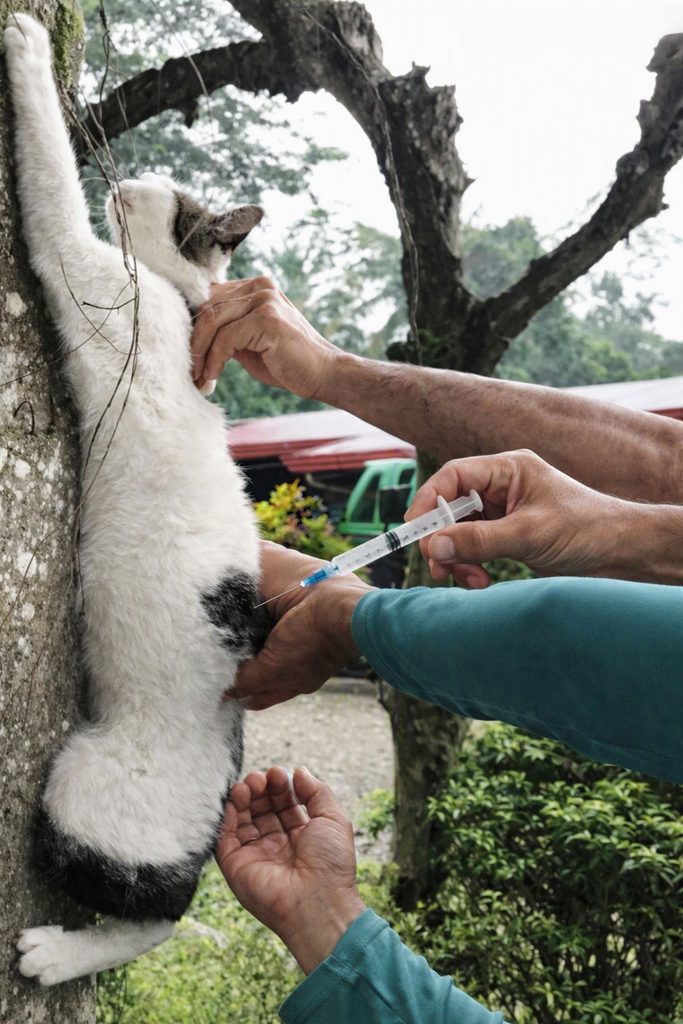
Rabies is 100% fatal once symptoms appear—but 100% preventable with timely vaccination.
If bitten or scratched by a dog or cat, immediate wound care is crucial:
- Wash the wound thoroughly with soap and running water.
- Apply antiseptic such as iodine or betadine.
- Seek medical attention immediately.
Victims must receive both active and passive immunization:
- Active immunization involves a series of rabies vaccines over several days.
- Passive immunization uses rabies immunoglobulin (HRIG or ERIG) to provide ready-made antibodies.
ERIG, derived from horse serum, is widely used in Asia because it is effective and more affordable than HRIG.
Serious allergic reactions to the vaccine are rare. Minor side effects—itching, dizziness, muscle aches—can be managed with common medications.
Dr. Nancy Nazaire-Bermal of Novartis Vaccines underscores the urgency: “Without timely treatment, rabies infection is 100 percent fatal. Rabies is the best example of an illness in which prevention is better than cure.”
The Role of Pet Owners and Communities
Vaccinating pets and livestock is essential. Government programs exist, but community participation is equally important.
“Parents must remind children to NEVER touch or feed stray dogs or cats,” advises Dr. Alon.
Rabies elimination requires:
- responsible pet ownership
- regular pet vaccination
- prompt treatment of bite victims
- public education
- stronger surveillance and laboratory capacity
Countries that have eliminated rabies did so through sustained, coordinated action. The Philippines can achieve the same—if communities, local governments, and national agencies work together.
Rabies is a preventable tragedy. No Filipino should die from a disease that science conquered more than a century ago.

 Facebook
 Twitter