
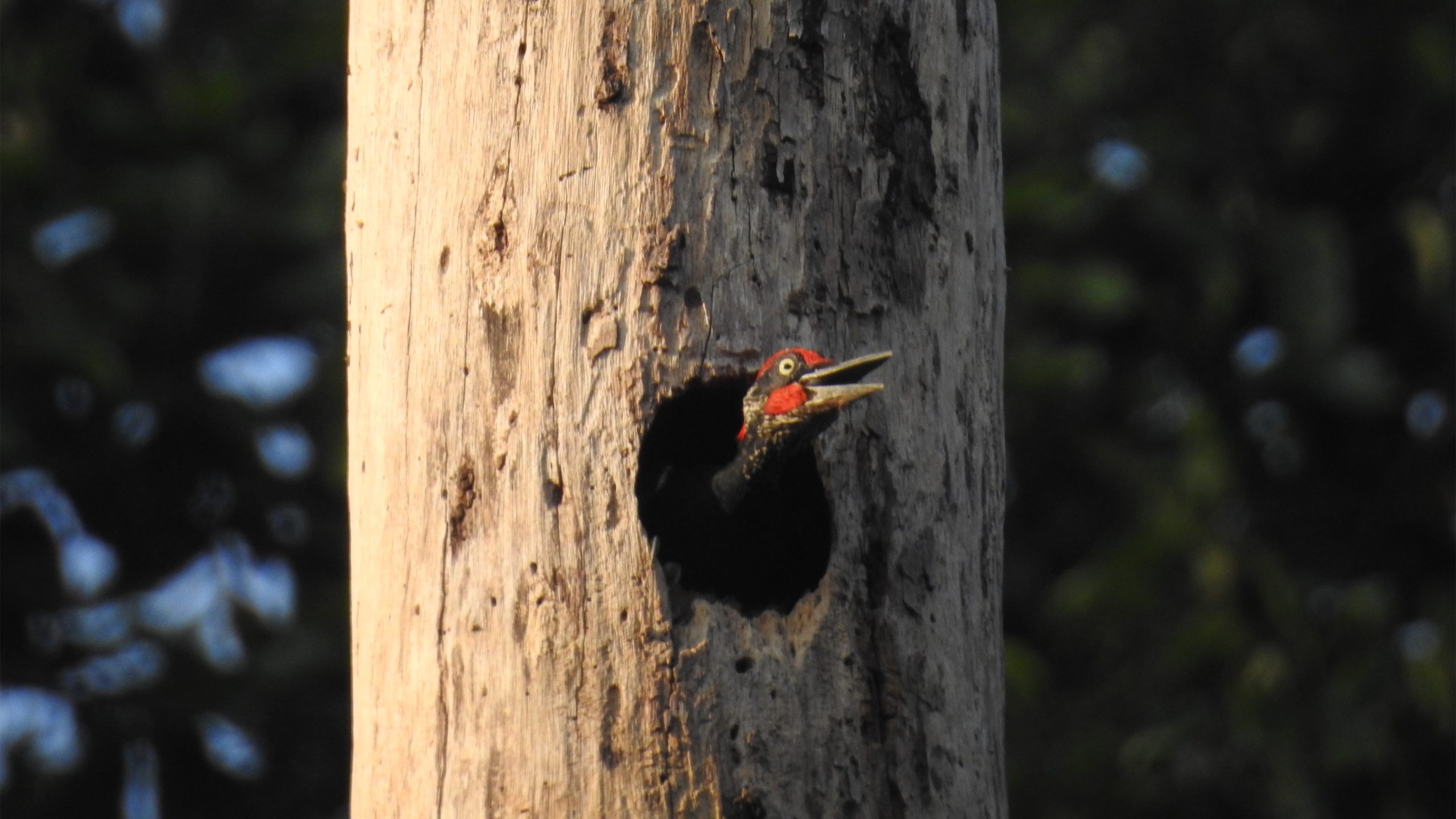
Tree cavities for forest birds play a vital role in nesting and survival, according to biologists who conducted field research in Subic.
Vince Angelo Gicaraya from the Institute of Environmental Science and Meteorology (IESM) and the Institute of Biology (IB) at UPD-CS, Dr. Carmela Española from UPD-CS’s IB and the Natural Sciences Research Institute (NSRI), and biologists from the Biodiversity Management Bureau of the Department of Environment and Natural Resources (DENR) and from Pampanga, together with local guides and volunteers, conducted a tree cavity survey along established and off-trail routes in Subic from February to June 2022.
The group found nests of 10 species of cavity-nesting birds in both living and dead native trees, primarily belonging to kupang trees (Parkia timoriana) and white lauan trees (Shorea contorta). Using multinomial logistic regression modeling, they discovered that cavity characteristics—such as depth, volume, and entrance area—play an important role in how bird species choose their nesting sites.
The research not only underscores the importance of conserving and planting native trees to support the nesting opportunities of cavity-nesting species but also provides baseline data (measurements) for developing conservation tools (e.g., species-specific nest boxes) for the Philippine Red List Critically Endangered and Vulnerable species Blue-naped Parrot (Tanygnathus lucionensis) and Luzon Hornbill (Penelopides manillae), respectively.
The study also showed that 63% of nests used by non-excavator birds were made by woodpeckers, highlighting the importance of woodpeckers in providing nest sites for many bird species.
“This study is the second of its kind in Asia—and the first in the Philippines—that examines nest web interactions at the community level,” the team of biologists explained. Nest web interactions refer to the way different animals, especially birds, are connected through their use of tree cavities for nesting.
“Unlike in temperate Europe and subtropical South America, where woodpeckers are not considered keystone species—or animals that have a particularly large impact on their environment—this study provides evidence of their keystone role in tropical forests, similar to findings in India and Canada.”
“These results highlight the urgent need to prioritize research and conservation efforts for primary excavators—birds like woodpeckers that create their own nesting holes—in the Philippines, where both these species and those that rely on their nesting sites remain largely understudied,” they added.
The research paper, titled “Cavity characteristics explain the differences in realized nest niches among tree cavity-nesting birds in a lowland tropical forest in Luzon Island, Philippines,” was included in Annales Zoologici Fennici, a journal publication which shares original research reports, in-depth reviews, and commentary on all aspects of animal ecology, evolution, and related fields.
This study was also funded by NSRI and the Department of Environment and Natural Resources Foreign-Assisted and Special Projects Service (DENR-FASPS) through the collaborative efforts of the Biodiversity Management Bureau (BMB) and IB.

 Facebook
 Twitter