
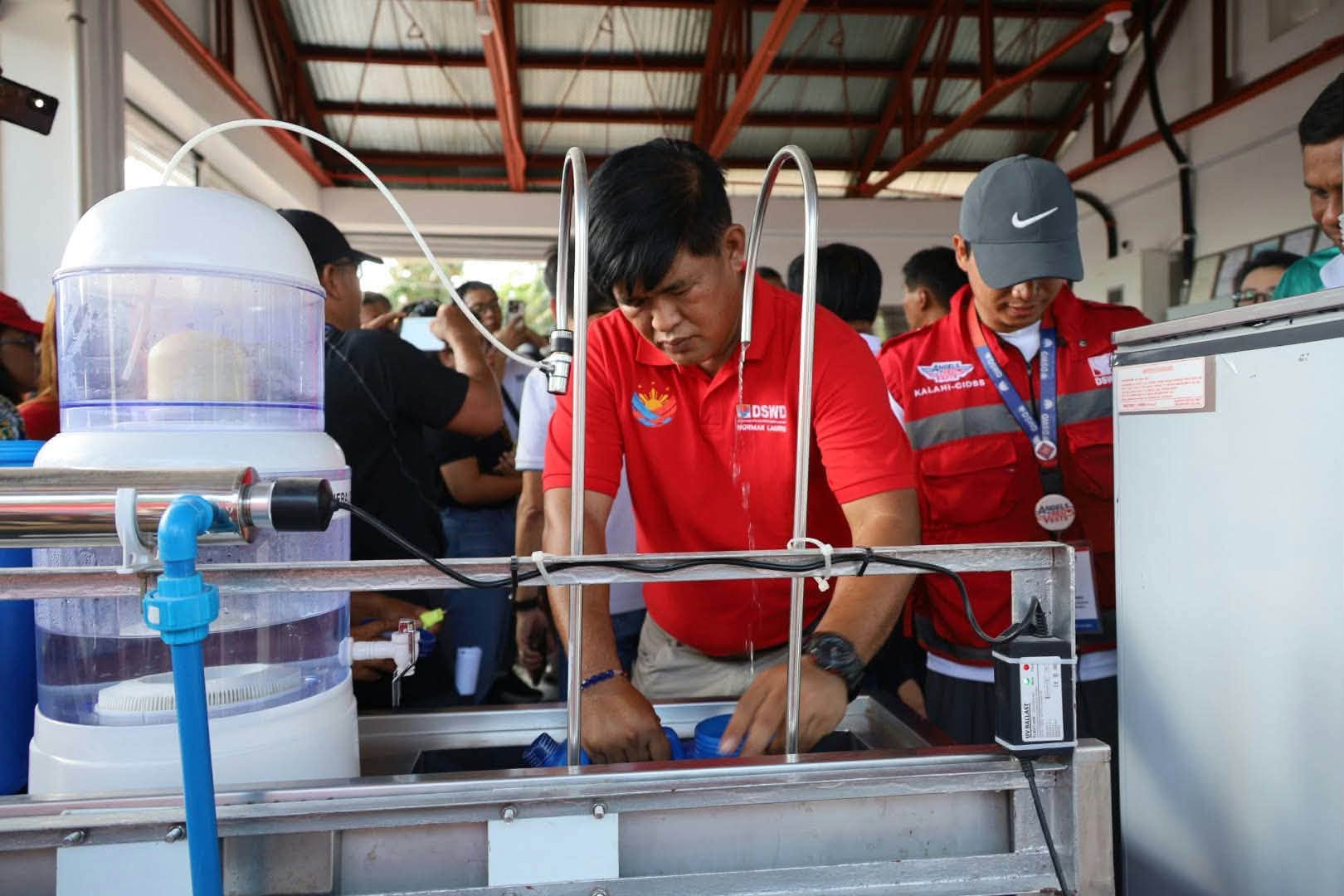
Atmospheric water generators are being considered by the Department of Social Welfare and Development (DSWD) as an alternative source of drinking water for vulnerable Philippine communities amid the threat of a Very Strong El Niño expected to persist into the first half of 2027.
The technology, which extracts moisture from the air and converts it into water, is being explored as an alternative source of drinking water for communities that struggle with limited or unreliable supplies.
Social Welfare Secretary Rex Gatchalian recently led a benchmarking visit to Barangay Gilotongan in Cawayan, Masbate, where a solar-powered atmospheric water generation facility was established under the government’s KALAHI-CIDSS program.
The visit on November 11, 2026, brought together representatives from several DSWD regional offices to examine the technology and assess its potential use in other areas facing water shortages.
According to DSWD, the Masbate installation could serve as a model for municipalities seeking alternative solutions to their drinking-water problems.
₱19-Million Water Project Serves 836 Households
The atmospheric water generation facility in Barangay Gilotongan represents an investment of approximately ₱19.04 million, with 836 households identified as beneficiaries.
The project was developed to address the community’s long-standing difficulty accessing safe drinking water, particularly because of its island location and limited water sources.
Before the facility became available, residents faced additional expenses when purchasing drinking water. DSWD reported that a gallon of water could cost ₱25 at a water-refilling station, ₱35 at local stores, and as much as ₱50 when obtained from Cawayan town.
Transportation challenges also made access more difficult, especially during unfavorable weather conditions when traveling by sea became less convenient.
The project, which began in October 2025 and was inaugurated on September 28, 2026, uses solar photovoltaic power alongside grid electricity and a backup generator.
Its reported production target is up to 1,000 liters of potable water daily, providing a potential local source of drinking water for the beneficiary households.
However, the actual amount available to each household will depend on production levels and the community’s water distribution arrangements.
How Does Atmospheric Water Generation Work?
Atmospheric water generators, commonly known as AWGs, produce water by extracting moisture from the surrounding air.
Most condensation-based systems use fans to draw humid air into the machine. The air is then cooled until the moisture condenses into liquid water, which undergoes filtration and treatment before it can be used for drinking.
Some systems also incorporate solar panels to help supply the electricity needed to operate the equipment.
Unlike conventional water systems that depend on rivers, reservoirs or groundwater, atmospheric water generators obtain their water directly from moisture in the atmosphere.
This makes the technology potentially useful in geographically isolated communities where establishing traditional water infrastructure can be difficult or expensive.
However, production depends heavily on environmental conditions. Humidity, temperature, equipment capacity and available electricity can all influence how much water a generator can produce.
Very Strong El Niño Raises Concerns Over Water Supply
The DSWD initiative comes as the country faces the possibility of worsening water shortages associated with El Niño.
In its November 4, 2026 advisory, the Philippine Atmospheric, Geophysical and Astronomical Services Administration (PAGASA) confirmed that a Very Strong El Niño was present in the tropical Pacific.
The weather agency said the phenomenon was expected to continue through the first half of 2027, with conditions potentially peaking toward the end of 2026.
PAGASA also reported that several provinces experienced drought, dry spells and dry conditions during October.
Below-normal to way below-normal rainfall was expected in many parts of the country in November, increasing concerns about water availability and agricultural production.
El Niño is a climate phenomenon associated with warmer-than-normal sea surface temperatures in the central and eastern equatorial Pacific. In the Philippines, it commonly results in reduced rainfall, prolonged dry periods and higher temperatures.
These conditions can affect water reservoirs, agricultural areas and communities that depend on rainfall for their daily needs.
Government agencies have been encouraged to implement water conservation and preparedness measures to reduce the potential effects of the climate phenomenon.
Technology Offers Potential but Long-Term Costs Remain a Concern
While atmospheric water generators could provide an additional source of drinking water, experts and policymakers still need to consider the technology’s operational requirements before expanding its use.
One major concern is electricity consumption. Conventional atmospheric water generators rely on cooling equipment to condense moisture, which can require considerable energy.
Solar power can help reduce dependence on conventional electricity, but the system must still have sufficient energy to operate consistently.
Another consideration is humidity. Since these machines extract moisture from the atmosphere, their water production may decline when surrounding air becomes drier.
This is particularly important during El Niño, when some parts of the Philippines experience prolonged dry conditions.
Regular maintenance and water-quality testing are also necessary. Extracted water must undergo appropriate treatment to ensure it meets drinking-water safety standards.
For communities considering similar installations, the initial construction cost is only one part of the equation. Government planners must also assess electricity expenses, filter replacement, equipment maintenance, distribution arrangements and long-term operating costs.
DSWD Considers Wider Use in Water-Insecure Communities
The Masbate project provides an opportunity for government agencies to examine whether atmospheric water generation can be replicated in other communities with limited access to safe drinking water.
The November 11 benchmarking activity included representatives from Regions IV-A, IV-B, VII, X and XIII, who were given an opportunity to observe the facility and learn about its implementation.
DSWD’s interest in expanding the technology reflects the growing need for alternative water sources, particularly in island communities and geographically isolated areas where conventional infrastructure may be difficult to establish.
However, wider implementation will require careful assessment of local environmental conditions, financial sustainability and the actual water requirements of each community.
Atmospheric water generators are unlikely to replace major water infrastructure, reservoirs, groundwater sources or rainwater harvesting systems. Instead, they could complement existing solutions by providing localized drinking-water supplies in areas where access remains a challenge.
As the Philippines prepares for the continuing effects of Very Strong El Niño, the experience in Gilotongan could help determine whether extracting water from the air is a practical addition to the country’s broader water-security efforts.

 Facebook
 Twitter