
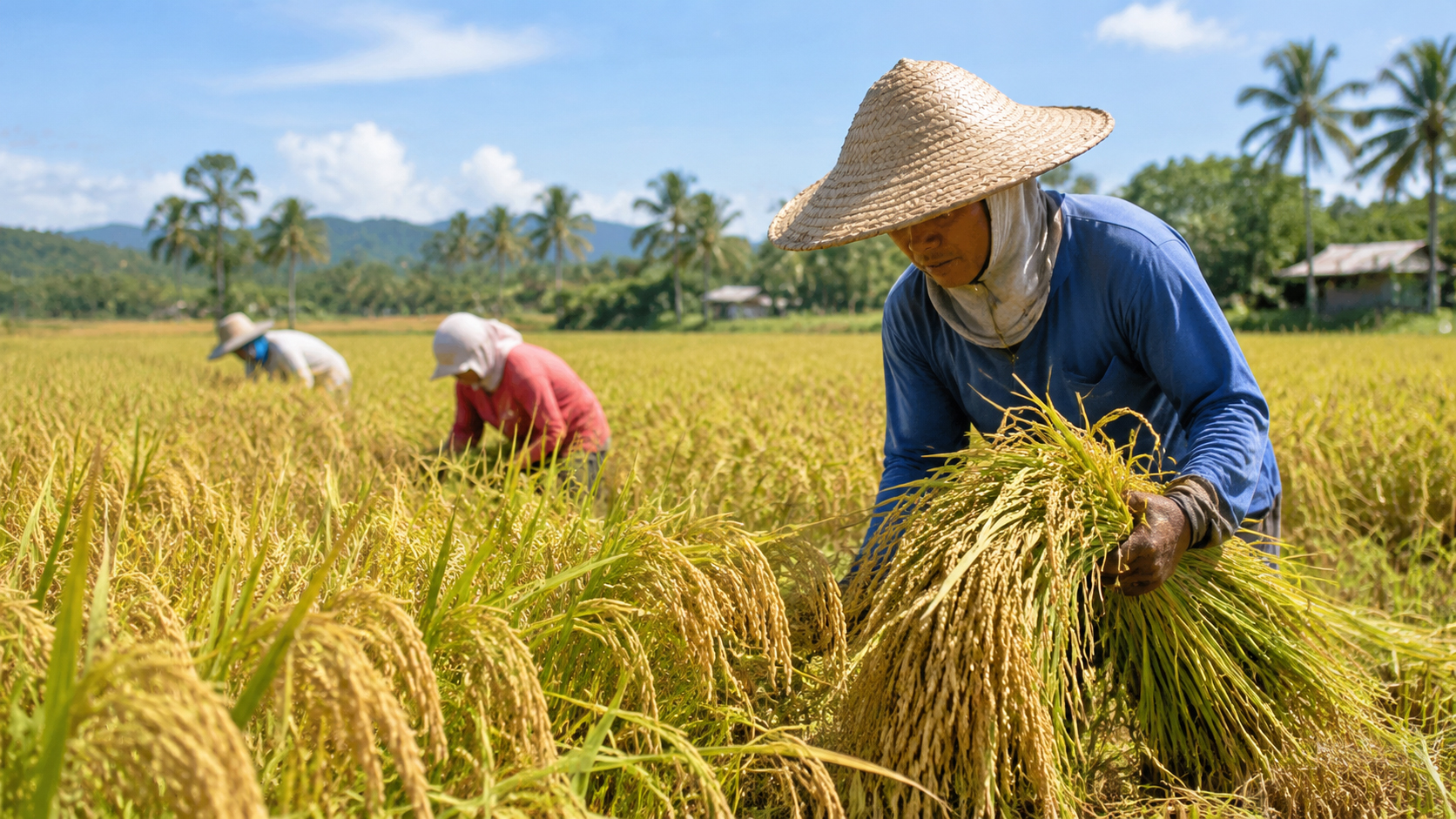
El Niño agricultural losses in the Philippines have reached nearly ₱10 billion, affecting hundreds of thousands of farmers and threatening local food production. The growing damage to rice, corn, and other crops is raising concerns about farmers’ livelihoods, agricultural productivity, and food affordability as the country prepares for potentially stronger dry conditions in 2027.
The Department of Agriculture (DA) reported approximately ₱9.99 billion in agricultural damage and production losses, affecting more than 324,000 farmers and over 323,000 hectares of agricultural land. The reported losses highlight the vulnerability of the country’s agricultural sector to prolonged dry conditions and extreme weather.
The damage comes at a difficult time for Filipino households, which continue to deal with elevated food prices and the rising cost of basic necessities.
El Niño losses hit rice and corn production
Rice and corn account for the largest portions of the reported agricultural damage, according to Department of Agriculture figures.
Corn suffered approximately ₱5.63 billion in losses, while rice recorded around ₱3.65 billion. High-value crops also sustained damage estimated at ₱656 million.
Combined, rice and corn account for more than 90 percent of the reported agricultural losses.
The effects extend beyond damaged crops. Farmers who lose their harvests may struggle to recover their production expenses, repay agricultural loans, purchase seeds and fertilizers, and prepare their land for the next planting season.
For small-scale farmers who depend on each harvest for their household income, prolonged drought can create financial difficulties that continue long after the weather improves.
Agricultural contraction adds to concerns
The agricultural crisis is also reflected in the country’s economic performance.
Data from the Philippine Statistics Authority showed that agriculture, forestry, and fishing contracted by 4.8 percent year-on-year in the third quarter of 2026.
Palay production declined by 17.8 percent, while corn production fell by 17.4 percent. Fishing and aquaculture also experienced an 8.5 percent contraction.
These figures demonstrate the challenges facing the agricultural sector, which remains an important source of employment and income for millions of Filipinos.
Although agriculture contributes a smaller share of the country’s overall economic output than services and industry, its performance directly affects food availability, rural employment, and the income of farming communities.
Food prices remain a concern for Filipino households
Agricultural production problems are particularly concerning because food affordability remains a major issue for consumers.
The Philippine Statistics Authority reported that headline inflation reached 7.8 percent in October 2026, while food inflation stood at 6.4 percent.
Rice inflation was considerably higher, reaching 20.7 percent year-on-year. Corn prices also increased by 19.3 percent.
Higher food prices place additional pressure on households, particularly low-income families that spend a substantial portion of their earnings on food.
However, agricultural losses should not be considered the sole cause of inflation. Fuel prices, transportation expenses, supply chain costs, and other economic conditions also influence the prices consumers pay in markets.
Nevertheless, prolonged disruptions in domestic agricultural production can make the country’s food supply more vulnerable to supply shortages and price fluctuations.
Davao farmers also affected by agricultural losses
The impact of El Niño is also being felt in Mindanao.
In the Davao Region, reported agricultural damage and losses reached approximately ₱584.68 million as of October 29, 2026, according to regional agricultural reports.
More than 6,200 farmers were affected, with over 6,600 hectares of agricultural land reporting damage.
Rice accounted for approximately ₱390.24 million in losses, followed by high-value crops at ₱126.9 million. Livestock and poultry losses reached ₱35.22 million, while corn losses were estimated at ₱32.32 million.
The regional government has outlined a ₱729.11 million El Niño action plan, including measures to support affected agricultural communities and strengthen preparations against prolonged dry conditions.
The situation highlights the importance of agricultural assistance in Mindanao, where farming remains a significant source of livelihood for many communities.
Government prepares for potentially stronger El Niño effects in 2027
The Department of Agriculture is also preparing for the possibility of more severe drought conditions in the coming months.
Government projections indicate that the strongest effects of El Niño could occur between January and April 2027.
Under a worst-case scenario, as many as 4.6 million farmers and fisherfolk could be affected, with agricultural losses potentially reaching ₱20 billion.
The government has been preparing interventions that include irrigation improvements, distribution of agricultural inputs, fuel assistance, emergency support, and other measures intended to help farmers maintain production during periods of limited rainfall.
The Department of Agriculture has also announced a broader El Niño preparedness and response program worth approximately ₱61.99 billion.
The effectiveness of these interventions will be important in determining how well agricultural communities can withstand the anticipated dry conditions.
Why protecting Philippine agriculture matters
The agricultural sector plays a critical role in the country’s food security and economic stability.
According to the Organisation for Economic Co-operation and Development, agriculture accounted for approximately 9.1 percent of Philippine gross domestic product in 2024 and provided 21.2 percent of total employment.
This means agricultural problems affect far more than farmers alone.
Disruptions in rice, corn, vegetable, and other agricultural production can influence food processors, traders, market vendors, transportation businesses, and consumers.
Supporting local farmers also helps strengthen domestic food production and reduce the country’s vulnerability to external supply disruptions.
As the Philippines prepares for another potentially challenging dry season, investments in irrigation, climate-resilient farming, agricultural infrastructure, and timely financial assistance will be essential.
For Filipino households already dealing with expensive food, protecting farmers and agricultural production is not simply an agricultural concern. It is also a matter of food security, economic stability, and the cost of living.

 Facebook
 Twitter