
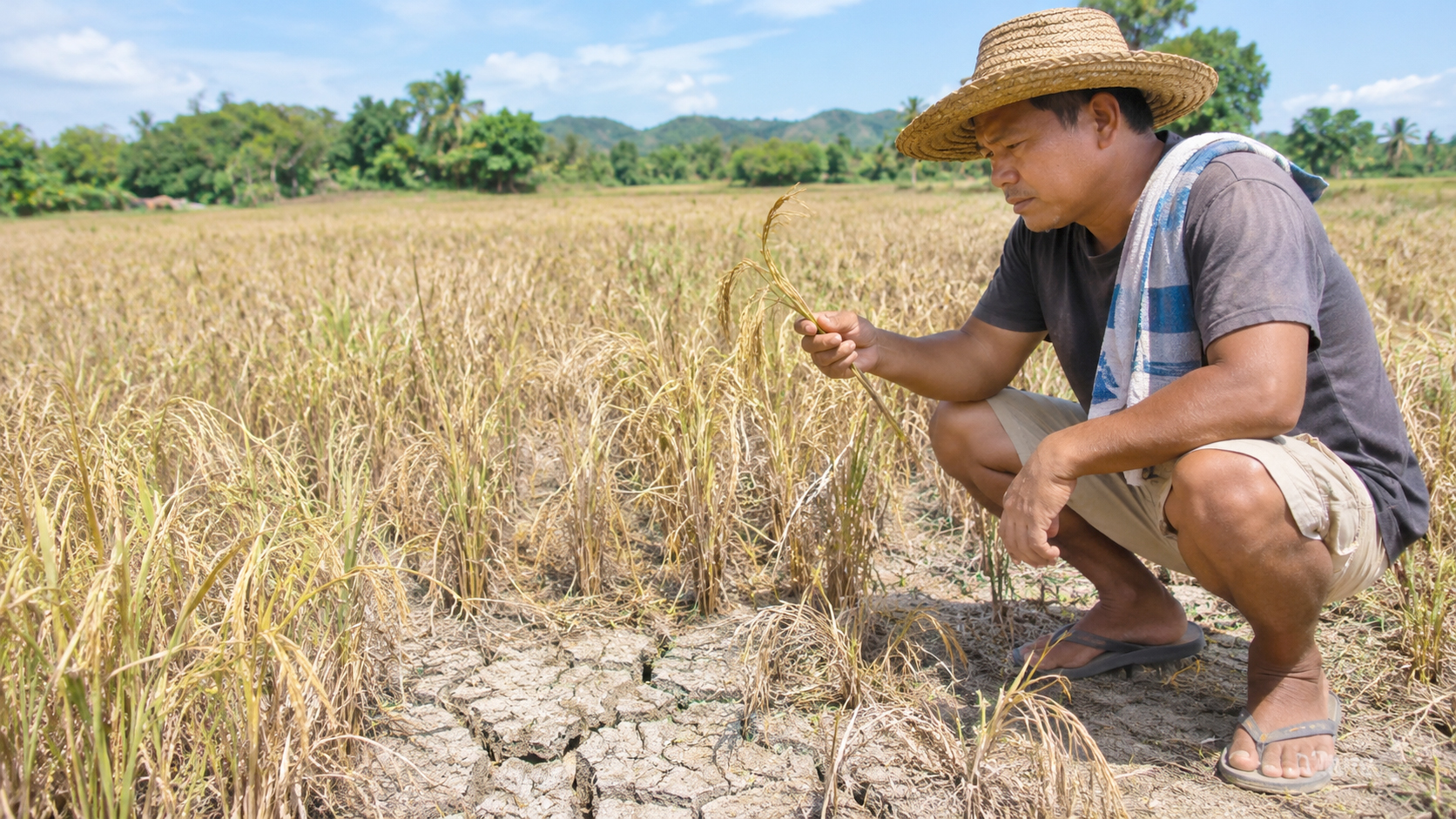
The Bohol drought crisis is worsening as agricultural and fisheries losses in the province exceed ₱372 million, affecting 18,384 farmers amid a very strong El Niño. Provincial officials are seeking a state of calamity declaration to help accelerate assistance as prolonged dry conditions threaten crops, water supplies and local livelihoods.
BOHOL, Philippines — November 17, 2026 — Agricultural and fisheries losses in Bohol have exceeded ₱372 million as the province faces worsening drought conditions linked to a very strong El Niño, affecting 18,384 farmers and raising concerns over food production and water availability.
The Provincial Disaster Risk Reduction and Management Council (PDRRMC) has recommended placing the entire province under a state of calamity to speed up the release of funds and delivery of assistance to affected communities.
The recommendation followed a meeting convened by Governor Aris Aumentado with concerned government agencies to assess the growing agricultural damage and prepare for prolonged dry conditions.
According to the provincial government, the losses have already exceeded ₱372 million, covering both agriculture and fisheries.
El Niño threatens Bohol’s agricultural sector
The worsening situation comes as the Philippine Atmospheric, Geophysical and Astronomical Services Administration (PAGASA) warns that a very strong El Niño is currently present in the tropical Pacific and could persist through the first half of 2027.
The weather phenomenon increases the likelihood of below-normal rainfall, prolonged dry spells and drought in several parts of the country.
For Bohol, provincial officials expect dry conditions to develop toward the end of December, with drought potentially beginning in late January and continuing through April 2027.
The prolonged dry period could further affect farmers who are already struggling with reduced water availability and damaged crops.
Rice production among the sectors affected
Rice farming is particularly vulnerable to the changing weather conditions.
In a November 9 report, the Philippine Information Agency said Bohol has approximately 53,880 hectares of rice land, but only around 30,000 hectares were planted during the wet season.
This represents roughly 55% of the province’s total rice-growing area.
Maricel Barloso, an agricultural technologist and rice program focal person at the Office of the Provincial Agriculturist, said some farmers postponed planting because of drought, while others who planted late experienced crop losses.
The provincial agriculture office has encouraged farmers to consider drought-tolerant rice varieties, adopt water-saving irrigation techniques and shift to high-value crops when water supplies are insufficient.
Provincial government strengthens drought preparations
Governor Aumentado has directed concerned offices to strengthen measures aimed at protecting water supplies and reducing the impact of the prolonged dry conditions.
Among the initiatives are securing existing water sources, preparing water pumps and deploying solar-powered systems to help maintain water supplies for communities and agricultural areas.
The governor also instructed the Office of the Provincial Agriculturist to release weekly updates and advisories to guide farmers on appropriate crops and available water resources.
These advisories are intended to help agricultural communities make informed planting decisions as drought conditions potentially intensify.
Cloud seeding and other agricultural interventions
Cloud seeding has also been among the measures pursued by the provincial government to help address insufficient rainfall.
Earlier reports from November 8 indicated that Bohol had allocated ₱5 million for approximately 31 hours of cloud-seeding operations.
However, cloud seeding is dependent on suitable atmospheric conditions and should not be considered a guaranteed solution to prolonged drought.
The province is also encouraging agricultural practices that require less water, particularly in areas where irrigation resources are limited.
PAGASA warns of prolonged dry conditions nationwide
The situation in Bohol reflects a wider climate concern affecting the Philippines.
In its November 4 advisory, PAGASA confirmed that a very strong El Niño was present in the tropical Pacific and could reach its peak before the end of 2026.
The agency reported that five provinces experienced meteorological drought in October, while 11 provinces were under dry-spell conditions and 10 others experienced dry conditions.
For November, below-normal to way-below-normal rainfall is expected across most parts of the country.
PAGASA also warned that the effects of El Niño could continue into the first half of 2027, increasing the need for water conservation and appropriate preparations among government agencies, farmers and communities.
Food security and farmers’ livelihoods at risk
The growing agricultural losses raise concerns about the potential effects of prolonged drought on food production and rural livelihoods.
Reduced planting areas, damaged crops and limited irrigation could make it more difficult for farmers to maintain production if dry conditions continue.
The situation also highlights the importance of preparing alternative water sources, improving irrigation efficiency and providing timely assistance to agricultural communities.
While the reported damage in Bohol does not automatically indicate nationwide rice shortages or higher food prices, continued production losses could add pressure to local agricultural supply.
For now, the provincial government’s proposed state of calamity declaration is intended to help accelerate assistance as communities prepare for the possibility of several more months of dry weather.
The coming months will be critical in determining how severely the prolonged El Niño affects Bohol’s farmers, fisheries and food production.
Sources: Philippine Information Agency, PAGASA, Bohol Provincial Government and Bohol Island News.

 Facebook
 Twitter