
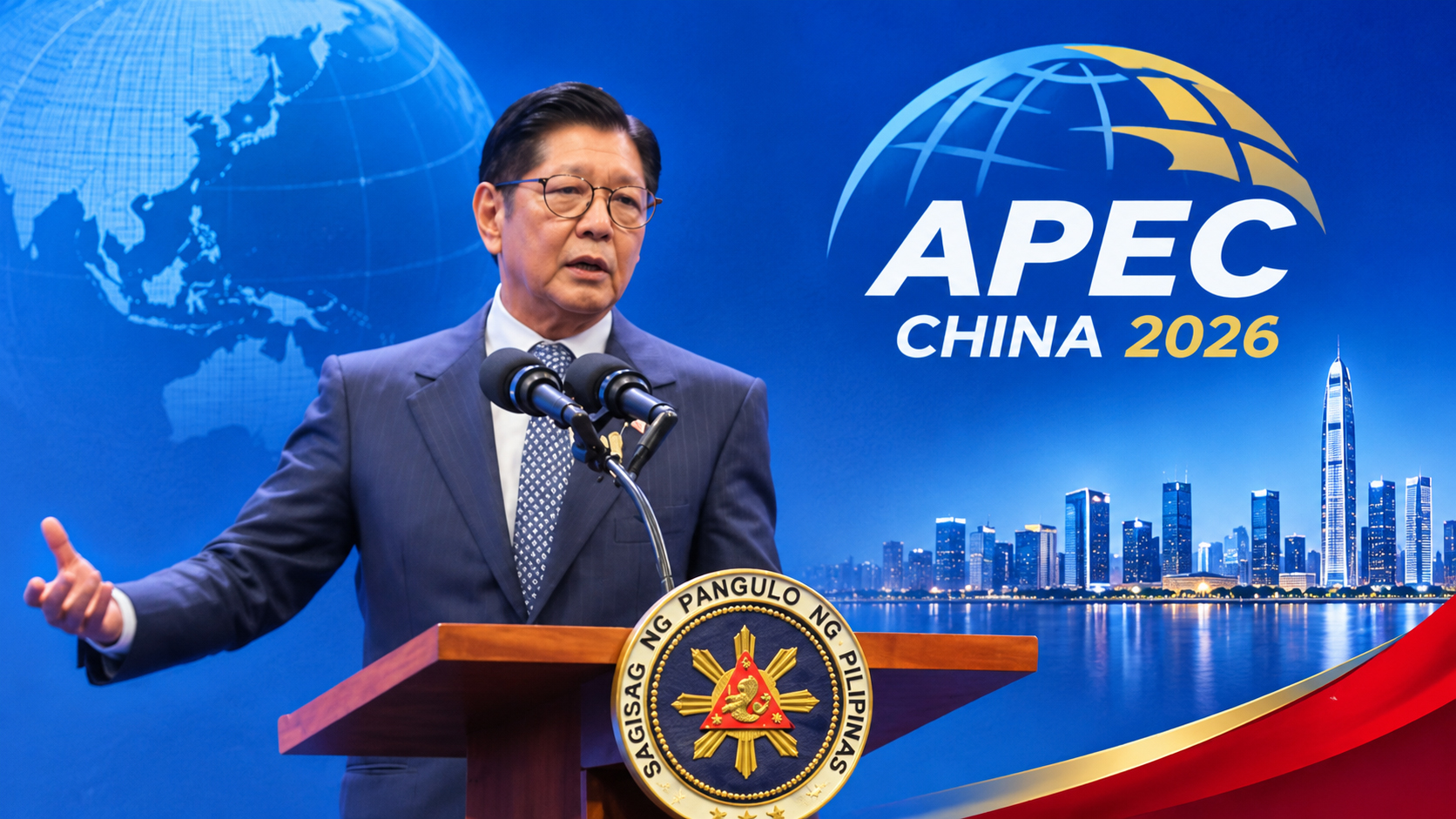
MANILA, Philippines — The Marcos APEC Summit China visit began on Wednesday, November 18, 2026, as President Ferdinand Marcos Jr. arrived in Shenzhen to attend the 33rd Asia-Pacific Economic Cooperation (APEC) Economic Leaders’ Meeting. The President aims to strengthen international trade relations, attract foreign investments, and explore new economic opportunities for Filipino businesses and workers.
The visit follows the Philippines’ hosting of the 49th Association of Southeast Asian Nations (ASEAN) Summit in Manila.
Marcos is joining leaders and representatives from 21 APEC member economies to discuss regional economic growth, international trade, investment, and technological development.
The meeting, hosted by Chinese President Xi Jinping, carries the theme “Building an Asia-Pacific Community to Prosper Together.”
The gathering provides an opportunity for the Philippines to strengthen economic partnerships while maintaining its position on important national and regional issues.
Marcos Arrives in Shenzhen for APEC Meeting
Marcos departed Villamor Air Base in Pasay City at approximately 3:25 p.m. on Wednesday aboard presidential aircraft PR001.
According to reports, the aircraft landed at Shenzhen Bao’an International Airport at around 5:30 p.m.
The President was accompanied by First Lady Liza Araneta-Marcos and several senior government officials.
Members of the Philippine delegation included officials responsible for finance, trade, foreign affairs, and government communications.
Marcos was expected to attend a welcome dinner before participating in the summit’s scheduled discussions and meetings.
The two-day gathering, scheduled for November 18 and 19, brings together leaders from major economies across the Asia-Pacific region.
Marcos APEC Summit China Visit Focuses on Trade and Investment
One of the main objectives of the Marcos APEC Summit China visit is to promote the Philippines as a destination for international business and investment.
The administration hopes to encourage foreign companies to explore opportunities in Philippine industries, including manufacturing, technology, and services.
Marcos has emphasized the importance of developing economic partnerships that can create employment opportunities and support long-term national growth.
Before departing for China, the President reiterated the administration’s message that the Philippines remains open to foreign investment.
“Our message is clear—the Philippines is open for business. Invest in the Filipino,” Marcos said.
The administration also aims to expand opportunities for Filipino businesses to participate in international markets.
Stronger trade relationships could help local companies reach additional customers and develop partnerships with foreign investors.
However, the economic benefits of these discussions will depend on future agreements, business decisions, and the implementation of investment projects.
APEC Summit Focuses on Regional Economic Growth
The Asia-Pacific Economic Cooperation forum was established in 1989 to promote economic cooperation among participating economies.
APEC has 21 member economies, including the Philippines, China, the United States, Japan, South Korea, Australia, and several Southeast Asian economies.
The organization provides a platform for discussions involving trade, investment, economic development, and regional cooperation.
According to Marcos’ departure statement, APEC economies collectively account for approximately 61 percent of global gross domestic product and 46 percent of global trade in goods and commercial services.
These figures highlight the importance of the region to international economic activity.
The Shenzhen meeting is expected to address economic challenges and opportunities affecting participating economies.
Discussions may include trade facilitation, digital transformation, innovation, supply chains, and sustainable development.
Unlike formal trade agreements, APEC generally operates through voluntary cooperation and nonbinding commitments.
As a result, participation in the summit does not automatically lead to new trade agreements or guaranteed investments.
Marcos Promotes Digital Economy and Innovation
Digital technology and innovation are among the economic priorities the Philippines intends to promote during the APEC gathering.
The administration has expressed interest in strengthening international cooperation involving artificial intelligence, digital services, and emerging technologies.
These industries may provide opportunities for Philippine businesses and workers as regional economies continue to adopt new technologies.
Improved digital infrastructure and technology partnerships could also support business development and economic competitiveness.
However, investments in these sectors require supporting policies, infrastructure, workforce development, and cooperation between government and private companies.
The summit offers participating economies an opportunity to exchange ideas and explore possible partnerships.
For the Philippines, developing its digital economy remains part of broader efforts to attract investment and create employment opportunities.
Philippines-China Relations Remain Important
The Marcos APEC Summit China visit also carries diplomatic significance because the Philippines and China maintain important economic relationships despite continuing disagreements over maritime issues.
China remains an important trading partner for the Philippines, with economic exchanges involving goods, services, and investment.
At the same time, the two countries continue to face tensions involving competing maritime claims in the South China Sea.
Before leaving Manila, Marcos said his administration would continue engaging China on economic matters while protecting Philippine national interests.
His position reflects an effort to maintain economic cooperation without abandoning the country’s stance on maritime concerns.
The President’s attendance at the APEC summit does not represent a resolution of the maritime disputes between Manila and Beijing.
No new agreement settling those disagreements had been announced at the time of his arrival.
Possible Meeting With Chinese President Xi Jinping
Chinese President Xi Jinping is hosting the 33rd APEC Economic Leaders’ Meeting.
As host, Xi is expected to participate in discussions with leaders and representatives from participating economies.
However, a separate bilateral meeting between Marcos and Xi had not been confirmed in the reports available at the time of his arrival.
Earlier reporting indicated that a formal meeting between the two leaders was not expected.
Marcos may also participate in discussions with other regional leaders during the gathering.
Such meetings could provide opportunities to discuss economic cooperation, trade relations, and investment prospects.
Any agreements or commitments resulting from these discussions would require separate confirmation from the governments involved.
APEC Participation Follows ASEAN Summit in Manila
Marcos’ participation in the APEC meeting follows the Philippines’ hosting of the 49th ASEAN Summit.
The two international gatherings provide opportunities for the country to strengthen diplomatic and economic relationships with regional partners.
While ASEAN focuses primarily on cooperation among Southeast Asian nations, APEC includes a wider group of economies across the Asia-Pacific region.
Participation in both forums allows the Philippines to engage with major trading partners and discuss issues affecting regional development.
The administration has emphasized the importance of maintaining international partnerships to support domestic economic priorities.
These include improving investment opportunities, expanding trade, and encouraging cooperation in emerging industries.
However, the results of such international engagements are generally measured through subsequent agreements, investment decisions, and implemented projects.
What the APEC Summit Could Mean for Filipinos
For Filipino workers and businesses, the potential benefits of APEC participation include expanded employment opportunities, stronger export markets, and increased foreign investment.
Businesses may benefit from improved access to regional markets and partnerships with international companies.
Technology cooperation could also support the development of new industries and services.
However, these outcomes are not automatic.
Foreign investment commitments must be translated into actual projects before they can generate jobs or contribute to economic activity.
Similarly, trade opportunities depend on market conditions, government policies, and the ability of businesses to compete internationally.
The government will need to follow through on discussions and maintain an environment that supports investment and business development.
Marcos Seeks Economic Opportunities While Protecting National Interests
Marcos’ arrival in Shenzhen marks another international engagement aimed at strengthening the Philippines’ economic relationships.
The President is expected to participate in discussions on trade, investment, digital technology, and regional economic cooperation during the two-day summit.
His administration has also emphasized that economic engagement with China should remain consistent with the protection of Philippine national interests.
Although the meeting provides opportunities for cooperation, no major investment agreements or new trade commitments had been confirmed at the time of his arrival.
The results of the summit will become clearer as participating economies announce the outcomes of their discussions.
For the Philippines, the focus will be on whether these international engagements produce practical benefits for businesses, workers, and the broader economy.

 Facebook
 Twitter