
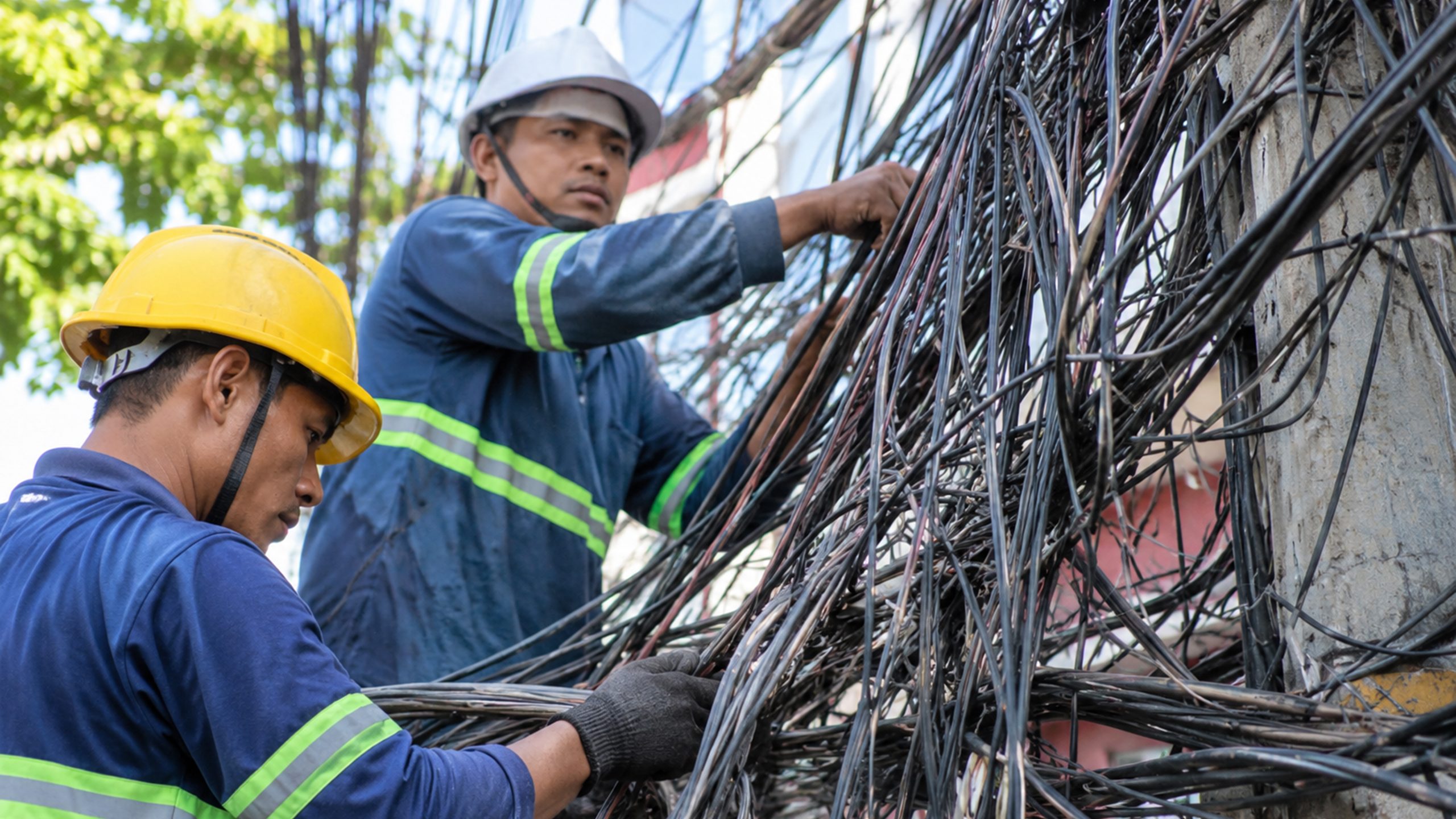
Dangling wires in the Philippines have become a growing public safety concern following several reported accidents involving motorists, pedestrians, and children. The issue has prompted Sen. Raffy Tulfo to seek a Senate investigation into hazardous electrical and telecommunications cables, including tangled and low-hanging utility lines commonly known as “spaghetti wires.”
The Senate is seeking an investigation into dangerous dangling and tangled utility wires across the Philippines following several reported incidents involving motorists, pedestrians, and children.
Sen. Raffy Tulfo filed Senate Resolution No. 776 on November 11, 2026, seeking a Senate inquiry into accidents and public safety hazards linked to poorly maintained electrical and telecommunications wires.
The proposed investigation aims to examine the risks posed by overhead cables commonly referred to as “spaghetti wires,” determine the responsibilities of companies operating these installations, and identify measures to prevent further accidents.
The issue has drawn renewed attention after several reported incidents highlighted the dangers of exposed, low-hanging, and improperly maintained utility lines in public areas.
Reported Accidents Highlight the Dangers of Dangling Wires
Several incidents involving utility wires have raised concerns about the safety of pedestrians and motorists.
One reported case involved a Grade 3 student who was electrocuted on April 28. The child reportedly suffered injuries so severe that both hands had to be amputated.
Another incident occurred on January 21, 2026, in Alegria, Cebu, where a 33-year-old French national was reportedly injured after his motorcycle became entangled in a low-hanging telecommunications cable. The wire allegedly wrapped around his neck.
In another case, a 12-year-old boy died on January 4, 2026, in Barangay Magdalo, Imus, Cavite, after reportedly being electrocuted upon contact with a streetlight post carrying an electrical current.
These incidents demonstrate that poorly maintained utility installations can pose serious risks even when they are not directly connected to a person’s home or workplace.
Why ‘Spaghetti Wires’ Are a Public Safety Concern
The term “spaghetti wires” commonly describes the tangled mass of overhead cables attached to utility poles in many Philippine communities.
These installations may include electrical distribution lines, telecommunications cables, internet connections, and cable television wires.
While some cables are active and necessary for providing essential services, others may be abandoned, improperly installed, or left hanging dangerously close to roads and pedestrian areas.
Low-hanging cables can become entangled with motorcycles, bicycles, trucks, and other vehicles. Damaged or exposed electrical wires can also create electrocution and fire hazards.
The risks become particularly concerning in densely populated communities where utility poles and overhead installations are located near sidewalks, residential properties, schools, and busy roads.
It is also important to distinguish between telecommunications cables and electrical distribution lines. Not all tangled wires carry electricity, but improperly maintained cables can still cause serious accidents.
Previous Anti-Dangling Wires Bill Raises Questions
The latest Senate resolution comes after previous legislative efforts to address the same problem.
In August 2025, Tulfo filed Senate Bill No. 1226, known as the proposed Anti-Dangling Wires Act.
The measure seeks to establish stronger requirements for the proper installation, inspection, and maintenance of overhead utility lines.
It also aims to address the responsibilities of companies operating electrical and telecommunications infrastructure, including the removal or correction of hazardous installations.
However, the Senate legislative record listed the measure as pending in committee as of September 15, 2025.
The renewed call for an investigation raises questions about the implementation of existing safety requirements and whether additional legislation or enforcement measures are necessary to address the persistent problem.
Utility Companies and Local Authorities Face Accountability Questions
The Senate inquiry could examine the respective responsibilities of electric distribution companies, telecommunications providers, cable operators, and government agencies.
Companies operating overhead utility lines are expected to maintain their installations and ensure that their equipment does not create unreasonable risks to the public.
Local government units also have responsibilities involving public safety and local infrastructure management, while relevant national agencies exercise regulatory and oversight functions within their respective mandates.
The investigation could help determine whether existing inspection procedures, coordination mechanisms, and reporting systems are sufficient to identify and address hazardous wires.
It could also examine how abandoned cables are identified and removed, particularly in areas where several service providers share utility poles and overhead infrastructure.
Establishing accountability will be important in preventing companies and responsible parties from passing responsibility to one another when dangerous installations are reported.
Stronger Enforcement Needed to Protect the Public
The problem of dangling utility wires requires more than occasional cleanup operations.
A more coordinated approach involving utility companies, telecommunications providers, local governments, and relevant regulatory agencies may be necessary to address the risks.
Regular inspections, clear reporting procedures, timely removal of abandoned cables, and stricter compliance with safety standards could help reduce accidents.
The proposed Senate investigation may also provide an opportunity to assess whether existing laws and regulations adequately protect communities from hazardous utility installations.
For residents, reporting visibly damaged, exposed, or dangerously low-hanging wires to the appropriate utility provider or local authorities can help bring attention to potential hazards. People should avoid touching or attempting to move suspicious cables, as some may carry dangerous electrical currents.
As the Senate seeks to examine the issue, the central question remains whether stronger enforcement and clearer accountability can finally address the growing concerns surrounding tangled and poorly maintained utility wires in Philippine communities.

 Facebook
 Twitter