
MANILA, Philippines — The Philippines Australia defense pact marks a significant step in strengthening military ties between Manila and Canberra, with both countries seeking closer coordination, improved maritime security and expanded defense cooperation amid growing tensions in the Indo-Pacific region.
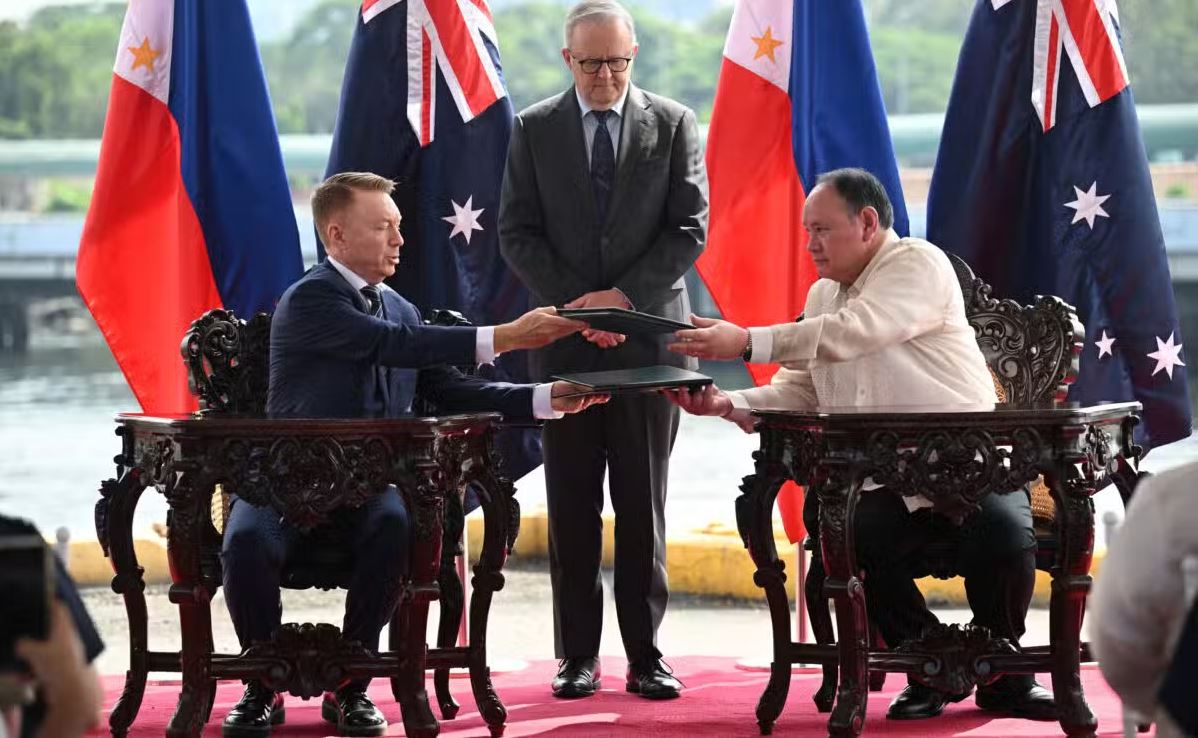
The agreement, formally known as the Philippines-Australia Defense Cooperation Arrangement (DCA), was signed in Manila on Sunday, November 15, with Australian Prime Minister Anthony Albanese witnessing the ceremony ahead of the 49th Association of Southeast Asian Nations (ASEAN) Summit.
Philippine Secretary of National Defense Gilberto Teodoro Jr. and Australian Ambassador to the Philippines Marc Innes-Brown signed the arrangement, marking another major step in the two countries’ expanding security partnership.
The agreement is intended to reduce administrative obstacles and make it easier for both countries to organize and conduct joint military activities.
Teodoro described the arrangement as an anti-red-tape measure, explaining that procedures for coordinating defense activities would become significantly simpler.
He said the agreement would streamline the implementation of the bilateral Status of Visiting Forces Agreement (SOVFA), allowing the Philippines and Australia to strengthen cooperation across their maritime, air and land forces.
The arrangement also covers cooperation in humanitarian assistance and disaster response, while supporting the Philippines’ efforts to strengthen its defense and deterrence capabilities.
Defense cooperation expands amid South China Sea tensions
The agreement comes as the Philippines continues to face maritime challenges in the South China Sea, where overlapping territorial and maritime claims have contributed to tensions with China.
Australia has consistently supported the Philippines’ position on the importance of international law, freedom of navigation and peaceful resolution of maritime disputes.
Canberra has also backed the 2016 arbitral tribunal ruling on the South China Sea, which rejected the legal basis for China’s expansive maritime claims. Beijing has rejected the ruling and maintains that its actions in the disputed waters are lawful.
According to reports, the new defense arrangement is expected to improve maritime awareness, information sharing, strategic dialogue, military training and interoperability between the two countries.
Albanese said the agreement would also support defense infrastructure development and strengthen cooperation in detecting maritime and cybersecurity threats.
He announced additional Australian investment in maritime domain awareness, including drone technology, equipment and training to improve the Philippines’ ability to monitor developments in its surrounding waters.
These capabilities are particularly important for the Philippines, an archipelagic country with extensive maritime areas to protect.
Australia has supported Philippine maritime capabilities
The latest agreement builds on existing Australian assistance to the Philippines, particularly in strengthening the capabilities of the Philippine Coast Guard.
Australia has provided more than A$13 million in support to the Philippine Coast Guard since April 2025, according to Australian media reports.
Much of the assistance has involved maritime surveillance drones, equipment and training for drone operators.
These capabilities help Philippine authorities monitor vessel movements, detect potential maritime threats and improve awareness of activities in the country’s waters.
Australia has also supported defense infrastructure development at several Philippine military bases on Luzon, forming part of broader efforts to improve the country’s territorial defense capabilities.
During an August 2026 meeting in Darwin, Australian Deputy Prime Minister and Defense Minister Richard Marles and Teodoro reaffirmed their commitment to expanding bilateral defense cooperation.
The two officials also discussed infrastructure projects, intelligence sharing, surveillance capabilities and participation in military exercises, including Balikatan, Pitch Black and Carabaroo.
Both governments emphasized that the Philippines would retain full sovereignty over its military sites.
Philippines strengthens defense ties with Australia, Japan and the United States
The signing also comes amid broader security cooperation involving the Philippines, Australia, Japan and the United States.
On October 28, defense leaders from the four countries met in Cebu on the sidelines of the ASEAN Defence Ministers’ Meeting-Plus.
The officials committed to establishing a Combined Coordination Center (CCC) in the Philippines to improve information sharing, maritime domain awareness and coordination among participating defense forces.
They also agreed to coordinate defense investments supporting the Philippines’ ability to defend its archipelago, strengthen consultations and expand the scope, complexity and frequency of joint military exercises.
The initiative reflects growing cooperation among countries seeking to strengthen regional security and maintain stability in the Indo-Pacific.
However, the four-country coordination initiative and the Philippines-Australia bilateral defense arrangement are separate developments, although both contribute to the country’s broader defense partnerships.
What the agreement means for the Philippines
The new arrangement provides an updated framework for defense cooperation between Manila and Canberra as both countries respond to evolving regional security challenges.
For the Philippines, stronger cooperation could improve military training, maritime surveillance, information sharing and the ability of its armed forces to coordinate with international partners.
It could also support efforts to protect critical maritime infrastructure, strengthen the Philippine Coast Guard and improve responses to humanitarian emergencies and natural disasters.
The agreement does not transfer ownership of Philippine military facilities to Australia or create an automatic mutual-defense obligation between the two countries. Instead, it strengthens existing defense arrangements and provides a more efficient framework for practical military cooperation.
The signing also coincides with the 80th anniversary of diplomatic relations between the Philippines and Australia, established in 1946.
As both countries continue expanding their strategic partnership, the agreement highlights the growing importance of defense cooperation in protecting maritime interests and promoting stability across the Indo-Pacific region.

 Facebook
 Twitter