
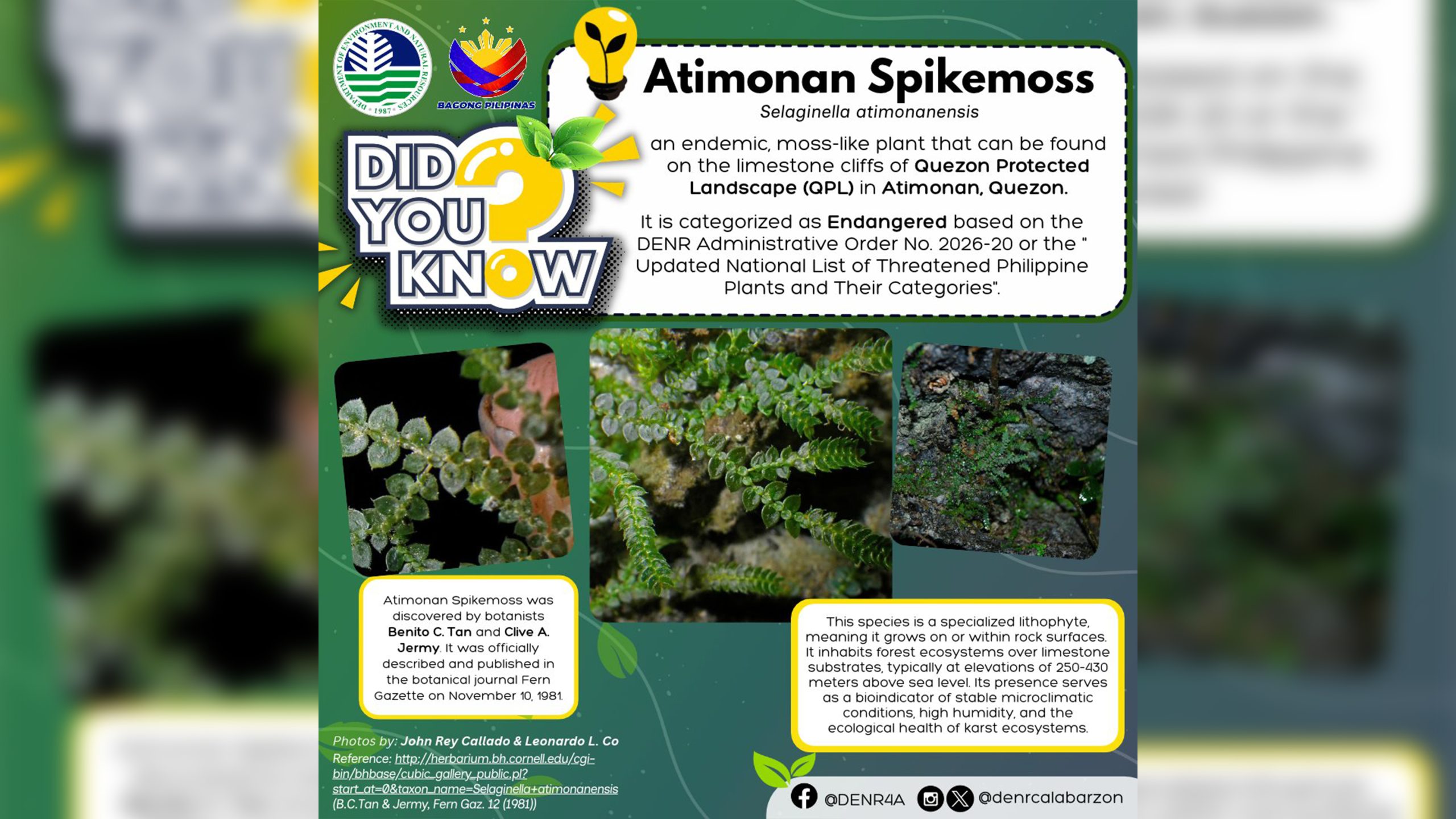
Atimonan Spikemoss, an endangered plant found naturally in Quezon province, is receiving renewed attention as the Department of Environment and Natural Resources (DENR) urges the public to help protect its remaining natural habitat. The rare Philippine species grows in the Quezon Protected Landscape, where preserving its limestone environment is important to maintaining the country’s unique plant biodiversity.
Scientifically known as Selaginella atimonanensis, the plant is endemic to the Philippines, meaning it is naturally found nowhere else in the world. Its restricted distribution makes the preservation of its natural habitat particularly important to biodiversity conservation.
In a November 16, 2026, report by the Philippine Daily Inquirer, the DENR emphasized the importance of protecting the species, which grows in the limestone environment of the Quezon Protected Landscape in Quezon province.
Atimonan Spikemoss classified as endangered
The Atimonan Spikemoss is included in the DENR’s updated national list of threatened Philippine plants under Administrative Order No. 2026-20, issued on March 16, 2026.
The updated list classifies Selaginella atimonanensis as Endangered (EN), highlighting the need to protect the species and its natural environment.
Its classification underscores the importance of conservation efforts for native plants with limited geographic distributions, particularly those vulnerable to changes in their habitats.
Despite its name and moss-like appearance, spikemoss is not a true moss. It belongs to the lycophytes, an ancient group of vascular plants related to ferns.
A rare plant growing on limestone cliffs
The species has a documented scientific history dating back to 1981, when it was formally described in botanical literature.
Its original collection locality was identified as Atimonan National Park in Quezon, specifically a limestone cliff along a trail leading toward the summit.
The plant has also been documented in the Pinagbanderahan area of the Quezon Protected Landscape.
A scientific study published in 2016 examining plant biodiversity in the northeastern portion of the protected landscape provided additional information about its habitat and conservation concerns.
Researchers observed that the Atimonan Spikemoss can dry out easily during summer and does not tolerate high light intensity.
These characteristics indicate that the plant may be particularly sensitive to environmental changes, making the protection of its natural growing conditions essential.
The researchers also recommended local conservation measures to address concerns about declining populations and genetic diversity.
Protecting the Quezon Protected Landscape
The Quezon Protected Landscape covers portions of Atimonan, Pagbilao and Padre Burgos in Quezon province.
It was established through Presidential Proclamation No. 394 on June 2, 2003, to protect an important natural area and its biodiversity.
The landscape provides habitat for various native plants and other wildlife, making its continued protection important for environmental conservation in the province.
Previous biodiversity research in the area identified several activities that could affect sensitive plant habitats, including land conversion, plant collection, ecotourism activities and water impoundment.
For the Atimonan Spikemoss, protecting individual plants is only part of the conservation effort. Preserving the surrounding limestone environment and maintaining suitable moisture and light conditions are also important.
How the public can help protect the species
The DENR’s appeal highlights the importance of public participation in protecting the country’s endangered plants.
Residents and visitors exploring protected areas can help by avoiding the collection or removal of wild plants, staying on designated trails and following environmental protection regulations.
Reporting activities that may damage protected habitats to environmental authorities can also support conservation efforts.
The protection of the Atimonan Spikemoss represents a broader responsibility to preserve the Philippines’ natural heritage, particularly species that exist only within the country.
As conservation efforts continue, protecting the habitats of rare and endangered plants remains essential to maintaining biodiversity and ensuring that future generations can appreciate the country’s unique natural resources.

 Facebook
 Twitter