
Words by Henrylito D. Tacio
Photos by Rhoy T. Cobilla
For nearly a decade, 35-year-old Serapion of Bansalan, Davao del Sur has devoted much of his time and energy to growing corn. Like countless farmers across the Philippines, he has learned that producing a successful harvest requires more than planting seeds and waiting for the rains. It means constantly battling pests and diseases that threaten to destroy months of hard work.
One of the most troublesome problems he has encountered in recent years is the common stalk borer, an insect pest capable of causing serious damage to corn crops. Young corn plants, ranging from two to 24 inches tall, are especially vulnerable to attack.
The damage is easy to recognize. Affected corn plants show ragged, irregular holes on newly unrolled leaves. In severe cases, the upper leaves wilt and die. According to agricultural experts, the most distinctive symptom is the so-called “dead heart,” which occurs when the insect bores into the stalk near the soil surface and tunnels upward through the plant.
Sometimes the pest enters through the top of the corn plant, tunneling downward into the whorl. Farmers often find sawdust-like waste material around the entry holes or inside the whorl, unmistakable evidence of the insect’s destructive activity.
For many years, Serapion relied on commercial chemical pesticides to combat insect infestations. Like many farmers, he believed that chemicals were the quickest and most effective solution. But a training program would soon change his perspective.
Discovering a Natural Alternative
Everything changed after he attended a two-day organic agriculture training conducted by the Mindanao Baptist Rural Life Center (MBRLC) in Kinuskusan, Bansalan, Davao del Sur. The training introduced him to a range of low-cost, environmentally friendly farming techniques. Among the most practical lessons was the use of tobacco spray as a natural pesticide.
“One of the best ways to eradicate the insects is by using tobacco spray,” Serapion said.
The preparation was surprisingly simple. He boiled 250 grams of dried tobacco leaves and stems in four liters of water for about 20 minutes. After allowing the mixture to cool, he filtered it through layers of cotton cloth. He then added another four liters of water and mixed in 50 grams of bar soap.
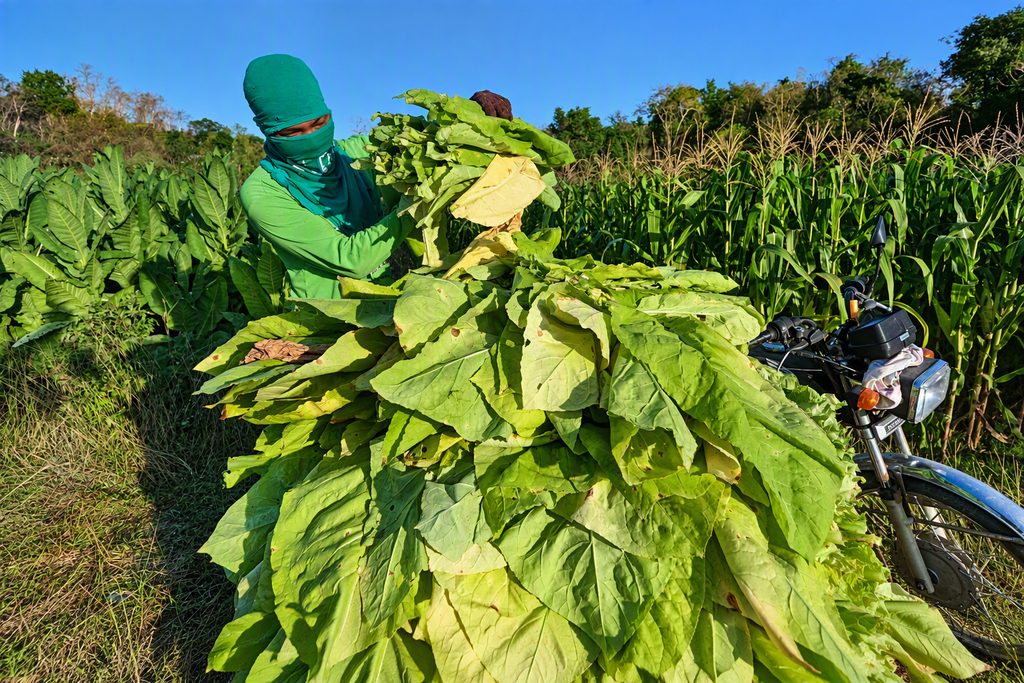
A farmer segregates the newly-harvested tobacco leaves.

The resulting solution was poured into the funnels or whorls of corn plants where stalk borers were hiding. The treatment proved effective in controlling the pest population. For Serapion, the technique offered several advantages. The ingredients were readily available, the cost was minimal, and there was less dependence on expensive chemical pesticides.
More Than Just a Corn Pest Remedy
According to MBRLC technicians, tobacco spray has a wider range of applications than many farmers realize.
The solution can be applied as a soil drench around plants to kill cutworms. It may also be sprayed on beans to help prevent rust disease. Farmers have found it useful in controlling aphids, beetles, cabbage worms, caterpillars, grain weevils, leaf miners, mites, stem borers, and thrips.
Technicians explain that tobacco extracts are particularly effective against insects that bite or suck plant tissues. In livestock production, tobacco solutions applied weekly with a brush have reportedly helped control ticks and fleas in cattle.
Such versatility makes tobacco one of the most useful botanical pesticides available to resource-poor farmers seeking alternatives to synthetic chemicals.
ECHO’s Version of Tobacco Spray
The Educational Concerns for Hunger Organization (ECHO), a Florida-based nonprofit that promotes sustainable agriculture worldwide, has developed its own version of tobacco spray.
Its method calls for soaking one kilogram of crushed or bruised tobacco stalks and leaves in 15 liters of water for 24 hours. The mixture is then filtered, and three to five tablespoons of liquid soap are added before application. The spray should be used immediately after preparation.
ECHO advises farmers to apply tobacco sprays during the evening hours. This allows the solution to remain active throughout the night and reduces rapid evaporation during daytime heat.
However, the organization also issues an important warning. Tobacco sprays should not be applied to potatoes, tomatoes, peppers, eggplants, or other members of the Solanaceae family because of the risk of spreading plant viruses.
Safety precautions are equally important. People and animals should never drink the solution. Farmers should wear protective clothing, especially masks, while spraying. Vegetables treated with tobacco spray should not be consumed within four days after application and must be washed thoroughly before eating.
Ancient Practice, Modern Science
The use of tobacco as a pesticide is far from a new idea. For centuries, gardeners around the world have relied on homemade tobacco-and-water mixtures to control damaging insects. Long before synthetic pesticides became widely available, tobacco was valued for its insecticidal properties.
Modern researchers are now finding scientific evidence to support what traditional farmers have known for generations.
A farmer segregates the newly-harvested tobacco leaves.
Scientists have explored the possibility of developing a “green” pesticide industry based on tobacco. Such an industry could provide tobacco growers with new income opportunities while supplying farmers with environmentally friendly pest-control products.
One promising approach involves pyrolysis, a process that heats tobacco leaves to approximately 900 degrees Fahrenheit in a vacuum. This treatment produces a substance known as bio-oil.
Researchers tested tobacco bio-oil against a variety of agricultural threats, including insect pests, fungi, and bacteria. The results were encouraging. The bio-oil successfully killed Colorado potato beetles and inhibited the growth of certain bacteria and fungi.
Perhaps most surprising was the discovery that even after nicotine was removed, the bio-oil remained highly effective as a pesticide. This suggests that compounds other than nicotine contribute significantly to tobacco’s pest-fighting ability.
A Weapon Against Fishpond Pests
In the Philippines, tobacco has demonstrated usefulness beyond crop production. The National Tobacco Administration (NTA) has promoted the use of tobacco dust as a means of controlling nuisance snails in fishponds and fish cages. These snails compete with fish for food and contribute to production losses.
The effectiveness of tobacco dust was demonstrated through studies conducted by researchers from the Southeast Asian Fisheries Development Center in Tigbauan, Iloilo. Field tests carried out in Bulacan, Pampanga, Bataan, Pangasinan, and Ilocos Sur confirmed the results.
The studies revealed that proper application of tobacco dust significantly reduced fingerling mortality. Fish losses reportedly dropped from around 20 percent to only 5 percent. Such improvements translated into savings of approximately P20,000 per hectare during a grow-out cycle.
The NTA describes tobacco dust as organic, biodegradable, and environmentally friendly. Because it leaves no harmful pesticide residues, it contributes to both consumer safety and the export potential of fish products.
This is especially significant because fish exports such as milkfish and tilapia have previously faced restrictions in foreign markets due to concerns over pesticide contamination.
The Paradox of Tobacco
Tobacco occupies a unique and often controversial place in human history. When consumed through smoking, it has been linked to numerous diseases and remains one of the leading causes of preventable deaths worldwide. Yet the plant itself possesses properties that have found beneficial applications in agriculture, science, and even medicine.
History records that tobacco was already valued by indigenous peoples long before the arrival of Europeans in the Americas. Explorer Christopher Columbus observed people carrying dried tobacco leaves because they were regarded as beneficial to health. Members of his crew also witnessed the use of burning tobacco for purposes believed to include disinfection and relief from fatigue.
Modern science has identified thousands of chemical compounds in tobacco leaves and tobacco smoke. Nicotine, one of the most studied among them, has attracted considerable interest among researchers investigating the human nervous system.
Studies have shown that nicotine affects neurotransmitter activity and interacts with receptors in the brain. Researchers have explored its potential role in understanding cognitive functions and certain neurological disorders.
While these medical investigations continue under strict scientific supervision, they highlight an important reality: plants often possess multiple characteristics, some harmful and others beneficial, depending on how they are used.
A Lesson in Sustainable Farming
For farmers like Serapion, tobacco’s value lies not in cigarettes but in its ability to protect crops naturally and affordably.
His experience reflects a growing movement toward sustainable agriculture, where farmers seek practical alternatives to costly chemical inputs. Botanical pesticides prepared from locally available materials offer one pathway toward reducing production costs while protecting environmental health.
Tobacco may never shake its controversial reputation. For decades, it has been associated with disease, addiction, and public health concerns. Yet in the hands of innovative farmers and researchers, the same plant is proving capable of making a positive contribution.
As Serapion discovered in his cornfield, sometimes solutions to modern agricultural problems can be found in age-old practices. The humble tobacco leaf, better known for filling cigarettes, may also help farmers safeguard their harvests, reduce dependence on synthetic chemicals, and move one step closer to more sustainable farming systems.
In agriculture, perhaps tobacco’s most promising future is not in smoke, but in the field.

 Facebook
 Twitter